Speed Limits in Europe: Every Country Compared
One afternoon’s drive can take you from an unlimited autobahn to a 130 km/h alpine motorway and a 100 km/h daytime zone. Every European country’s speed limits in one table, in km/h and mph.
 Ramis Kalkan
Updated: 13 min read
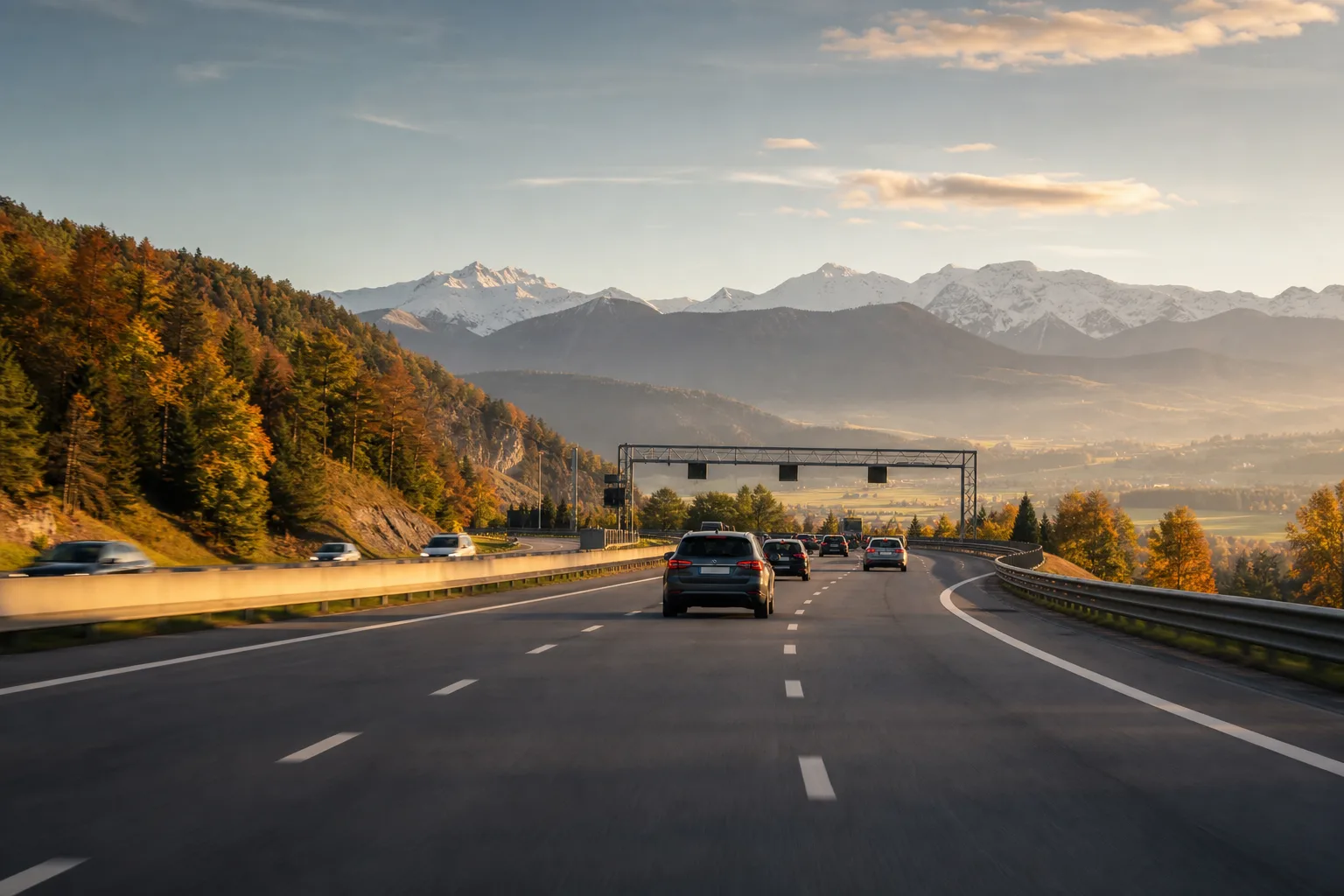
Most European countries set their motorway speed limit at 120 or 130 km/h, open roads at 80 to 100 km/h, and towns at 50 km/h. The exceptions are what catch drivers out. Poland and Bulgaria allow 140 km/h, much of the German autobahn has no fixed limit at all, and the Netherlands caps its motorways at 100 km/h during the day.
Here’s why that matters. On a single afternoon you can leave an unrestricted autobahn near Munich, meet a hard 130 km/h limit at the Austrian border, and drop to 120 km/h as you enter Switzerland. Nothing about the road changes. The law does, at every border, and cameras enforce the new number from the first kilometre.
This guide puts the speed limits in Europe into one table, in km/h and mph, covering every country drivers regularly cross. It then covers the rules that shift with weather and time of day, the limits for caravans and trucks, how enforcement works, and what happens when a fine chases you home. Every figure is tied to an official national or EU source.
Key Takeaways
- Most of Europe runs 120-130 km/h on motorways, 80-100 km/h on open roads, and 50 km/h in towns.
- The highest posted limits in Europe are 140 km/h, on Polish and Bulgarian motorways and a handful of private Turkish routes.
- Germany’s autobahn has no general limit on many stretches, only a 130 km/h advisory, and it is the only road network in Europe like that.
- Limits move with conditions: France and Italy cut motorway limits in rain, and the Netherlands caps daytime motorway speed at 100 km/h.
- EU countries exchange number-plate data under Directive 2015/413, so a speeding fine from abroad can reach your home address.
Speed Limits in Europe by Country
The table below shows the default limits for a standard passenger car. Signs always override these defaults. Several countries also move them with weather, season, or time of day – the notes in each cell flag those. Each country name links to our full guide for that country.
| Country | Motorway (km/h) | Open road (km/h) | Towns (km/h) |
|---|---|---|---|
| Austria | 130 (100 in IG-L zones) | 100 | 50 |
| Belgium | 120 | 70 Flanders, 90 Wallonia | 50 (30 in Brussels) |
| Bulgaria | 140 | 90 | 50 |
| Croatia | 130 (110 expressways) | 90 | 50 |
| Czech Republic | 130 (110 expressways) | 90 | 50 |
| Estonia | no motorways (up to 110 signed in summer) | 90 | 50 |
| France | 130 (110 in rain) | 80 (90 where restored) | 50 |
| Germany | no general limit, 130 advisory | 100 | 50 |
| Greece | 130 (110 expressways) | 90 | 50 |
| Hungary | 130 (110 expressways) | 90 | 50 |
| Iceland | no motorways | 90 paved, 80 gravel | 50 |
| Ireland | 120 | 100 national, 80 secondary | 50 (30 in centres) |
| Italy | 130 (110 in rain) | 90 | 50 |
| Moldova | no motorways (110 expressways) | 90 | 50 |
| Netherlands | 100 by day, up to 130 at night | 80 | 50 |
| Poland | 140 | 90 (120 expressways) | 50 |
| Portugal | 120 | 90 | 50 |
| Romania | 130 | 90 (100 on E-routes) | 50 |
| Slovakia | 130 (expressways too) | 90 | 50 |
| Slovenia | 130 (110 expressways) | 90 | 50 |
| Spain | 120 | 90 | 50 (30 on single-lane streets) |
| Switzerland | 120 | 80 | 50 |
| Turkey | 130 (140 on private routes) | 90 (110 on divided roads) | 50 |
Quick conversions for mph thinkers: 50 km/h is 31 mph, 80 is 50, 90 is 56, 100 is 62, 110 is 68, 120 is 75, 130 is 81, and 140 is 87 mph.
Three rows need a word of explanation. Belgium sets its open-road default by region, so the limit changes from 70 to 90 km/h when you cross from Flanders into Wallonia mid-drive. Estonia, Iceland, and Moldova have no motorways in the legal sense, so their fastest roads run at 90 to 110 km/h. And Ireland signs everything in km/h but drives on the left, which surprises more visitors than the numbers do.
More European countries at a glance
The countries below round out the map for northern European routes. The same defaults-plus-signs logic applies.
| Country | Motorway (km/h) | Open road (km/h) | Towns (km/h) |
|---|---|---|---|
| United Kingdom | 70 mph (113 km/h) | 60 mph single, 70 dual | 30 mph (20 in Wales) |
| Denmark | 130 | 80 | 50 |
| Sweden | 110 (120 where signed) | 70 base, signed up to 100 | 50 |
| Norway | 110 top band | 80 | 50 |
| Finland | 120 summer, 100 winter | 80 | 50 |
| Luxembourg | 130 (110 in rain) | 90 | 50 |
| Latvia | 120 where signed (110 in winter) | 90 | 50 |
| Lithuania | 130 summer, 110 winter | 90 (70 gravel) | 50 |
The UK is the outlier twice over: it signs in mph and drives on the left. Its national speed limit, the default where no lower number is posted, is 60 mph on single carriageways and 70 on motorways. Sweden works in signed bands rather than one national motorway number, so treat the signs as the law. Lithuania also caps novice drivers, licensed under two years, at 90 km/h on motorways and 70 elsewhere.
The Autobahn Myth: Where Europe Really Has No Speed Limit
Germany is the only country in Europe, and one of the very few on earth, where long stretches of motorway carry no general speed limit. On an open autobahn section you can legally drive as fast as conditions safely allow. The law adds a recommended 130 km/h, the Richtgeschwindigkeit (advisory speed), and driving above it isn’t an offence by itself.
The freedom is narrower than the reputation. Roadworks, interchanges, urban sections, and variable overhead gantries put binding limits on a large share of the network, and cameras enforce every one of them. Our Germany guide, linked in the table above, covers the sign system in detail.
Can you drive 200 mph on the autobahn?
On a genuinely unrestricted stretch, yes, no posted number stops you. Two things still apply. German law requires your speed to match conditions, so 320 km/h in traffic can be charged as dangerous driving even with no limit posted. And if you crash above the 130 km/h advisory, German courts can cut the compensation you receive, because the extra speed counts as added risk you chose to carry.
Nowhere else comes close
No other European country has unrestricted public roads. The next tier down is the 140 km/h club: Polish autostradas, Bulgarian motorways, and a few privately operated Turkish motorways and bridges. The Czech Republic has been trialling a variable 150 km/h section on the D3 near České Budějovice since late 2025, active only in dry, clear conditions, but the national default remains 130.
Where the Limits Drop: Rules That Catch Drivers Out
The table above is only the default layer. Several countries move their limits with weather, time, or air quality, and these are the rules that generate fines for drivers who learned one number and stopped reading signs.
Rain changes the number in France and Italy
France cuts its motorway limit from 130 to 110 km/h the moment rain falls, and dual carriageways drop from 110 to 100. Novice drivers keep the lower set permanently for three years. Italy applies the same logic, 130 down to 110 on autostradas in any precipitation, and its Tutor average-speed cameras enforce the wet-weather number, not the dry one.
The Netherlands runs on a clock
Dutch motorways are capped at 100 km/h between 06:00 and 19:00, a nitrogen-emissions measure in force since 2020. At night many sections return to 120 or 130 where signed, and since 2025 a handful of stretches run 130 all day. Drivers rolling off a ferry and setting cruise control to the old 130 are the classic case. That’s 30 km/h over the daytime limit.
Austria’s clean-air 100 zones
Long sections of Austria’s A12 and A13 in Tyrol carry a permanent 100 km/h limit under the IG-L air-quality law. The signs look like any other 100 sign, but the fines are higher than for ordinary speeding, and the zones sit exactly where transit traffic to Italy flows. Fully electric cars are exempt and may keep to 130. The same motorways also require a valid Austrian vignette, so sort both before the border.
Switzerland is 120, and it means it
Switzerland caps motorways at 120 km/h, not the 130 of its neighbours. The statutory measurement tolerance is a few km/h deducted for the device, nothing more, so it isn’t worth gaming. Serious speeding triggers income-based fines, and the criminal Raser tier can mean licence withdrawal, vehicle confiscation, and prison. Reset your cruise control at the border.
Seasonal and recent changes worth knowing
The north of Europe moves with the calendar. Finland cuts its motorways from 120 to 100 km/h for the winter, and Lithuania drops from 130 to 110 between November and March. Latvia trims its fastest signed roads from 120 to 110 between December and March, while Estonia only raises signed limits to 100-110 km/h in summer.
Recent reforms bite too. Ireland cut its rural local-road default to 60 km/h in 2025 and moved town centres to 30. Spain has run 30 km/h on all single-lane urban streets since 2021, and Wales moved built-up areas to 20 mph. If your last European road trip was a few years ago, several numbers you remember are no longer the law.
Speed Limits for Caravans, Motorhomes, and Trucks
Towing or driving anything heavier than a standard car usually means a lower limit than the table above, and the gap varies by country.
Cars with a caravan or trailer
A car towing a caravan or trailer typically loses 20 to 50 km/h off the motorway limit. The sourced examples show how wide the spread is:
- Germany caps any car-plus-trailer at 80 km/h, even on the autobahn.
- Switzerland does the same at 80 km/h on motorways.
- The Netherlands allows a car and caravan up to 3.5 tonnes to run 90 on motorways.
- Austria drops heavier trailer combinations to 80 on motorways.
- Romania takes 10 km/h off every open-road limit when you tow.
- Turkey tiers by road type and tops out at 90 km/h for car-and-caravan on motorways.
Motorhomes over and under 3.5 tonnes
Motorhomes split by weight. Under 3.5 tonnes they generally follow car limits. Over 3.5 tonnes they follow goods-vehicle limits, which in most countries means 80 to 100 km/h on motorways and 70 to 80 on open roads.
Trucks, buses, and HGVs
HGV speed limits (heavy goods vehicles) run on their own national tables, typically 80 to 100 km/h on motorways. Hungary, for one, holds trucks and cars with trailers to 70-80 km/h depending on the road class. If you drive anything over 3.5 tonnes, check the country guide before you route through it.
Speed Cameras and Enforcement Across Europe
European enforcement has quietly shifted from single radar points to average-speed measurement, and that changes how you drive through it.
Average-speed cameras time you between two gantries kilometres apart and fine you on the section average. Slowing for the camera and speeding up after it does nothing. The method is spreading fast:
- Italy: the Tutor system covers much of the autostrada network.
- Hungary: average checks run on the M1, M3, and M7.
- Bulgaria: motorways are fined on section averages.
- The Netherlands: trajectcontrole (section control) pioneered the approach.
- Austria: the same method runs in tunnels and roadworks.
Tolerance margins are the other trap. Drivers often assume a comfortable buffer over the posted number. There isn’t one.
Switzerland writes its deduction into law, and it’s a few km/h, not ten. The Czech Republic applies minimal camera tolerance, and Turkey abolished its 10 percent radar tolerance outright in February 2026.
At the extreme end, several countries now confiscate vehicles. Austria’s 2024 rules allow seizure and auction for the worst offences, even for hire and company cars. Poland suspends licences on the spot for 50 km/h over in town, and the Netherlands seizes licences at similar excess. These aren’t theoretical powers, and they reach foreign drivers too.
Speeding Fines Abroad: They Do Follow You Home
The days of shrugging off a foreign camera flash are over. EU Directive 2015/413 obliges member states to exchange vehicle-keeper data for speeding, so a fine earned in France, Italy, or Hungary is posted to your home address in your own language.
Switzerland sits outside the directive but shares data bilaterally and can stop known offenders at re-entry. Turkey went further in 2026: a foreign-plated car with unpaid fines or toll debt can be blocked at customs on the way out of the country.
The practical read for a cross-border trip is that compliance travels with you. The same motorways that set these limits usually charge for access too, whether as a windscreen sticker, an electronic toll, or a plate-registered charge, and the rules change at every border just like the limits do. Our overview of European vignettes and tolls covers what each country charges and how to arrange it before you leave.
The Short Version
Speed limits in Europe cluster tightly: 120-130 km/h on motorways, 80-100 on open roads, 50 in towns. Learn that baseline and the exceptions become manageable. Poland and Bulgaria run 140, and Germany’s autobahn is partly unrestricted with a 130 advisory. France and Italy drop their limits in rain, the Netherlands caps daytime motorway speed at 100, and Switzerland holds firm at 120 with near-zero tolerance.
Check the row for every country on your route before you set off, and remember that enforcement crosses borders with you under EU data-sharing rules. Each country name in the table links to our full guide, with the fines, alcohol limits, and local quirks that didn’t fit here. There are more in our driving guides. Sort your vignettes and tolls for the same route in advance, and the only thing left to manage on the road is the number on the sign.
Frequently Asked Questions
Which country in Europe has the highest speed limit? Poland and Bulgaria share the highest posted limit at 140 km/h on motorways. A few privately operated Turkish motorways and bridges also allow 140. Germany’s unrestricted autobahn stretches have no posted ceiling at all, which is different from a high limit: where a number applies in Germany, it’s usually 130 or lower.
Are there any roads in Europe with no speed limit? Yes, but only in Germany. Many autobahn stretches have no general speed limit, only a 130 km/h advisory. No other European country has unrestricted public roads, and even in Germany a large share of the network carries binding signed or variable limits.
What are European speed limits in mph? Typical European motorway limits are 75 to 81 mph (120 to 130 km/h), with Poland and Bulgaria at 87 mph (140 km/h). Open roads run 50 to 62 mph (80 to 100 km/h) and towns 31 mph (50 km/h). Only the UK and Ireland think in miles on the road, and Ireland actually signs in km/h.
How fast can you drive through Europe? As fast as each country you cross allows, and the number changes at every border. A Munich to Milan run alone moves from unrestricted autobahn to Austria’s 130, then 100 in the Tyrol IG-L zones, then Italy’s 130. Set your cruise control per country, not per trip.
Do speed limits change when towing a caravan or trailer? Yes, in almost every country. Germany and Switzerland cap car-plus-trailer at 80 km/h on motorways, the Netherlands allows 90, and Romania cuts 10 km/h off open-road limits when towing. Check the towing rules for each country on your route, because the reductions differ.
Can a speeding fine from another European country reach me at home? Yes. EU Directive 2015/413 makes member states exchange number-plate and keeper data for speeding offences, so the fine arrives by post in your language. Switzerland shares data through bilateral agreements, and Turkey can hold a foreign-plated car at the border until fines are paid.
Sources
- Austria: oesterreich.gv.at speed limits
- Austria: Tyrol IG-L 100 km/h zones
- Austria: extreme-speeding vehicle confiscation (BMI)
- Belgium: Your Europe road rules
- Bulgaria: Your Europe road rules
- Bulgaria: parliament confirms 140 km/h and average-speed control (BTA)
- Croatia: Road Traffic Safety Act (Narodne novine)
- Czech Republic: Your Europe road rules
- Estonia: Your Europe road rules
- France: Sécurité Routière speed regulation
- Germany: StVO Section 3
- Germany: autobahn advisory-speed ordinance
- Greece: Your Europe road rules
- Hungary: Your Europe road rules
- Iceland: Safetravel driving rules
- Ireland: Citizens Information speed limits
- Ireland: rural local road limit change (gov.ie)
- Italy: Polizia di Stato speed limits
- Moldova: road traffic regulation (legis.md)
- Netherlands: Rijksoverheid motorway speed limits
- Netherlands: RVV 1990 statute
- Netherlands: speed enforcement thresholds (OM)
- Poland: Your Europe road rules
- Portugal: Your Europe road rules
- Romania: Your Europe road rules
- Slovakia: Act 8/2009 (Slov-Lex)
- Slovenia: Slovenian Police
- Spain: Your Europe road rules
- Switzerland: ch.ch speed limits
- Turkey: KGM speed limits
- Turkey: Law No. 7574 traffic-fine reform (Resmî Gazete)
- Czech Republic: D3 150 km/h trial (ŘSD)
- United Kingdom: gov.uk speed limits
- Denmark: borger.dk speed limits
- Sweden: Trafikförordning 1998:1276
- Sweden: Trafikverket speed limit bands
- Norway: Vegtrafikkloven Section 6
- Norway: Statens vegvesen speed limit criteria
- Finland: Väylävirasto winter speed limits
- Luxembourg: Your Europe road rules
- Latvia: Road Traffic Regulations (likumi.lv)
- Lithuania: Road Traffic Rules (e-seimas)
- EU: Directive (EU) 2015/413 on cross-border exchange of information
Ramis Kalkan
Ramis Kalkan leads growth at Vignetim. He writes about everything that makes European road trips smoother, from digital vignettes to eSIMs. Based in Ankara, usually mid-way through planning his next drive.