Speed Limits in Slovenia and the Vinjeta You Also Need
You join the Karawanken motorway at 130 km/h, and twenty minutes later the limit drops to 50 at a village. Here’s how Slovenia’s speed limits actually work for foreign drivers, the 2026 fines, and the vinjeta that applies to the same roads.
 Ramis Kalkan
Updated: 7 min read
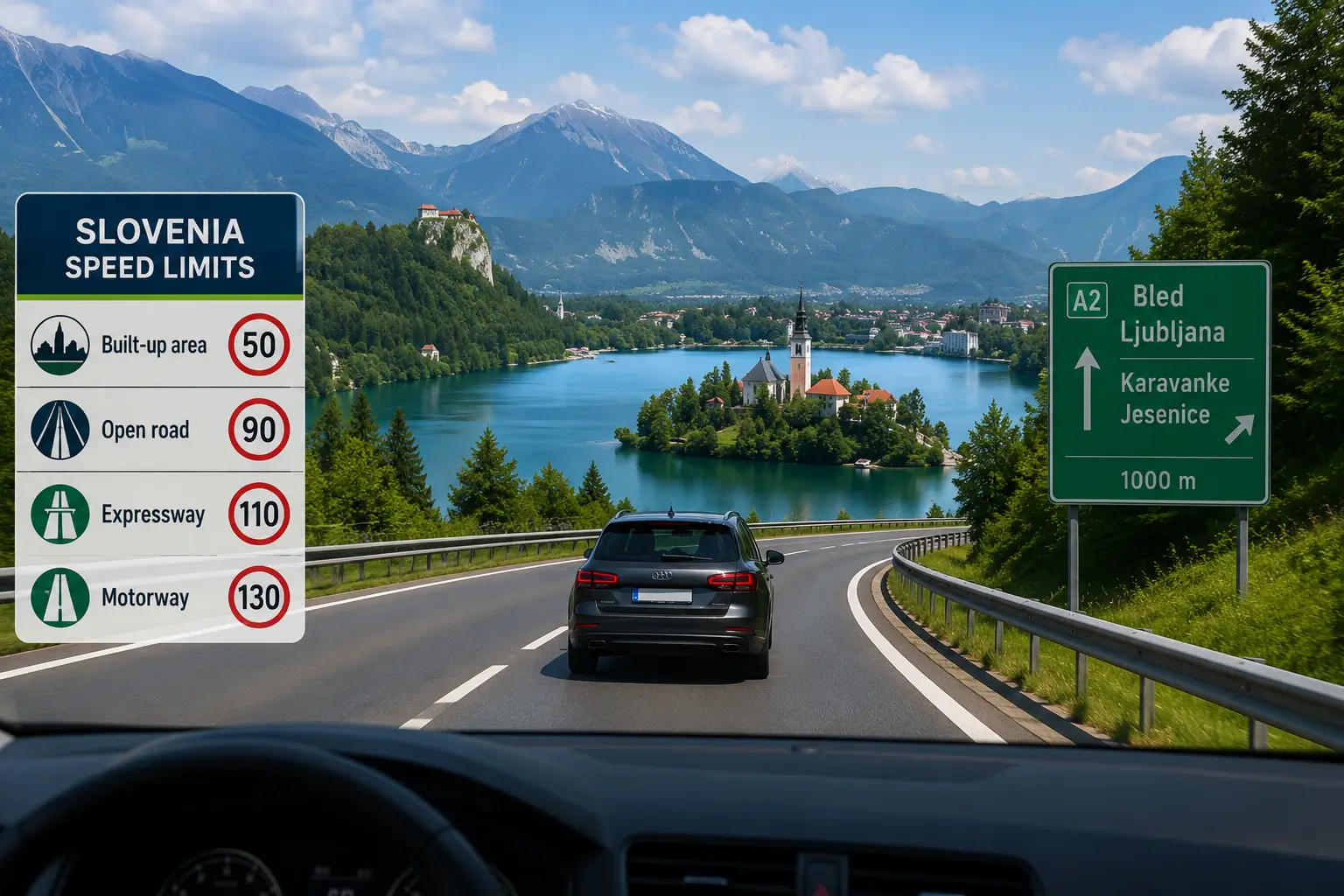
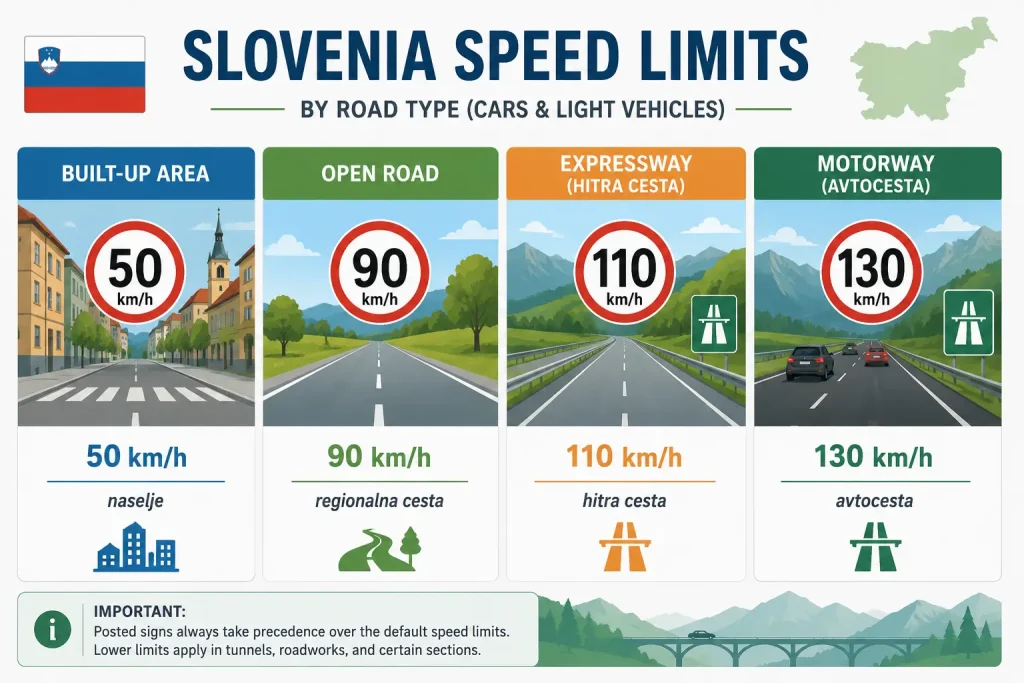
Slovenia’s speed limits for cars are 50 km/h in built-up areas, 90 km/h on open roads, 110 km/h on expressways (hitra cesta), and 130 km/h on motorways (avtocesta). You also need a vinjeta (Slovenia’s motorway sticker) to use those motorways and expressways, and Slovenian police enforce both rules with cameras, mobile patrols, and EU cross-border follow-up after you’ve gone home.
If you’re driving through Slovenia on the way to Croatia, looping up to Lake Bled, or working your way along the Alpine corridor from Austria, this is the short version of what foreign drivers actually need. We’ve laid out the limits by road type, the speeding fines you can expect, how enforcement works for foreign plates, and the vinjeta requirement that applies to the same roads as the speed limits above. Every figure here is sourced to an official Slovenian or government page, with the link in the source list at the end.
Key Takeaways
- Speed limits for cars are 50 km/h (urban), 90 km/h (open road), 110 km/h (expressway), and 130 km/h (motorway).
- You need a vinjeta on motorways and expressways. The fine for not having one is €300.
- Winter equipment is mandatory 15 November to 15 March, plus any time conditions turn wintry.
- EU cross-border enforcement applies. A Slovenian fine can reach a UK or EU driver at home weeks after the trip.
Slovenia’s Speed Limits by Road Type
Slovenia uses four standard road-type limits for cars and light vehicles. Posted signs always win, so a 100 km/h sign on a stretch of motorway, or a 30 km/h sign at a village, overrides the default.
| Road Type | Local Term | Speed Limit | Mph (approx) |
|---|---|---|---|
| Built-up area | naselje | 50 km/h | 31 mph |
| Open road | regionalna cesta | 90 km/h | 56 mph |
| Expressway | hitra cesta | 110 km/h | 68 mph |
| Motorway | avtocesta | 130 km/h | 81 mph |
A few things foreign drivers tend to miss. The Ljubljana ring drops to 100 km/h in sections. Limits also fall sharply around the Karawanken tunnel approach, the Postojna corridor, and most toll-plaza approaches even though Slovenia uses a vinjeta system rather than barrier tolls. Roadworks limits are enforced strictly and they change often during summer.
If you’re towing a caravan or driving a vehicle over 3,500 kg, lower limits apply. Drivers in those categories should confirm the current figures with Slovenian Police before travel.
Speeding Fines in Slovenia
Slovenian speeding fines climb steeply once you go more than 20 km/h over the limit, and the figures get higher in built-up areas than on the motorway for the same excess speed.
| Speed Over Limit | Typical Fine | Penalty Points |
|---|---|---|
| Up to 10 km/h | €50 to €120 | 0 |
| 11 to 20 km/h | €120 to €300 | 3 |
| Over 20 km/h | €300 to €1,200 | 5, plus possible licence suspension |
Indicative ranges compiled from public reseller summaries. Brackets vary by road type and circumstance. Verify the exact figure for your case with AVP or Slovenian Police before paying.
There’s an 8-day early-payment discount of 50% on most fines, which is worth knowing if a notice reaches you after your trip. Enforcement runs on a mix of fixed cameras on the main motorways, mobile speed patrols, and average-speed checks in some tunnel sections.
How Slovenia Enforces Speeding Against Foreign Plates
A Slovenian speeding fine can still find you after you’ve left the country. Slovenia is part of the EU Cross-Border Enforcement Directive, which lets Slovenian authorities pass driver details and offence data to your home country so the fine reaches you by post.
The US Embassy in Ljubljana puts it plainly: “Slovenia actively enforces fines against foreign-registered vehicles. Through EU cross-border enforcement directives, fines can be collected in your home country. Unpaid fines may arrive by mail months after your trip.”
For UK drivers post-Brexit, the picture is similar in practice. Slovenia keeps reciprocal arrangements with several non-EU countries, and the UK Foreign Office notes that on-the-spot fines apply for speeding offences and that drink-driving is treated as a serious offence with fines and possible imprisonment. The safest assumption: a Slovenian fine will follow you home, so it’s worth paying it within the 8-day discount window.
The Vinjeta You Also Need on the Same Roads
The motorways and expressways where the 110 km/h and 130 km/h limits apply are the same roads that need a Slovenia vinjeta. The vinjeta is Slovenia’s e-vignette, linked digitally to your plate since 2022. There’s no physical sticker any more.
It comes in three periods, weekly, monthly and annual, and the rate depends on your vehicle class, not on the car itself. Class 2A covers vehicles up to 3.5 tonnes that measure up to 1.30 m above the front axle, which includes most cars. Class 2B is for taller vans and motorhomes and costs twice as much, and motorcycles have their own class with weekly, half-year and annual options. Buying 2A for a 2B vehicle counts as having no vinjeta at all. Pick the period that fits your trip and sort it before you travel, so the whole motorway network is covered from your first kilometre.
If you drive on a Slovenian motorway or expressway without a valid vignette, the fine is €300, far more than the vinjeta itself, and it’s a common stop on the A1 and A2 axes. Vignetim handles Slovenia’s e-vignette in the same app you use for the rest of your European trip, including reminders before your validity expires.
Winter Equipment and Seasonal Rules That Affect Speed
From 15 November to 15 March, every vehicle in Slovenia needs prescribed winter equipment. The rule also applies any time conditions turn wintry outside that window, which is common in the Alpine north well into April.
For cars up to 3,500 kg, you have two options under the Slovenian Police rules:
- Winter tyres on all four wheels, marked M+S, M.S, or M&S, with a minimum tread depth of 3 mm
- Summer tyres on all four wheels plus snow chains carried for the drive wheels
The UK Foreign Office quotes a €125 fine for driving without the prescribed equipment, rising to €417 if you cause traffic delays. Daytime running lights are also mandatory year-round, which is easy to forget if your home country only requires lights in poor visibility.
In winter conditions, the standard speed limits still apply, but lower posted limits are common around mountain passes and in fog. Treat them as the real limit, not the default 90 or 130.
Final Thoughts
Driving in Slovenia is straightforward once you have the four limits in your head and the vinjeta sorted before you cross the border. Stick to 50 in towns, 90 on open roads, 110 on expressways, and 130 on motorways.
Carry the right winter equipment from mid-November to mid-March. And don’t try the motorway without a valid Slovenian e-vignette on your plate, because the fine is far higher than the sticker itself.
For anything else you need before you go (e-vignette, travel eSIM, Green Card if you’re heading on into the Balkans), Vignetim brings it together in one place so you can focus on the drive.
Frequently Asked Questions
Is there a tolerance over the posted speed limit in Slovenia?
There’s no published tolerance from Slovenian Police. Average-speed cameras and fixed cameras enforce the posted figure. The safest assumption is to treat the sign as the limit.
Will a Slovenian speeding fine reach me at home in the UK?
Yes, in most cases. Slovenia uses EU cross-border enforcement and maintains reciprocal arrangements with several non-EU countries including the UK. Notices can arrive by post weeks or months after your trip. The 8-day early-payment discount runs from the date of the notice.
Do I need a vinjeta if I only use expressways and not motorways?
Yes. The vinjeta applies to both avtocesta (motorways) and hitra cesta (expressways). DARS confirms this in its e-vinjeta terms.
How much is the fine for driving without a vinjeta in Slovenia?
€300, according to DARS. You’ll also have to buy a valid vinjeta on the spot, and the fine is in addition to that cost.
Are winter tyres really mandatory on a sunny day in February?
Yes. The 15 November to 15 March rule is a calendar requirement, not a weather requirement. You need either winter tyres on all four wheels or summer tyres plus chains, regardless of the forecast for the day.
Sources
- DARS e-vinjeta portal: evinjeta.dars.si/en
- Slovenian Police, winter equipment: policija.si
- UK Foreign Office, Slovenia travel advice: gov.uk/foreign-travel-advice/slovenia
- US Embassy in Slovenia, driving guidance: si.usembassy.gov
- Slovenian Tourism Board, driving information: slovenia.info
Ramis Kalkan
Ramis Kalkan leads growth at Vignetim. He writes about everything that makes European road trips smoother, from digital vignettes to eSIMs. Based in Ankara, usually mid-way through planning his next drive.