Speed Limit in the Netherlands: What Foreign Drivers Need to Know
You roll off the ferry, set cruise control at 130, and you’re already speeding by 30 in daylight. The Dutch motorway limit is 100 by day and 130 only at night. Here’s every Netherlands speed limit, the fines, and why there’s no vignette.
 Ramis Kalkan
Updated: 8 min read
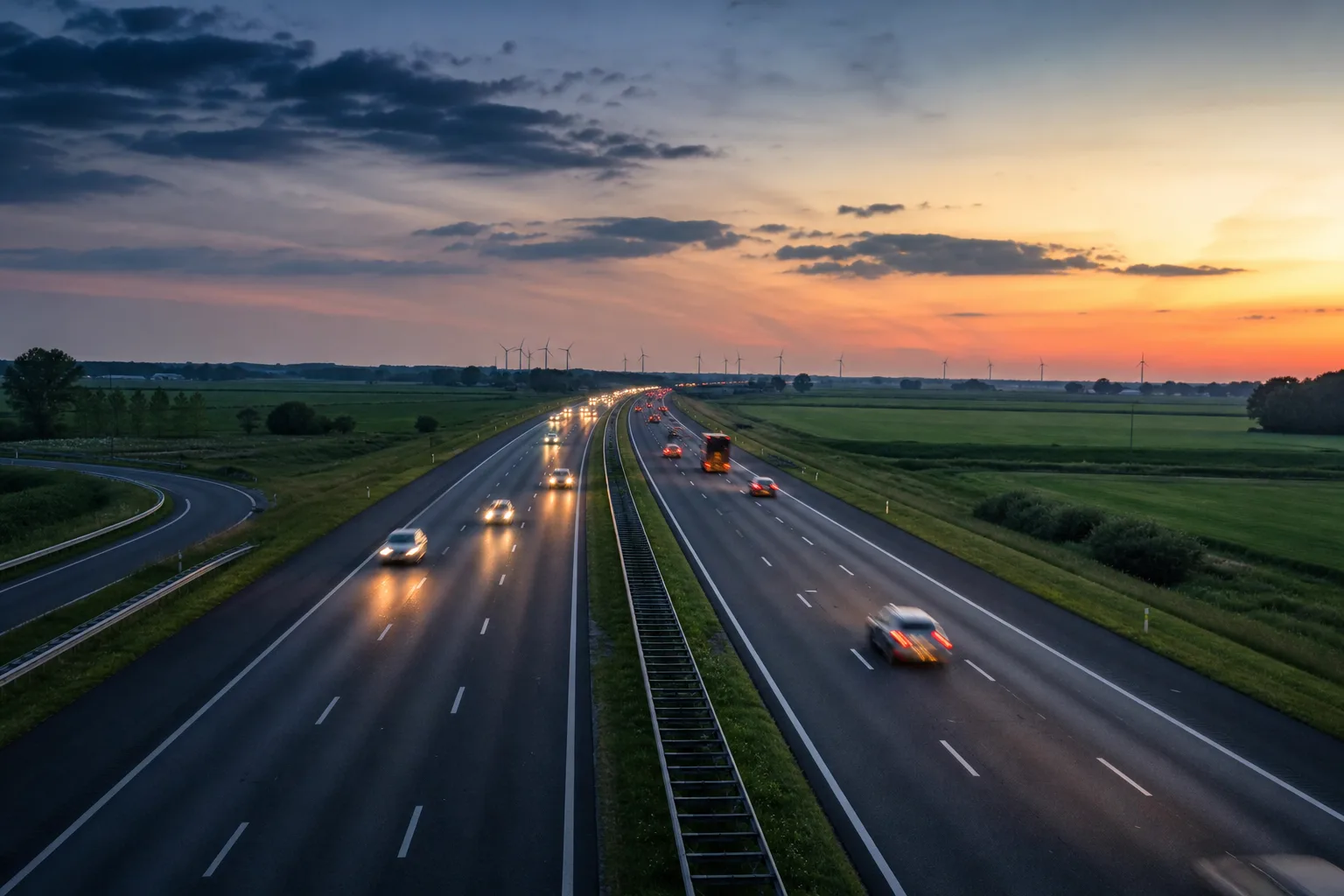
The speed limit in the Netherlands is 100 km/h on motorways during the day, from 06:00 to 19:00, and 130 km/h at night where signs allow it. On rural roads outside towns the limit is 80 km/h, and in built-up areas it is 50 km/h, dropping to 30 in many city centres.
That daytime motorway rule is the one that catches people out. Most of Europe runs a single motorway number all day, so a driver coming off the ferry sets the cruise control at 130 out of habit. In daylight, that is already 30 km/h over the Dutch limit, and the country is covered in cameras.
This guide gives you every Dutch speed limit by road type, explains the day and night split, and covers the fines, the drink-drive rules, and why there is no vignette to buy here. Every figure is from an official Dutch or EU source and was checked in June 2026.
Key Takeaways
- The Dutch motorway limit is 100 km/h from 06:00 to 19:00, and 130 km/h at night only where signed.
- Default limits are 100 motorway (day), 80 outside towns, and 50 in built-up areas, with 30 km/h now common in cities.
- The blood alcohol limit is 0.5 grams per litre, and 0.2 for drivers in their first five years.
- Speeding fines run from about €28 to a top fixed fine of just over €500, set by the public prosecutor and revised each January, plus a €9 admin fee on every one.
- The Netherlands has no vignette. The only road charges are a few tunnel tolls.
Speed Limits in the Netherlands by Road Type
The Netherlands uses three core limits, plus a time rule on motorways and lower limits in cities. The local road-type names appear on signs, so it helps to know them.
| Road type | Speed limit | Local term |
|---|---|---|
| Motorway, daytime 06:00 to 19:00 | 100 km/h | autosnelweg |
| Motorway, night 19:00 to 06:00 | 130 km/h where signed (sometimes 120 or 100) | autosnelweg |
| Expressway | 100 km/h | autoweg |
| Outside built-up areas (rural) | 80 km/h | buiten de bebouwde kom |
| Built-up areas and towns | 50 km/h, often 30 in city centres | bebouwde kom |
| Home zones | walking pace | woonerf |
A sign always beats the default. Roadworks, ring roads, and busy stretches often post a lower number, and that posted limit is the one that applies. When you tow a trailer or caravan, your limit drops to 90 km/h on the motorway and 80 km/h on other roads outside towns. You can check the current rules on the EU’s Your Europe road-rules page for the Netherlands.
Why the Motorway Limit Is 100 by Day and 130 by Night
The Dutch motorway speed limit is 100 km/h during the day for an environmental reason. The government cut the daytime maximum to 100 in March 2020 to lower nitrogen emissions near nature areas. At night, when traffic is lighter, the limit rises again to whatever the sign shows, usually 130 km/h.
The practical effect is simple but easy to miss. Between 06:00 and 19:00 you hold 100 on the motorway, even on a wide, empty stretch. After 19:00 you can speed up to the posted night limit. Roadside signs with a small clock symbol tell you when each limit applies, so watch for them as the evening starts.
The 2025 sections that went back to 130
There is one recent change worth knowing. From April 2025, the daytime 100 limit was lifted on a handful of motorway stretches that now run at 130 km/h around the clock. Three switched first, in April 2025: the A7 across the Afsluitdijk, the A7 between Winschoten and the German border, and the A6 between Lelystad and the Ketelbrug. A fourth, on the A37 near Zwartemeer, followed in the summer of 2025. Everywhere else, the daytime 100 rule still stands, so treat 100 as the default and only trust a higher number when a sign confirms it.
The 30 km/h City Limit Now Spreading Across Dutch Towns
Many Dutch cities have dropped the default urban limit from 50 to 30 km/h. Amsterdam led the change in December 2023, lowering the limit to 30 on about 80% of its streets, according to the city. Rotterdam, Utrecht, Haarlem, and others have followed on a growing list of roads.
For a visitor, this matters most in city centres. The 50 km/h figure you expect in a built-up area is now 30 on many roads, marked by signs and road design that make higher speeds hard anyway. Slow down early in towns, watch for the 30 signs, and give cyclists plenty of room. Bikes have strong priority in the Netherlands, and a 30 zone is built around them.
Speeding Fines and How They Reach Foreign Drivers
Dutch speeding fines are among the strictest in Europe, and a foreign plate does not protect you. The fines are set each year by the public prosecutor, the Openbaar Ministerie.
How much a Dutch speeding fine costs
Fines rise sharply with each km/h over the limit. The amounts are set by the public prosecutor and published in the official OM fine database (Boetebase), which is revised each January.
| Road type | Minor overspeed, from* | Becomes a court case above |
|---|---|---|
| Motorway | ~€28 | 40 km/h over |
| Outside built-up areas | ~€33 | 30 km/h over |
| Built-up areas | ~€37 | 30 km/h over |
*These are the public prosecutor’s published tariffs, which are uplifted a few percent each January, so check the OM Boetebase for the exact current amount.
Each fine adds the €9 admin fee, and the highest fixed motorway fine is just over €500, charged at around 35 km/h over. Once you pass the thresholds above, you are summoned instead of fined on the spot, and you can face a driving ban of 2 to 6 months on top of a larger penalty. From 50 km/h over the limit, the police seize your licence on the spot.
Average-speed cameras and cross-border enforcement
The Netherlands relies heavily on average-speed checks, known as trajectcontrole. These measure your speed between two points over several kilometres, so braking for a single camera does not help. Speed cameras are common on motorways, rural roads, and city streets alike.
Fines follow foreign drivers home. Under EU cross-border rules, Dutch authorities can trace a plate and pursue the fine in your own country, and an unpaid fine can resurface the next time you enter. Pay any Dutch fine promptly rather than assuming it will not reach you.
Drink-Driving and Other Limits Foreign Drivers Miss
The legal blood alcohol limit in the Netherlands is 0.5 grams per litre, which is 0.05%. For drivers in their first five years on a licence, the limit is much lower at 0.2 grams per litre. You can confirm the rules on the official government.nl page on alcohol and driving.
A few other points catch foreign drivers out. Using a handheld phone while driving brings a heavy fine, dipped headlights are sensible in poor visibility, and cyclists almost always have priority, especially at junctions and in 30 zones. When in doubt in a Dutch town, expect a bike to have right of way.
Do You Need a Vignette to Drive in the Netherlands?
No. The Netherlands has no vignette, and there is no general charge to use Dutch roads. This surprises many drivers who assume a sticker is needed, the way Switzerland or Austria require one, but the Dutch motorway network is free to use.
The only charges are a small number of tunnel tolls, such as the Westerscheldetunnel and the Kiltunnel, plus a newer toll on the A24 Blankenburg connection near Rotterdam. You can see how these Dutch tunnel tolls work if your route uses one. If you are wondering why the Netherlands has no vignette while its neighbours vary, it comes down to how each country chooses to fund its roads.
The Short Version
The speed limit in the Netherlands is 100 km/h on motorways by day, 130 at night where signed, 80 on rural roads, and 50 in towns, with 30 km/h now common in cities. The daytime 100 rule is the trap for ferry arrivals, so reset your habits at the coast. Fines are steep, average-speed cameras are everywhere, and they reach foreign plates, so keep a clear margin under every limit.
The good news is that there is nothing to buy before you drive. No vignette, no general road charge, just a couple of tunnel tolls if your route happens to use one, and it helps to know what separates a toll from a vignette across Europe.
If your trip runs deeper into Europe, the rules shift again. Check how fast you can drive in the next country, from the speed limits in Slovenia to those in the Czech Republic, before you cross.
Frequently Asked Questions
What is the speed limit on Dutch motorways?
The Dutch motorway speed limit is 100 km/h during the day, from 06:00 to 19:00, and 130 km/h at night where signs allow it. A few sections of the A6, A7, and A37 now run at 130 around the clock.
Why is the speed limit 100 in the Netherlands?
The daytime motorway limit was cut to 100 km/h in March 2020 to reduce nitrogen emissions near protected nature areas. The limit applies between 06:00 and 19:00, then rises again at night.
Can I drive 130 in the Netherlands at night?
Yes, but only on motorway sections where a sign shows 130 km/h, between 19:00 and 06:00. Many stretches stay at 120 or 100 even at night, so always follow the posted sign.
How much is a speeding fine in the Netherlands?
Dutch speeding fines start at around €28 to €37 for a small overspeed and reach a top fixed fine of just over €500 for about 35 km/h over on the motorway, with a €9 admin fee added on top. The public prosecutor revises the amounts each January, so check the OM Boetebase for the exact figure. Going more than 30 km/h over in town, or 40 over on the motorway, leads to a court summons and a possible driving ban.
Do you need a vignette to drive in the Netherlands?
No. The Netherlands has no vignette and no general road charge. The only tolls are a few tunnels, such as the Westerscheldetunnel and Kiltunnel, plus the A24 Blankenburg connection.
What is the drink-drive limit in the Netherlands?
The blood alcohol limit is 0.5 grams per litre for experienced drivers. For drivers in their first five years on a licence, the limit drops to 0.2 grams per litre.
Sources
- RVV 1990, the Dutch road-rules statute (speed limits, art. 20-22)
- Rijksoverheid, Maximum speed on motorways
- Rijksoverheid, Motorway sections back to 130 km/h all day (April 2025)
- Rijksoverheid, Legal alcohol limit for drivers
- government.nl, Alcohol, drugs and driving
- Rijkswaterstaat (national road operator)
- Openbaar Ministerie, Boetebase (speeding fines)
- SWOV, Speed limits in the Netherlands
- Your Europe (EU), Road rules in the Netherlands
Ramis Kalkan
Ramis Kalkan leads growth at Vignetim. He writes about everything that makes European road trips smoother, from digital vignettes to eSIMs. Based in Ankara, usually mid-way through planning his next drive.