Speed Limits in Hungary: What Foreign Drivers Need to Know
Cross the M1 at 130, hit a slow zone at 110, then a village edge at 50. Hungary’s speed limits shift fast, and so does the fine for missing the drop. The full table by road and vehicle, plus the 0.0 alcohol rule.
 Ramis Kalkan
Updated: 11 min read
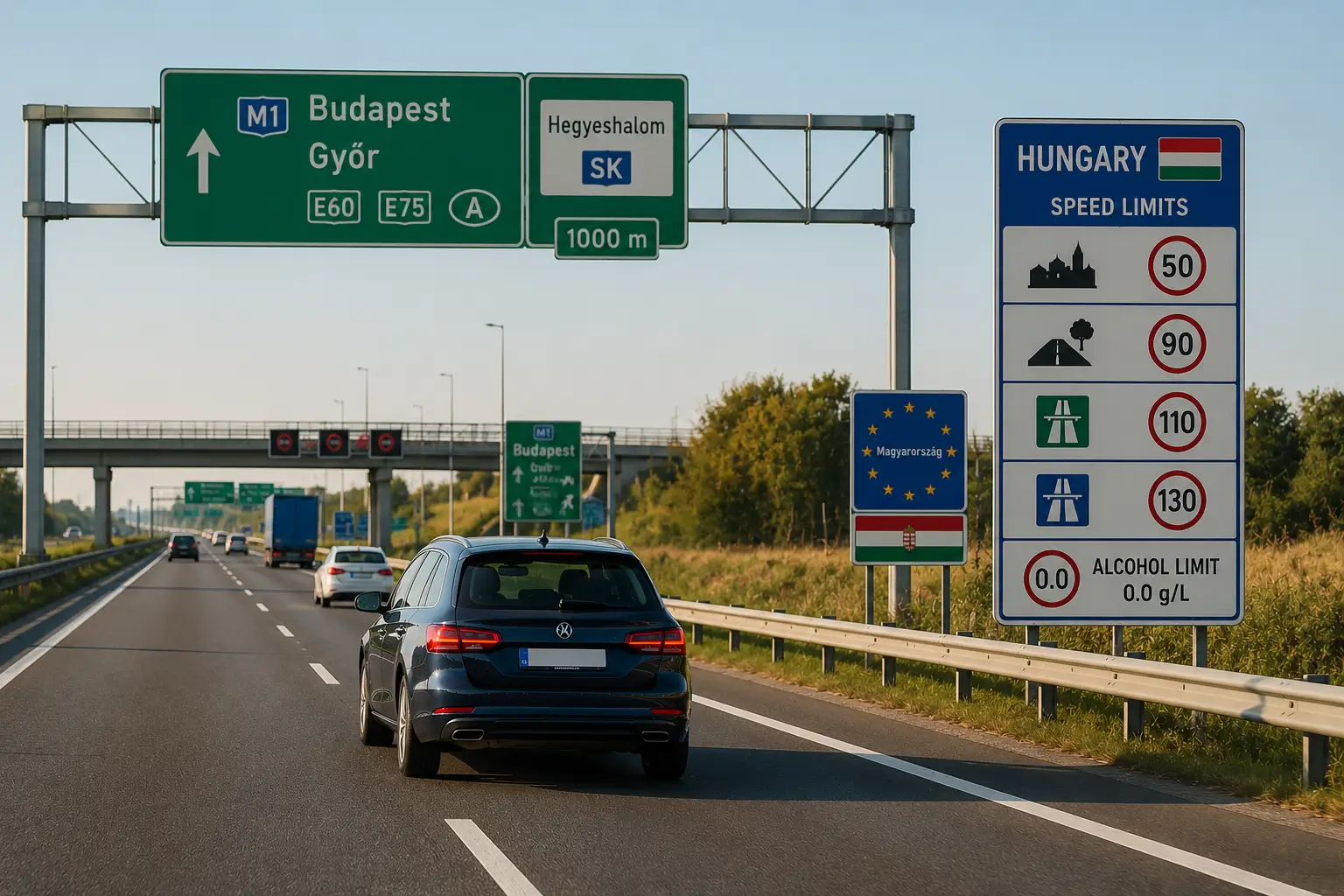
Hungary’s motorway (autópálya) limit is 130 km/h, the expressway (autóút) limit is 110 km/h, rural roads are 90 km/h, and built-up areas are 50 km/h. Those figures apply to cars and motorbikes. The moment you add a trailer, drive a van over 3.5 tonnes, or take a bus, the limits drop sharply and the fines stay just as steep. Hungary also runs a strict 0.0 g/L alcohol rule and enforces foreign-plate fines across the EU under Directive 2015/413.
A lot of foreign drivers cross the M1 at Hegyeshalom from Austria, settle at 130, and assume the same number holds until Budapest. It doesn’t. The limit drops to 110 on the bypass, 90 on rural roads, and 50 the moment you reach a village edge. Cameras catch the drop, the fine reaches the registered keeper, and “I was abroad” is no defence. Here is the full speed limit in Hungary picture in plain English, plus the e-matrica trap that catches almost every first-time visitor.
Key Takeaways
- Cars and motorbikes on the autópálya:130 km/h. Towing a trailer, or driving a van over 3.5 tonnes, on the same road:80 km/h.
- Speeding fines are graduated by km/h over the limit. Camera-detected speeding starts at HUF 30,000 and tops out at HUF 468,000 for the worst brackets.
- Hungary’s drink-drive limit is 0.0 g/L. There is no “one beer” margin.
- You also need an e-matrica (digital vignette) to use any Hungarian motorway. The cheap county (vármegyei) version is the most common foreign-driver mistake. It stops at the first junction past the county border.
- Foreign-plate fines are enforced across the EU. The “they won’t chase me at home” assumption is wrong for Hungary.
Hungary’s Speed Limits by Road Type
Hungary uses four standard speed bands, defined in the Hungarian Highway Code and summarised on the European Commission’s Your Europe portal. The figures below are the legal maximums. Local signs always override.
| Vehicle | Built-up area | Rural road | Autóút (expressway) | Autópálya (motorway) |
|---|---|---|---|---|
| Cars, motorbikes, vans up to 3.5t | 50 | 90 | 110 | 130 |
| Cars with a trailer, or vans over 3.5t | 50 | 70 | 70 | 80 |
| Heavy goods vehicles (over 3.5t) | 50 | 70 | 70 | 80 |
| Buses (technically compliant) | 50 | 80 | 80 | 100 |
A few things foreign drivers miss:
- The autópálya is signed M1, M3, M5, M7, M30, M70 and similar. The M-number is the cue you can drive at 130.
- The autóút is a green-signed expressway. It often looks like a motorway but caps at 110.
- Built-up areas start at the white town-name sign, not the first house you see. The 50 limit applies from that sign forward.
- Many urban arteries are signed at 60, 70 or 80 km/h. Trust the sign, not the default.
- Residential zones often drop to 30 km/h under “Lakó-pihenő övezet” (residential zone) signs.
A note on the proposed 2026 reform
There is a draft overhaul of the Hungarian Highway Code under public consultation. It proposes 140 km/h on selected motorway sections and 120 km/h on dual carriageways. The bill is expected in parliament after the 2026 elections. None of this is law yet. Drive to the figures in the table above until the change is published in the Magyar Közlöny (Hungarian Official Gazette).
Hungary’s Speeding Fines
Hungary’s speeding fines run on two tracks. If a police patrol stops you, the on-the-spot fine for a minor offence sits between HUF 5,000 and HUF 50,000 (around €13 to €125), payable by card or bank transfer. If a camera catches you, the fine is objective liability, meaning the registered keeper is liable regardless of who was driving. Camera fines range from HUF 30,000 to HUF 300,000 under Government Decree 235/2000, the legal instrument that sets the bracket schedule.
For a 50 km/h urban zone, the camera fine ladder is:
| km/h over the limit | Fine (HUF) | Approx EUR |
|---|---|---|
| 15 to 25 | 50,000 | €125 |
| 26 to 35 | 70,000 | €175 |
| 36 to 45 | 100,000 | €250 |
| 46 to 55 | 140,000 | €350 |
| 56 to 65 | 210,000 | €525 |
| 66 to 75 | 312,000 | €780 |
| 76 and above | 468,000 | €1,170 |
Higher-limit zones (90 and 130) follow the same graduated logic with different thresholds. The pattern is the point: small overspeeds are expensive, large ones are punishing.
A few enforcement notes that catch foreigners out:
- Tolerance is usually around 10 km/h before a camera triggers. Don’t rely on it.
- Fixed average-speed sections sit on the M1, M3 and M7 around major junctions. Slowing for the camera then accelerating doesn’t work.
- Police can confiscate a driving licence on the spot for serious offences, including major speeding.
The 0.0 g/L alcohol rule
Hungary enforces a zero blood alcohol limit for all drivers. Any detectable alcohol is an offence. The European Commission states the limit as “0,0 mg/ml”, and the European Transport Safety Council Hungary fact file confirms the three administrative and criminal bands:
- Trace to 0.3 g/L: roughly HUF 30,000 (around €75) and 6 penalty points on the licence.
- 0.3 to 0.5 g/L: around HUF 100,000 (around €250) and 8 penalty points.
- Above 0.5 g/L: criminal offence under section 236 of the Hungarian Criminal Code. Up to 2 years’ imprisonment, 11 penalty points, and a driving ban from 1 month to 10 years.
A driving ban issued on a Hungarian licence applies across the EU. A ban issued on a foreign licence applies in Hungary, and your home authority can extend it. The rule is simple. If you plan to drive in Hungary that day, you cannot drink at all.
How Foreign Plates Are Caught
A common myth is that camera fines abroad never reach you. Hungary is one of the more active EU states on cross-border enforcement, and three mechanisms work together.
- Roadside police stops. Officers can fine on the spot and accept cash or card for the minor offences range. For rental drivers, the fine is usually charged to the deposit on file.
- Automated camera fines under objective liability. A fixed or mobile camera reads your plate and the fine is issued to the registered keeper. The driver is not identified and does not need to be. Source: Hungarian Police, police.hu.
- EU Cross-Border Enforcement Directive (2015/413). Hungary shares keeper data with all EU member states and the UK. Your home authority forwards the demand. If you ignore it, debt-recovery firms take over.
The practical takeaway: Hungarian camera fines do reach UK, German, Austrian and Romanian addresses, and they get there in weeks rather than months. Pay them through the official online portal listed on the demand letter.
The e-Matrica You Also Need (and the County Trap to Avoid)
Every Hungarian motorway and expressway needs a valid e-matrica linked to your plate. There is no physical sticker. The system is run by the Nemzeti Útdíjfizetési Szolgáltató (NÚSZ), the national toll authority. The blog stays focused on the rules that catch foreign drivers out. The one product choice worth getting right before you travel is which e-matrica you actually buy.
National vs county: the trap
Hungary sells two kinds of annual e-matrica, and they cover very different areas.
- The national (országos) e-matrica covers the entire Hungarian motorway network. It is the one almost every foreign driver actually needs.
- The county (vármegyei) e-matrica is the cheaper option, but it only covers one of Hungary’s 19 counties plus Budapest, and it only reaches the first junction past that county’s border.
Foreigners browsing in a hurry pick the cheaper county option, buy it, and assume they are covered. The moment they leave that county on the motorway, the system reads the plate as having no valid e-matrica and triggers a supplementary toll. If you are passing through Hungary on the way to Croatia, Romania or Turkey, the national e-matrica is the one you want. Romania needs its own rovinieta road tax on top, and you can check what each onward border requires on our European vignettes and tolls hub. NÚSZ has also added a new M1 regional option for 2026, covering Pest, Fejér, Komárom-Esztergom and Győr-Moson-Sopron. It is useful if you only drive the Vienna corridor.
The simplest way to skip the county trap is to buy the national Hungary e-matrica through Vignetim before you set off. It links straight to your plate and covers the whole motorway network, so the right scope is sorted before you reach the first toll gate, with no county map to second-guess.
Vehicle categories at a glance
NÚSZ recognises four active categories. Each one applies to a specific vehicle class.
- D1M: motorcycles.
- D1: passenger cars up to 3.5 tonnes with up to 7 seats.
- D2: minibuses, motorhomes and light vans not covered by D1.
- U: trailers towed behind a D2 or B2 vehicle.
The bus category (B2) is discontinued. Buses now use the distance-based HU-GO toll system instead.
If you forget: the 60-minute rule and the pótdíj
You have 60 minutes from entering the motorway to buy an e-matrica retroactively without penalty. That window is on the NÚSZ FAQ and it is the single most useful rule for foreign drivers who realise their mistake at the first rest stop. Miss the window, and a supplementary toll (pótdíj) applies.
Under Decree 45/2020, as published by NÚSZ, there are two kinds, and each is cheaper if you pay within 60 days. These rates apply from 1 January 2026:
| Situation | Within 60 days | After 60 days |
|---|---|---|
| No valid e-matrica, or expired | HUF 27,790 (around €70) | HUF 95,730 (around €242) |
| Wrong or lower category (the county trap) | HUF 15,530 (around €39) | HUF 49,190 (around €125) |
That second row is the county trap in numbers. Use a county vignette outside its junctions, or buy a D1 when your vehicle needs a D2, and you pay the differential surcharge even though you bought something.
Our guide to vignette penalties covers how these letters reach foreign drivers and what happens if you let them lapse.
Winter Driving Considerations
Hungary does not make winter tyres mandatory by law, unlike Austria or Slovakia where seasonal rules apply. The advice from Magyar Közút, the national road authority, is to fit winter tyres from November to March, and most rental cars come prepared in season.
A few rules still apply year-round on Hungarian roads:
- Snow chains: maximum 50 km/h when fitted. Only carry them if you plan to drive in mountain or border areas during heavy snow.
- Daytime running lights: mandatory outside built-up areas, all year.
- Hi-vis vest: must be worn if you leave the vehicle on a rural road or motorway, at night or in poor visibility.
- Mandatory equipment year-round: warning triangle, first-aid kit, spare bulbs.
- UK or Irish plates: fit headlamp converters before the trip.
If you plan an Alpine route through Austria, Slovenia, or Slovakia before Hungary, those countries do require winter tyres in season. Our guide to Slovenia’s speed limits and vinjeta rules covers the equivalent rules for that leg.
Conclusion
Hungary’s speed limits are straightforward once you know the four bands and the vehicle-class drops. 130 km/h on the autópálya, 110 on the autóút, 90 on rural roads, 50 in town. Towing slashes those numbers, the 0.0 alcohol rule has no margin, and cameras under objective liability mean foreign-plate fines reach you at home.
The e-matrica is the second half of staying compliant. Pick the national version unless you are certain you are staying inside a single county. If you forget, the 60-minute grace window can save the trip. After that, the surcharge for no valid e-matrica rises to nearly HUF 96,000 once you pass 60 days, and the county trap carries its own differential surcharge on top.
You can sort your Hungary e-matrica before you set off, link it to your plate, and keep the confirmation in the app for the whole trip. Compared to a roadside camera fine, it is the cheapest part of driving in Hungary.
If your route continues toward the Bulgaria-Turkey corridor, our guide to speed limits in Turkey covers what changes once you cross the EU border. For the concept side, how European vignettes work covers it in one read.
Frequently Asked Questions
What is the speed limit on Hungarian motorways?
The speed limit on Hungarian motorways (autópálya) is 130 km/h for cars and motorbikes. Towing a trailer or driving a van over 3.5 tonnes drops the limit to 80 km/h on the same road. Bus limits sit at 100. The Magyar Közút road authority publishes the figures, and the EU summarises them on the Your Europe portal.
What is Hungary’s drink-drive limit for foreign drivers?
Hungary’s BAC limit is 0.0 g/L for everyone, including foreign drivers. Any detectable alcohol triggers an administrative fine starting around HUF 30,000 and 6 penalty points. Anything over 0.5 g/L is a criminal offence under section 236 of the Hungarian Criminal Code, with up to 2 years in prison and a driving ban of 1 month to 10 years.
Do Hungarian speeding fines reach me at home?
Yes. Hungary uses the EU Cross-Border Enforcement Directive (2015/413) to share keeper details with your home authority. Camera fines arrive in weeks rather than months and are enforceable across all EU member states and the UK. Ignoring the demand leads to debt-recovery action.
Is a county e-matrica enough if I’m passing through Hungary?
No. A county (vármegyei) e-matrica covers only one Hungarian county plus the first junction past its border. For any cross-country drive, including Vienna to Budapest or any transit toward Romania, Serbia or Croatia, you need the national (országos) e-matrica. The county version is cheaper, but the supplementary toll for guessing wrong wipes out the saving.
Are Hungarian speed limits changing in 2026?
Not yet. A draft of the Hungarian Highway Code proposes 140 km/h on some motorway sections and 120 km/h on dual carriageways, but it is in public consultation only. Until the bill clears parliament and appears in the Magyar Közlöny, the current limits in the table above stand.
Are winter tyres mandatory in Hungary?
No. Hungary does not require winter tyres by law. They are strongly recommended from November to March, and rental cars are usually fitted in season. If you drive on into Austria or Slovakia, those countries do apply seasonal winter-tyre rules.
Sources
European Commission Your Europe, NÚSZ, NÚSZ surcharges (Decree 45/2020), Hungarian Police, ETSC drink-driving Hungary, Magyar Közút.
Ramis Kalkan
Ramis Kalkan leads growth at Vignetim. He writes about everything that makes European road trips smoother, from digital vignettes to eSIMs. Based in Ankara, usually mid-way through planning his next drive.