Speed Limits in Turkey: What Foreign Drivers Need to Know
You cross Kapıkule at 130 km/h, and twenty minutes later the limit drops to 50 at a village. Here’s how Turkey’s speed limits actually work in practice, the new February 2026 fines, and what happens if you leave the country with an unpaid ticket.
 Ramis Kalkan
Updated: 9 min read
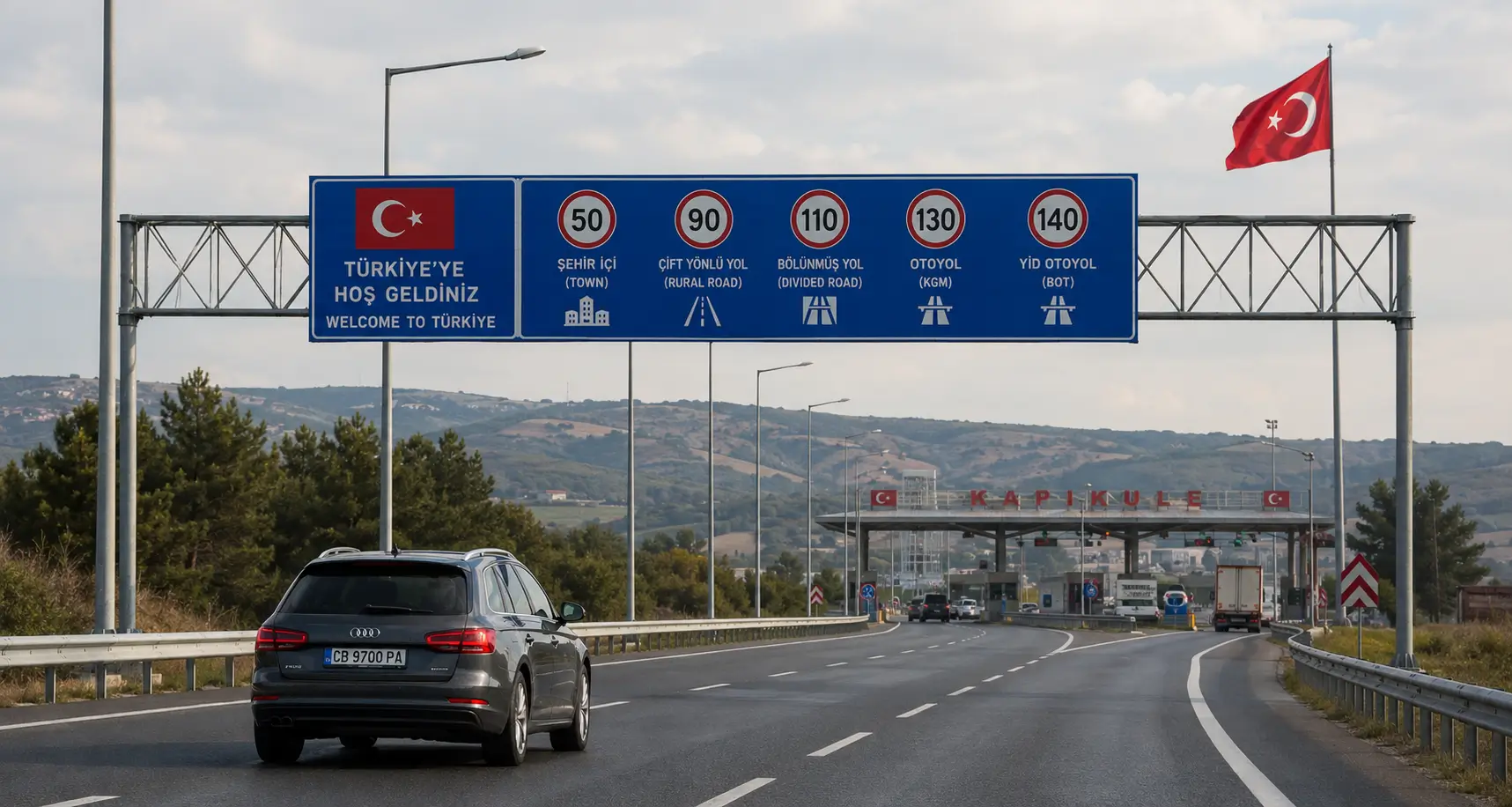
The speed limit in Turkey is 50 km/h in towns, 90 on two-way rural roads, 110 on divided roads, 130 on state motorways and 140 on private (BOT) motorways for cars. Vans, buses and trucks run lower across the board. These tiers come straight from the General Directorate of Highways (KGM).
You cross at Kapıkule, hit the first toll gate, and the limit jumps to 130 km/h. Twenty minutes later it drops to 90 at a junction, then 50 at a village, then never resumes. That is Turkey in one paragraph, and it is exactly why foreign drivers pick up fines without realising it.
This guide gives you the current, official figures. You will see every limit by road type and vehicle class, the new fine tariff from February 2026, how the cameras catch you, and what happens at the border if you leave Turkey with an unpaid ticket. Every number is sourced to KGM, the EGM (Turkish National Police) or the Resmi Gazete.
Key Takeaways
- Cars: 50 km/h in towns, 90 on two-way rural roads, 110 on divided roads, 130 on KGM motorways, 140 on private (BOT) motorways.
- Heavier vehicles run 10 to 50 km/h slower than cars on every road type (table below). –
- The old 10% radar tolerance was abolished by Law 7574 on 27 February 2026. Fines now start at 6 km/h over in towns and 11 km/h over on open roads.
- Top fine tier is 30,000 TL plus a 90-day licence suspension.
- From 2026, a foreign-plated car cannot leave Turkey through customs with unpaid traffic fines or HGS tolls.
Turkey’s Speed Limits by Road Type
Turkey splits its road network into five categories, each with its own speed cap. The figures below come straight from the KGM speed-limits page and the Highway Traffic Regulation backing it.
| Vehicle class | Town | Rural two-way | Divided road | KGM motorway | Private (YİD/BOT) motorway |
|---|---|---|---|---|---|
| Car | 50 | 90 | 110 | 130 | 140 |
| Minibus | 50 | 80 | 90 | 100 | 100 |
| Bus | 50 | 80 | 90 | 100 | 100 |
| Van / panelvan | 50 | 80 | 85 | 95 | 95 |
| Truck / HGV | 50 | 80 | 85 | 90 | 90 |
| Motorbike | 50 | 80 | 90 | 100 | 100 |
| Car towing a caravan or trailer | 40 | 70 | 80 | 90 | 90 |
A few things to know that the table does not show.
The 140 km/h tier only applies on private “Yap-İşlet-Devret” (Build-Operate-Transfer) motorways. In practice that means the Yavuz Sultan Selim Bridge, Osmangazi Bridge, Avrasya Tunnel, the Northern Marmara motorway and a handful of others. Every other “otoyol” (state-operated) is capped at 130 km/h.
Rural two-way roads (the 90 km/h tier) are most of Turkey’s intercity road network outside the motorways. These are where the limit drops most often, because every town, junction or roadworks zone overrides the default.
Towns are always 50 km/h by default, even on wide multi-lane city boulevards, unless a sign says otherwise. School zones, residential roads and some city centres post 30 km/h.
Why Some Signs Show 82, 94 or 112 km/h
The first odd sign you will see on a Turkish motorway is a circle that says 82 or 112. These are not posted in error and they are not metric-to-imperial conversions.
Before 27 February 2026, Turkey applied a 10% radar tolerance. A 90 km/h limit was enforced at roughly 99 km/h. An 82 km/h sign told a heavy goods driver that 90 km/h was effectively the cap. Many of these signs were never repainted. You will still see them on long stretches of D-roads and on heavy-vehicle limits.
The tolerance itself is gone (more on that below), so treat the printed number as the real limit. A sign that reads 82 means 82, not 90.
Speeding Fines Under Turkey’s New 2026 Law
Speeding fines in Turkey were rewritten on 27 February 2026 when Law No. 7574 replaced the old percentage-based tariff with a tiered, km/h-based system. The EGM amendment summary confirms the structure. The headline change for foreign drivers: the de-facto 10% margin is gone, and the new fines bite earlier and harder.
Fines outside built-up areas (rural and motorways)
| Excess over the posted limit | Fine | Extra |
|---|---|---|
| 11–15 km/h | 2,000 TL | – |
| 16–20 km/h | 4,000 TL | – |
| 21–25 km/h | 6,000 TL | – |
| 26–30 km/h | 8,000 TL | – |
| 31–40 km/h | 12,000 TL | – |
| 41–50 km/h | 15,000 TL | – |
| 51–60 km/h | 20,000 TL | 30-day licence suspension |
| 61–70 km/h | 25,000 TL | 60-day licence suspension |
| 71+ km/h | 30,000 TL | 90-day licence suspension |
So on a 130 km/h KGM motorway, the first fine tier kicks in the moment your speed reads 141 km/h. On a 140 km/h BOT motorway, it kicks in at 151 km/h.
Fines inside built-up areas (towns and cities)
| Excess over the posted limit | Fine | Extra |
|---|---|---|
| 6–10 km/h | 2,000 TL | – |
| 11–15 km/h | 4,000 TL | – |
| 16–20 km/h | 6,000 TL | – |
| 21–25 km/h | 8,000 TL | – |
| 26–35 km/h | 12,000 TL | – |
| 36–45 km/h | 15,000 TL | – |
| 46–55 km/h | 20,000 TL | 30-day suspension |
| 56–65 km/h | 25,000 TL | 60-day suspension |
| 66+ km/h | 30,000 TL | 90-day suspension |
In town the first tier triggers at just 56 km/h in a 50 km/h zone.
Early-payment discount: pay within 15 days of issue and you get 25% off the fine. This is statutory and applies to every tier.
The percentage tolerance that drivers used to rely on (everything under +10% slipped through) no longer exists. Radar devices still have a small technical margin of error (roughly 2–3 km/h), but that is a defence you raise in court if a calibration was off. It is not a buffer you can drive on.
How Speed Is Actually Enforced
Three systems do the work, and they overlap.
TEDES (Trafik Elektronik Denetleme Sistemi) is the network of fixed motorway and main-road cameras that combine speed measurement with plate recognition. TEDES sites are flagged with “Radar Hız Kontrolü” signs ahead of the camera, so they are usually predictable.
MOBESE is Turkey’s urban CCTV network. It was built for general security but it feeds traffic enforcement too: red lights, bus-lane misuse, illegal turns and some speed checks.
EDS (Elektronik Denetleme Sistemi) is the mobile enforcement arm. EDS vans, marked overhead, park on bridges and lay-bys and run radar plus plate-reading at the same time. EDS deployments are not posted. Istanbul, Ankara and the holiday coastlines are where you will see them most often.
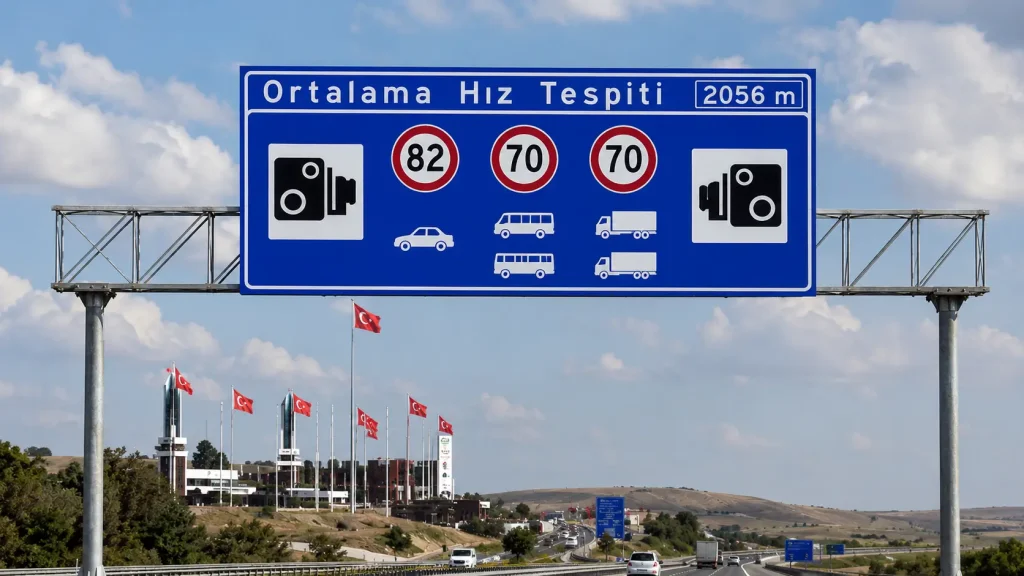
On parts of the motorway network you will also encounter average-speed enforcement between two fixed points. Your plate is logged at point A and again at point B; if your average exceeds the limit, you get a fine even though you were under the cap at each individual gantry. Radar-detector hardware is illegal in Turkey and carries its own penalties, so the only defence is to drive the limit.
What Happens if You Are Fined in a Foreign-Plated Car
Until recently a tourist could drive home and quietly forget the ticket. That door is now closed.
Under a 2026 regulation, Turkish customs check unpaid fines and HGS tolls before clearing a foreign-plated vehicle to leave the country (see the official KGM foreign-plate payments portal). The fine appears in the system as soon as it is issued, even if you have not received a formal notification (tebligat), and the vehicle is held at the border until the balance is cleared.
In practical terms:
- A ticket caught by TEDES on a Tuesday can block your departure on Friday.
- Unpaid HGS tolls accumulate the same way, so a missed motorway pass is on the same list as a speeding ticket.
- Payment is made through the Turkish Revenue Administration (Interaktif Vergi Dairesi) or the KGM foreign-vehicle payments portal in English. Cash at the border desk is not the default.
This is the single biggest change in foreign-driver enforcement in Turkey, and it makes ignoring a fine a much worse strategy than it used to be.
If you are entering by car from Bulgaria, Greece or Georgia, sort two more things before you cross. First, an HGS account, so that motorway gantries do not log unpaid tolls in your name. Second, a motor insurance Green Card that covers Turkey, because Turkey sits outside the EU motor-insurance zone. You can register and top up HGS for foreign-plated vehicles from your phone before you reach Kapıkule. That is the route most drivers want, now that the PTT counter is the only domestic alternative.
Turkey, by the way, does not have a vignette. It has HGS, the electronic toll system, and if you want the short version of vignette vs toll vs ENC it is worth a one-minute read before any cross-border trip.
How Long Your Home Licence Works in Turkey
Foreign driving licences are valid in Turkey for a limited window, set by the Ministry of Foreign Affairs.
- Non-Turkish citizens (tourists, short-stay visitors): up to six months from each entry into Turkey. The clock resets at every border crossing.
- Turkish citizens entering on a foreign licence: up to 12 months from entry.
- An International Driving Permit is not legally required but is strongly recommended, especially if your home licence is not in the Latin alphabet. Some rental companies will only release a car with one.
After the window closes, foreigners must convert to a Turkish licence. Drive past the deadline and you fall under a separate offence in the Highway Traffic Code, with its own fine and a roadside ban from continuing.
The Takeaway for a Foreign Driver
Turkey’s roads are well marked and largely well surfaced, and the rules themselves are not exotic. Three things catch foreign drivers out: how often the limit drops on D-roads and never resumes, the new 2026 fine tariff that bites at much smaller overages, and the customs rule that holds the car at the border until any ticket is cleared.
Knowing the table above is the easy part. The harder part is the cross-border admin: HGS for the tolls and a Green Card for the insurance. Getting Turkey’s HGS toll system sorted from your phone before you cross at Kapıkule, Ipsala or Sarp removes the single most common reason a foreign-plated car gets stopped at the exit gate.
If you want the wider picture, our guide to driving in Turkey covers documents, insurance, fuel and the rest of the road rules a foreign driver actually needs.
Frequently Asked Questions
What is the speed limit in Turkey?
For cars, the speed limit in Turkey is 50 km/h in built-up areas, 90 km/h on two-way rural roads, 110 km/h on divided roads, 130 km/h on state motorways and 140 km/h on private (BOT) motorways. Vans, buses and trucks run lower across every category (full table above).
What is the speed limit on Turkish motorways?
130 km/h on KGM-operated motorways and 140 km/h on private (BOT) motorways. State motorways are the default; private ones include the Osmangazi Bridge, Yavuz Sultan Selim Bridge, Avrasya Tunnel and the Northern Marmara motorway.
Can I drive 140 km/h anywhere in Turkey?
Only on the BOT motorways listed above. Everywhere else on the motorway network it is 130 km/h, and lower limits apply to vans, buses and trucks.
What is the speeding fine for foreigners in Turkey?
The same as for Turkish drivers. From February 2026 the tiers run from 2,000 TL (the lowest band) to 30,000 TL plus a 90-day licence suspension at the top. A 25% discount applies if you pay within 15 days.
Will a Turkish speeding fine follow me home?
You probably will not need to wait that long. Since 2026 Turkish customs check for unpaid fines and tolls before letting a foreign-plated car leave the country, so the ticket usually catches up with you at the border itself.
Why does my sat-nav show a 82 km/h limit?
That is a legacy sign from the old 10% tolerance era, when 82 km/h told a driver the real limit was 90. The tolerance is gone since February 2026, so treat what is printed on the sign as the enforceable number.
Can I take a Turkish rental car into Bulgaria or Greece?
Almost never. Most Turkish rental contracts forbid taking the car out of Turkey, partly because the insurance does not cover it. Check the cross-border clause before you book, especially if you are planning a Balkan loop.
Sources used in this article: KGM Hız Sınırları · Resmi Gazete, Law 7574 (27 Feb 2026) · EGM – 2026 traffic safety amendment · KGM Foreign Plate Payments · MFA – driving rules for visitors · Karayolları Trafik Kanunu (2918).
Ramis Kalkan
Ramis Kalkan leads growth at Vignetim. He writes about everything that makes European road trips smoother, from digital vignettes to eSIMs. Based in Ankara, usually mid-way through planning his next drive.