Speed Limits in Romania: What Foreign Drivers Need to Know
You cross from Hungary at Nădlac onto the A1 at 130, then the motorway runs out and you’re on a national road at 90 that still needs a rovinieta. Romania’s speed limits, the 2026 fines, and the 0.0 alcohol rule for foreign drivers.
 Ramis Kalkan
Updated: 8 min read
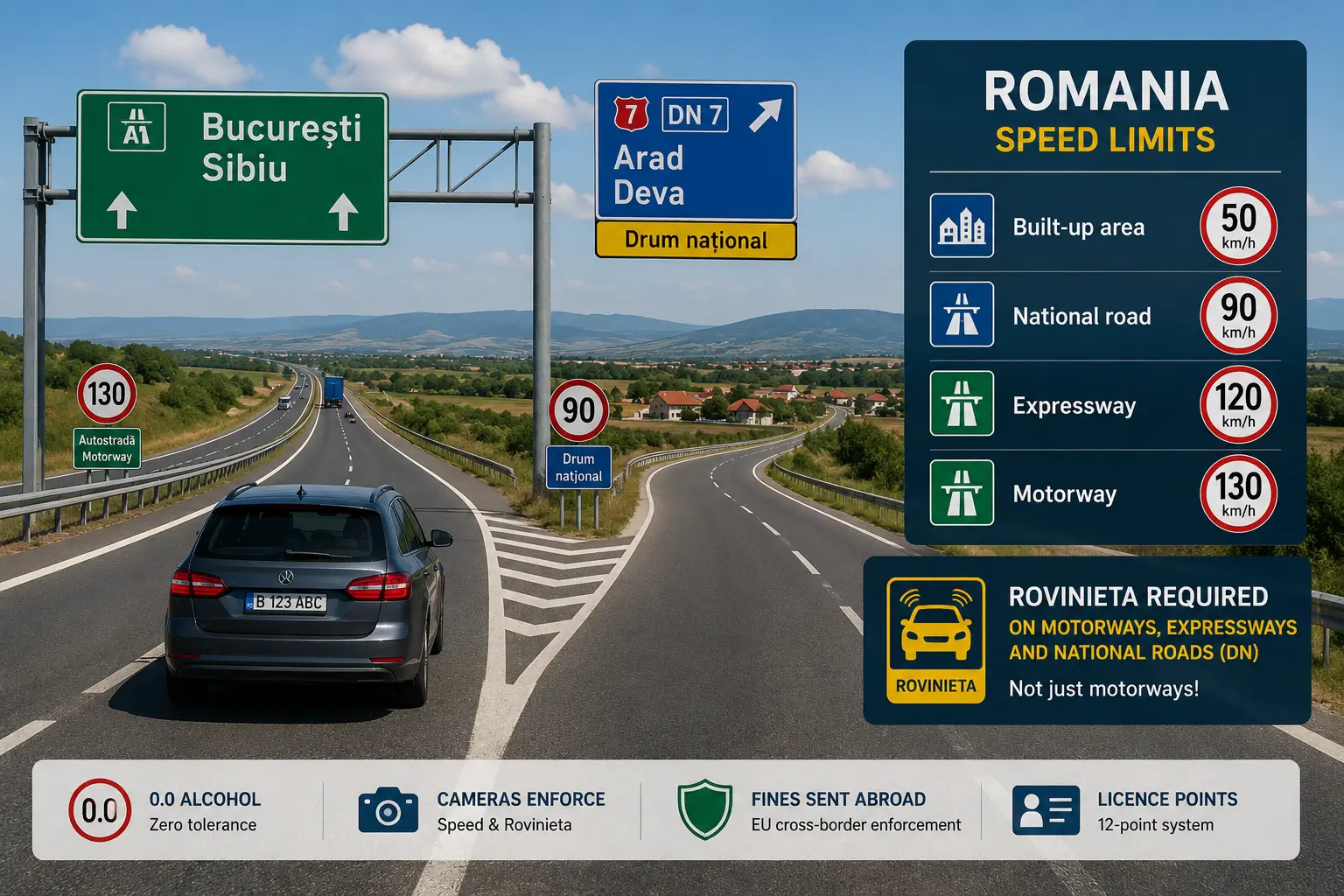
The speed limit in Romania for cars is 50 km/h in built-up areas, 90 km/h on national roads, 120 km/h on expressways, and 130 km/h on motorways. Romania also runs an absolute 0.0 alcohol rule, and the rovinieta road tax is required on almost every road, not just motorways.
Most foreign drivers enter from Hungary at Nădlac on the A1 and settle at 130. Then the motorway runs out. Romania has a relatively short motorway network, so you spend most of the drive on national roads at 90 km/h, and every one of them still needs a rovinieta. Miss that detail and the cameras catch it.
This guide covers the full speed limit in Romania by road type, what the drum (road) classes mean, the 2026 fines and penalty points, the 0.0 alcohol rule, how foreign-plate fines reach you, and the rovinieta you need. Every figure traces to an official source.
Key Takeaways
- Romanian car limits: 50 km/h in town, 90 on national roads, 120 on expressways, 130 on motorways.
- New drivers, in their first year, must drive 20 km/h slower outside built-up areas. Trailers drop the limit by 10 km/h.
- The drink-drive limit is 0.0. Above 0.80 g/L it stops being a fine and becomes a criminal offence.
- Speeding penalties run on fine points (1 point = 202 RON in 2026), and big overspeeds carry a 90 or 120-day licence suspension.
- The rovinieta is required on motorways, expressways and ordinary national roads, not just motorways. County and communal roads are exempt.
Romania’s Speed Limits by Road Type
These are the default limits for cars and vehicles up to 3.5 tonnes, set in the Romanian road traffic law (OUG 195/2002) and summarised by the European Commission’s Your Europe portal. Local signs always override the defaults.
| Road type | Cars (up to 3.5t) |
|---|---|
| Built-up area (localitate) | 50 km/h |
| National road (drum național) | 90 km/h |
| National road on a European route (E-road) | 100 km/h |
| Expressway (drum expres) | 120 km/h |
| Motorway (autostradă) | 130 km/h |
Two reductions catch foreign drivers out, and both come straight from the traffic law:
- New drivers in their first year on a licence must drive 20 km/h below the limit outside built-up areas. So a recently qualified driver tops out at 110 on the motorway, not 130.
- Towing a trailer or caravan drops the limit by 10 km/h outside towns.
What the drum classes mean
Romanian road signs sort roads into classes, and the class sets both your speed limit and whether you need a rovinieta. It is the single biggest source of confusion for visitors.
- Autostradă (A): full motorway, 130 km/h. Blue signs with a white motorway symbol.
- Drum expres (DX): expressway, 120 km/h. A newer category that looks like a motorway but is signed differently.
- Drum național (DN): national road, 90 km/h (100 if it is also a European E-route). Single carriageway most of the time.
- Drum județean (DJ): county road. Lower-grade roads where no rovinieta is required.
Romania has far more national road than motorway, so assume you’re on a 90 km/h single carriageway for most of any cross-country drive.
Speeding Fines and the 0.0 Alcohol Rule
Romanian fines are set in “fine points” (puncte-amendă), and each point has a fixed value. From 1 January 2025 that value rose to 202 RON per point, so the cash amount of every fine went up. The figures below are this year’s, in RON with an approximate euro value for reference.
A minor overspeed, around 10 km/h over the limit, runs to roughly 290 to 725 RON (about €60 to €145), per the Romanian Police and OUG 195/2002. The serious brackets add a licence suspension on top of the fine:
- More than 50 km/h over the limit: licence suspension of 90 days.
- More than 70 km/h over the limit: licence suspension of 120 days.
Romania uses a 12-point licence system as well. Lose all your points and the suspension follows automatically.
The alcohol rule leaves no margin at all:
- The Romanian drink-drive limit is 0.0 g/L. Any measurable alcohol is an offence.
- Up to 0.80 g/L is a contravention, with a fine of roughly 1,305 to 2,900 RON (about €260 to €580) and a 90-day licence suspension.
- Above 0.80 g/L it becomes a criminal offence, not just a fine, with prosecution and a possible prison sentence.
There’s no “one small beer” allowance. If you plan to drive in Romania, keep it at zero.
How Foreign Plates Are Enforced
Romania enforces both speed and the rovinieta with ANPR plate-recognition cameras spread across the national network, and a foreign plate is no shield. The system reads your plate, checks it against the rovinieta database, and logs your speed at the same time.
Fines do not stop at the border either. As an EU member, Romania shares driver and keeper details with other member states under the EU’s cross-border enforcement framework (Directive 2015/413), so a camera fine can be sent to your home address weeks after the trip. For a hire car, the rental company usually passes the charge to the card on file, often with an admin fee on top.
The practical takeaway is simple. “I was a foreign driver” isn’t a defence, and ignoring a Romanian fine tends to make it bigger, not smaller.
The Rovinieta, and Why It Covers More Than Just Motorways
Romania requires a rovinieta (the national road-tax vignette) on far more than its motorways, and this is the trap that catches almost every first-time visitor. In Austria or Slovenia the vignette covers motorways. In Romania the rovinieta is required on motorways (A), expressways (DX), and ordinary national roads (DN), including E-routes, according to the road operator CNAIR. Only county roads, communal roads, and the stretch of a national road that passes through a town are exempt.
Because Romania has a short motorway network, a foreign driver who never touches a motorway still needs a rovinieta for the national roads in between. It’s plate-linked and fully digital, so there’s no sticker, and ANPR cameras check it automatically. One of many European vignette systems, it works on the same plate-recognition principle as its neighbours.
For the current price and validity options, sort your Romania’s rovinieta before you cross the border, so the whole national network is covered from your first kilometre.
Winter Rules That Trigger Lower Limits
Romania does not run a fixed-date winter-tyre season. Instead, winter tyres are required whenever the road is covered in snow, ice, or frost, per Your Europe and OUG 195/2002. In practice that means the rule can bite from late autumn to early spring, especially in the Carpathians, so fitting winter tyres for the cold months is the safe call.
A few related points matter on a winter drive:
- Snow and ice drop your safe speed below the posted limit. The limits in the table are maximums for good conditions, not targets for a snow-covered pass.
- Mountain routes through the Carpathians can close or require chains at short notice.
- Daytime running lights and a standard equipment kit (warning triangle, first-aid kit, hi-vis vest) are expected year-round.
The Short Version
The speed limit in Romania is easy once you know the four bands: 50 in town, 90 on national roads, 120 on expressways, and 130 on motorways. New drivers go 20 km/h slower outside town, trailers 10 km/h slower, and the alcohol rule is a hard zero. Watch the drum class on the signs, because it sets both your limit and whether you need a rovinieta.
The rovinieta is the part foreign drivers underestimate. It covers ordinary national roads, not just motorways, and Romania has a lot more national road than motorway. Sort your Romanian road tax (rovinieta) before you cross, keep to the signed limit, and a Romanian road trip stays simple.
If your route runs on through the region, our guides to speed limits in Hungary and Bulgaria’s speed limits cover the neighbours.
Frequently Asked Questions
What is the speed limit on Romanian motorways?
The speed limit on Romanian motorways (autostradă) is 130 km/h for cars. On expressways (drum expres) it is 120 km/h, on national roads 90 km/h, and in built-up areas 50 km/h. Drivers in their first year on a licence must go 20 km/h slower outside built-up areas.
Is the rovinieta only for motorways in Romania?
No. The rovinieta is required on motorways, expressways and ordinary national roads (including European E-routes), not just motorways. Only county roads, communal roads, and national roads passing through a town are exempt. Because Romania has few motorways, you usually need one for the national roads in between.
What is the drink-drive limit in Romania?
Romania’s drink-drive limit is 0.0 g/L, so any measurable alcohol is an offence. Up to 0.80 g/L is a fine of around 1,305 to 2,900 RON plus a 90-day licence suspension. Above 0.80 g/L it becomes a criminal offence with possible prosecution.
Do Romanian speeding fines reach foreign drivers at home?
Yes. Romania uses ANPR cameras and shares driver details with other EU countries under the cross-border enforcement framework, so a camera fine can reach your home address. For hire cars, the rental firm usually charges the card on file, often with an admin fee.
Are winter tyres mandatory in Romania?
Winter tyres are required whenever the road is covered in snow, ice, or frost, rather than on fixed calendar dates. The rule mainly bites in the cold months and in the Carpathians, so fitting winter tyres through winter is the safe approach.
How much over the limit triggers a licence suspension in Romania?
Driving more than 50 km/h over the limit carries a 90-day licence suspension, and more than 70 km/h over carries a 120-day suspension, on top of the fine. Romania also runs a 12-point licence system, and losing all your points triggers a suspension too.
Sources
Ramis Kalkan
Ramis Kalkan leads growth at Vignetim. He writes about everything that makes European road trips smoother, from digital vignettes to eSIMs. Based in Ankara, usually mid-way through planning his next drive.