Speed Limits in Austria: What Foreign Drivers Need to Know
You join the Austrian Autobahn at 130, then a plain 100 sign appears. Miss that it’s an IG-L air-quality zone and the fine bites harder than expected. Here’s every Austrian speed limit and the Pickerl you also need.
 Ramis Kalkan
Updated: 9 min read
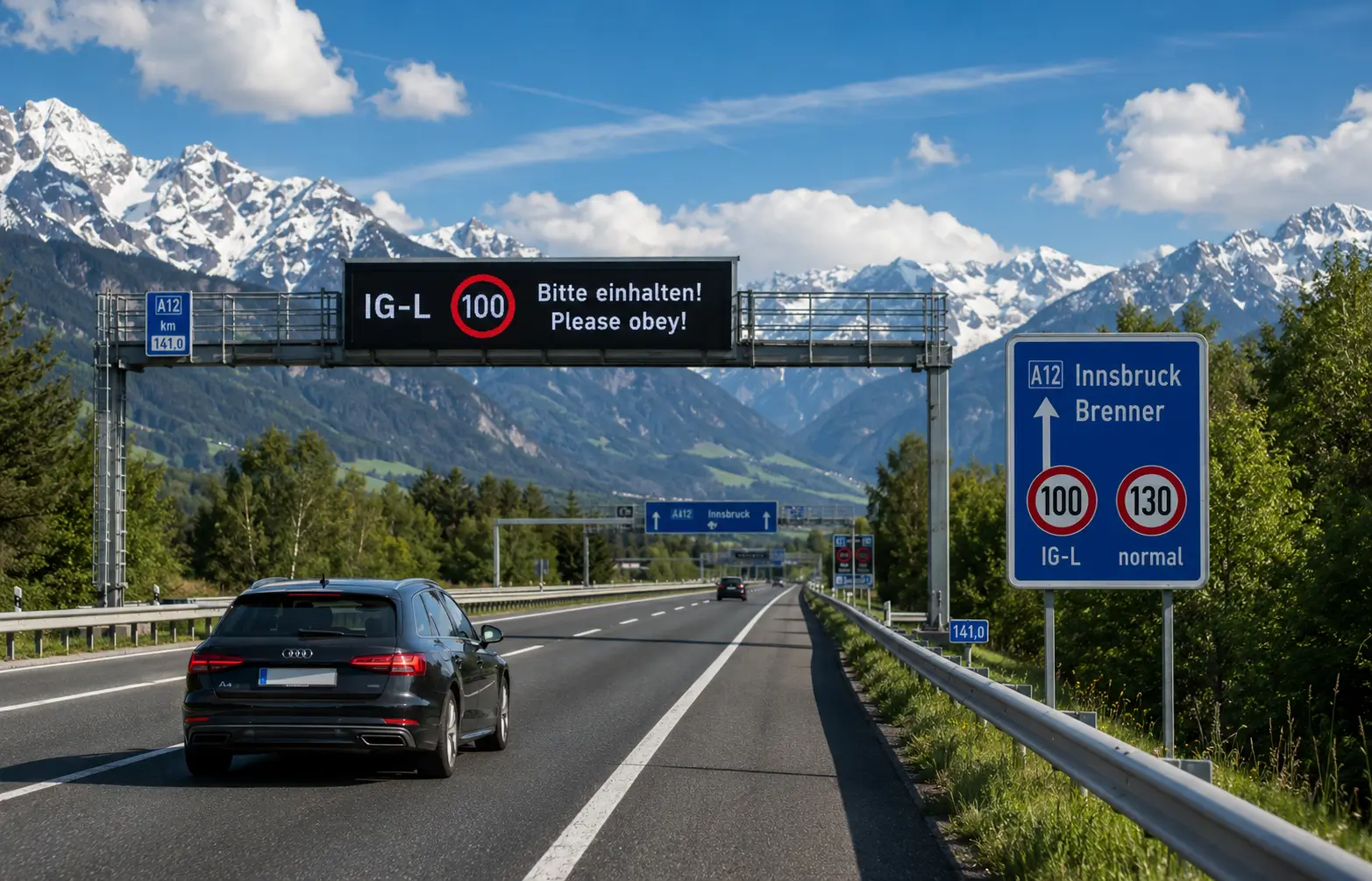
The speed limit in Austria is 50 km/h in towns, 100 km/h on rural roads and expressways, and 130 km/h on the motorway (Autobahn) for cars. Those are the headline numbers, but two things catch foreign drivers out: variable “IG-L” signs that quietly drop the motorway limit to 100, and a 2024 law that lets police seize a car for extreme speeding.
If you’re heading to the Alps for skiing, or just crossing Austria on the way to Italy or Croatia, the rules are stricter and the fines steeper than in many neighbouring countries. The good news is that the system is simple once you know where the limits change. This guide gives you every limit by road type, the current fines, how enforcement reaches a foreign plate, and the Pickerl (the Austrian motorway vignette) you need on the same roads.
Key Takeaways
- Cars: 50 km/h in town, 100 on rural roads and expressways, and 130 on the motorway.
- “IG-L” signs cut the Autobahn limit to 100 km/h for air quality, with higher fines, though electric cars are exempt.
- On-the-spot speeding fines start from about €20 and climb fast.
- Since 1 March 2024, extreme speeding can mean the car is impounded, and in the worst cases confiscated and auctioned.
- You also need a valid Pickerl on every Austrian motorway and expressway, on top of keeping to the limit.
Austria’s Speed Limits by Road Type
For a standard car or motorhome up to 3.5 tonnes, Austria uses four default limits. They apply unless a sign says otherwise, and signs always win.
| Vehicle | Town (Ortsgebiet) | Rural road | Expressway (Schnellstraße) | Motorway (Autobahn) |
|---|---|---|---|---|
| Car or motorhome up to 3.5t | 50 | 100 | 100 | 130 |
| Car with a light trailer | 50 | 100 | 100 | 100 |
| Car with a heavier trailer | 50 | 70 | 80 | 80 |
| Bus | 50 | 80 | 100 | 100 |
| Truck over 3.5t | 50 | 70 | 80 | 80 |
All figures are in km/h and come from the official Austrian citizen portal, oesterreich.gv.at.
A few points matter for visitors. The 130 km/h motorway limit is a maximum, not a target, and Austria has no unlimited stretches like the German autobahn. Towing a trailer drops your limit sharply, so a caravan or a loaded trailer changes the numbers above. There’s also a night rule: certain heavy goods vehicles are held to 60 km/h on some routes at night, mainly to cut noise in Alpine valleys.
If you’re planning a wider trip, the limits shift again the moment you cross a border. Our guides to Slovenia’s speed limits and how fast you can drive in Hungary cover two of the most common onward routes from Austria.
Variable Speed Zones (IG-L Tempo 100): The Foreign-Driver Trap
This is the rule almost no foreign guide explains, and it’s the one most likely to cost you money. On several motorways, a sign marked “IG-L” lowers the limit to 100 km/h to protect air quality. Locals call it the “Lufthunderter”, which roughly means the “air hundred”.
The trap is simple. An IG-L sign looks like an ordinary 100 km/h sign, so a visitor reads it as a normal limit. But the IG-L tag carries a different legal basis and noticeably higher fines than a standard speeding offence. You can be doing what feels like a sensible 120 on an empty motorway and still pick up a heavier penalty than the speed alone suggests.
Where the Lufthunderter applies
The best-known stretch is in Tyrol, on the A12 Inntal motorway and the A13 Brenner motorway toward Italy. On these routes the air-quality limit for cars has been made a permanent 100 km/h, so it applies day and night regardless of current pollution levels, as the Tyrol regional government sets out. Other regions can switch IG-L limits on during pollution spikes, shown on electronic signs. The rule is always the same: if the sign says IG-L, treat 100 as firm.
Why electric cars get a pass
Fully electric and hydrogen vehicles are exempt from the IG-L limit, including foreign cars on E-plates. Because the restriction exists to cut exhaust emissions, a zero-emission car may keep to the normal 130 km/h in an IG-L 100 zone. This exemption is confirmed by Austria’s mobility ministry, bmimi.gv.at. If you’re in a petrol or diesel car, the 100 limit applies to you.
Speeding Fines and the Raserei Tier
Austria handles ordinary speeding in two ways. Police can issue an on-the-spot summary fine (an “Organmandat”) of up to €90, and the authority can follow up with a penalty notice of up to €600 for a more serious offence, as set out by oesterreich.gv.at. Serious cases can also bring a driving ban. IG-L zones and repeat offences sit at the higher end.
| Offence | What you can expect |
|---|---|
| Minor speeding | On-the-spot summary fine (Organmandat) up to €90 |
| More serious speeding | Authority penalty notice up to €600, with a possible driving ban |
| Extreme speeding: more than 60 km/h over in town, or 70 km/h over on the open road | Fine of €500 to €7,500, and the car can be seized |
| First offence more than 80 km/h over in town, or 90 km/h over outside it | The car can be confiscated and auctioned |
When police can take your car
Since 1 March 2024, Austria has applied a much harder line on extreme speeding, often called the “Raserei” rule. Drive more than 60 km/h over the limit in a town, or more than 70 km/h over on an open road, and police can seize the vehicle on the spot. In the most serious or repeat cases, more than 80 km/h over in a town or 90 km/h over outside one, the car can be permanently confiscated and sold at auction. Fines in this tier run from €500 to €7,500, confirmed by the mobility ministry, bmimi.gv.at, under the 2024 reform of the road traffic act.
The rule still applies if you don’t own the car. A hire car or company vehicle can be seized too, and the driver can be banned from using that vehicle. The lesson for visitors is plain: Austria treats heavy speeding as a serious offence, not a minor ticket.
How Speed Is Enforced for Foreign Plates
Austria uses fixed cameras, mobile cameras, and average-speed checks through tunnels and roadworks, so a foreign plate is no shield. Many fines arrive by post weeks after the trip, sent to the address linked to your registration.
Within the EU, a cross-border directive lets Austrian authorities trace the keeper of a foreign-registered vehicle and send the penalty home. Enforcement is especially close between Austria and Germany, given the volume of traffic between them. For a minor fixed-camera fine you’ll usually get a letter. For a serious offence stopped at the roadside, the penalty is dealt with there and then.
It’s worth knowing the drink-drive limit too, since a roadside stop often checks both. Austria’s general blood-alcohol limit is 0.5 g/L (0.05%), dropping to 0.1 g/L for novice and professional drivers, per oesterreich.gv.at.
One practical tip: pay genuine fines promptly and keep the paperwork. Ignoring an Austrian penalty doesn’t make it disappear, and it can resurface on a later trip.
The Pickerl You Also Need on the Same Roads
Keeping to the limit is only half the job on Austrian motorways. To drive legally on any Autobahn or Schnellstraße, you also need a valid Pickerl, the Austrian motorway vignette, before you join the road. The speed limit and the vignette apply to exactly the same stretches.
The Pickerl is sold by duration rather than distance. The official validity periods set by the motorway operator ASFINAG are a 10-day pass, a 2-month pass, and an annual one. Austria has largely moved from the old windscreen sticker to a digital vignette linked to your number plate, which is why some drivers are unsure which version they hold. If that’s you, our explainer on the shift from sticker to digital vignettes clears it up.
What you’ll actually pay depends on the duration you choose and your vehicle type. You can check current prices and sort your Austria vignette before you travel, so it’s active the moment you reach the motorway. Driving those roads without one risks a separate fine, on top of any speeding penalty.
Winter and Seasonal Rules That Affect Speed
From 1 November to 15 April, Austria applies a situational winter-equipment rule, set out by the national tourist office, austria.info. When there’s snow, slush, or ice on the road, cars must have winter tyres on all four wheels, or snow chains fitted to at least two drive wheels. Winter tyres need an “M+S”, “M.S.”, or snowflake marking and a tread depth of at least 4 mm.
Conditions, not the calendar, trigger the rule, so a mild dry day in winter doesn’t force winter tyres. But Alpine weather changes fast, and a pass that was clear in the morning can be white by afternoon. If you’re carrying chains, note that they’re only allowed when the road is genuinely snow-covered, and snow or ice naturally means lower safe speeds than the posted limit.
The Short Version
Austria’s speed limits are straightforward once you know them: 50 km/h in town, 100 on rural roads and expressways, and 130 on the motorway for a car. The two things that surprise foreign drivers are IG-L “Tempo 100” zones, which cut the motorway limit with higher fines, and the 2024 Raserei law, under which extreme speeding can cost you the car.
Watch the signs, take any “IG-L” 100 seriously, and remember that winter and trailers lower your limits further. Sort your Pickerl before you set off, keep to the posted speed, and Austria is an easy and beautiful country to drive. Plan the limit and the vignette together, and there are no nasty letters waiting when you get home.
If your route carries on north, check the Czech Republic’s speed limits before you cross, as the limits and the toll sticker work differently again.
Frequently Asked Questions
Is Austria strict on speeding?
Yes. Austria has steep fines that climb quickly, and since March 2024 police can impound or even confiscate a car for extreme speeding. Average-speed cameras and a cross-border fine system mean foreign plates are traced too.
Does Austria have a motorway with no speed limit?
No. Unlike Germany’s autobahn, every Austrian motorway has a limit, usually 130 km/h for cars and lower where signs apply. There are no unlimited stretches.
What is an IG-L speed limit sign in Austria?
An IG-L sign is an air-quality speed limit, often Tempo 100 on the motorway. It looks like a normal 100 sign but carries higher fines. Fully electric and hydrogen cars are exempt and may keep to 130.
What happens if a foreigner gets a speeding fine in Austria?
The fine usually arrives by post at your home address, traced through your vehicle registration under an EU cross-border directive. Serious offences are handled at the roadside. Unpaid fines can catch up with you on a later visit.
Do I need a vignette as well as keeping to the speed limit?
Yes. A valid Pickerl is required on every Austrian motorway and expressway, separate from the speed limit. You can sort it online before you travel so it’s active when you reach the road.
Sources
- oesterreich.gv.at – Speed limits
- oesterreich.gv.at – Summary administrative penal proceeding (fines)
- bmimi.gv.at – Extreme speeding and vehicle confiscation
- bmimi.gv.at – IG-L and electric vehicles
- Tyrol regional government – IG-L permanent 100 km/h zones
- austria.info – Driving in Austria (winter equipment)
- oesterreich.gv.at – Drinking and driving (BAC limit)
- ASFINAG – Vignette and toll information
Ramis Kalkan
Ramis Kalkan leads growth at Vignetim. He writes about everything that makes European road trips smoother, from digital vignettes to eSIMs. Based in Ankara, usually mid-way through planning his next drive.