Speed Limits in Switzerland: What Foreign Drivers Need to Know
You cross from Germany still doing 130, but Switzerland caps the motorway at 120, and serious fines climb with your income. Here are the Swiss speed limits, the criminal Raser tier, and the vignette the same roads require.
 Ramis Kalkan
Updated: 9 min read
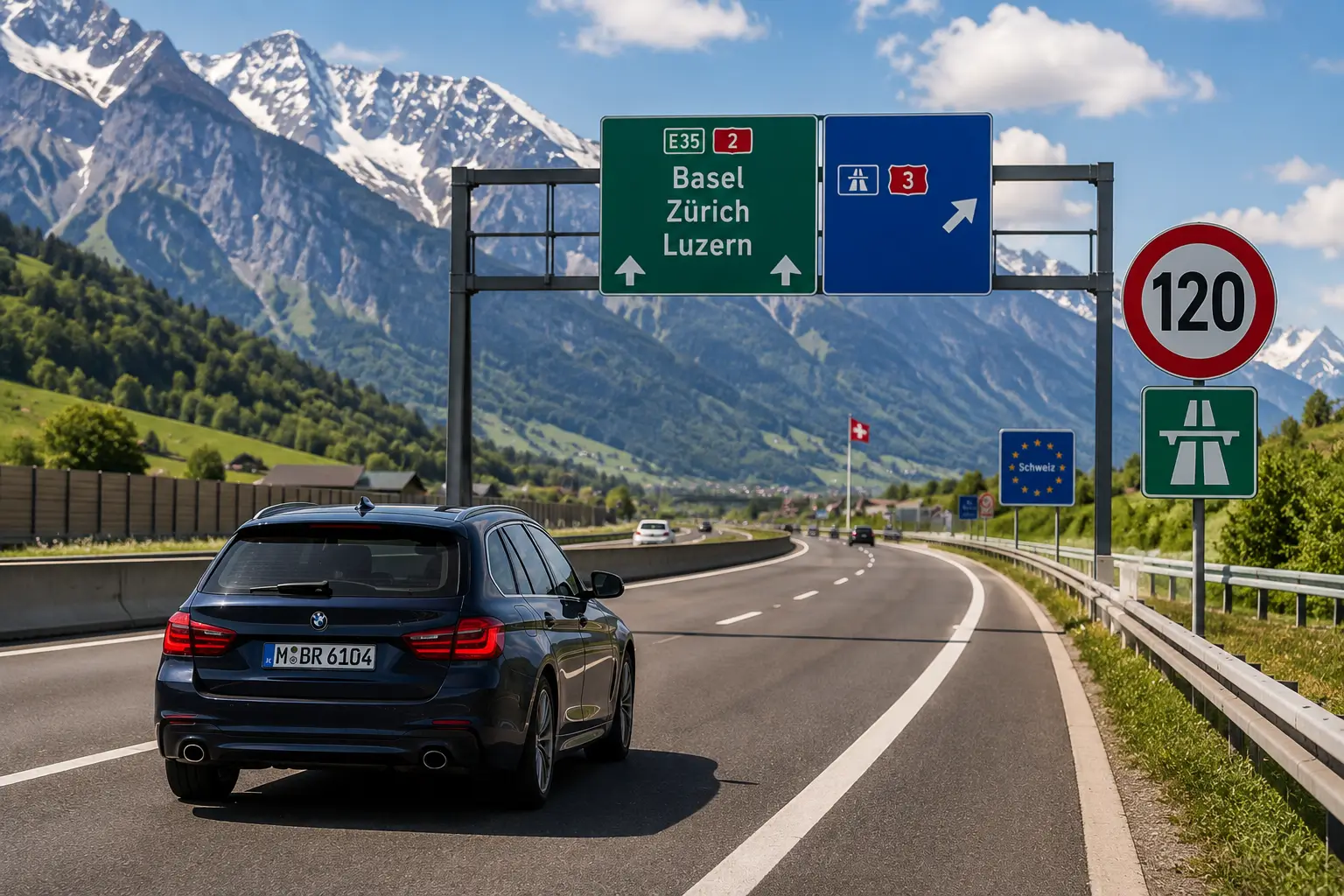
The speed limit in Switzerland is 120 km/h on the motorway, 100 km/h on expressways, 80 km/h outside towns, and 50 km/h in built-up areas. Lower limits apply wherever a sign or a 30 km/h zone says so.
That motorway figure is the trap. Germany, Austria and Italy all run 130, and parts of the German autobahn run with no limit at all. Cross into Switzerland on the same stretch of road and the ceiling drops to 120, but your right foot often doesn’t. Switzerland also enforces hard, with fines that can climb with your income and a criminal “Raser” tier that can put your car and your licence at risk.
This guide gives you every Swiss speed limit by road type, how the fines really work, when speeding becomes a crime, and the vignette the same motorways require. Every figure is sourced from official Swiss bodies and was checked in June 2026.
Key Takeaways
- The Swiss motorway speed limit is 120 km/h, not 130 like several neighbours.
- Default limits are 120 motorway, 100 expressway, 80 outside towns, 50 in towns, and 30 in marked zones.
- The blood alcohol limit is 0.5 grams per litre, and 0.0 for drivers in their first three years.
- Small overspeeds get a flat fine, but serious cases use income-based day-fines, so the same speed can cost far more for a high earner.
- Going 80 km/h or more over the motorway limit is a criminal “Raser” offence, with prison, a two-year minimum licence ban, and possible loss of your car.
Switzerland’s Speed Limits by Road Type
Switzerland uses four standard limits, plus lower limits in special zones. The local term changes by region, since the country has German, French and Italian-speaking areas, but the numbers are the same everywhere.
| Road type | Speed limit | Local term (German) |
|---|---|---|
| Motorway | 120 km/h | Autobahn |
| Expressway (semi-motorway) | 100 km/h | Autostrasse |
| Outside built-up areas | 80 km/h | Ausserorts |
| Built-up areas and towns | 50 km/h | Innerorts |
| Residential and school zones | 30 km/h (or 20 in a meeting zone) | Tempo-30-Zone |
A few details catch foreign drivers out. The 50 km/h town limit starts at the place-name sign, not at the first house, and it can appear suddenly as a main road enters a village. If you’re towing a trailer or caravan, your limit drops to 80 km/h even on the motorway. Always follow a posted sign when it shows a lower number than the table above.
These limits are set in federal law and have been stable for years, so the 120 km/h motorway figure is not a recent change. You can confirm the current rules on the official Swiss portal, ch.ch.
Why the Motorway Limit Is 120, Not 130
The single most common mistake foreign drivers make is carrying a 130 habit across the border. France, Italy, Austria and Slovenia all cap the motorway at 130, and on the open German autobahn there is often no limit at all. Switzerland sits in the middle of these countries, and the Swiss motorway speed limit holds at a firm 120.
It sounds like a small gap, but 10 km/h is enough to push you from a clean drive into a fine, especially on a long, quiet motorway where it is easy to drift upward. If you are coming off the German network or crossing from Slovenia’s motorways, reset your cruise control at the Swiss border. The same applies in reverse for drivers used to the Czech Republic’s 130 limit.
How the measurement tolerance works
Swiss police don’t fine you on the raw number a camera shows. They first deduct a security margin for measurement error, so the fine is based on a figure a few km/h below your measured speed. A laser reading of 87 km/h, for example, is assessed at 84 after a 3 km/h deduction. The exact amount depends on the device used and the speed involved.
This is helpful to know, but don’t treat it as a free buffer. The tolerance covers equipment accuracy, not a deliberate choice to sit above the limit.
Speeding Fines and How Switzerland’s Income-Linked System Actually Works
Switzerland has a reputation for enormous, salary-based speeding fines. That reputation is half right, and the half that people get wrong matters. Minor speeding gets a flat fine. Income only enters the picture once you cross into the serious tier.
Fixed fines for minor speeding
For small overspeeds, the police issue a fixed fine on the spot. The amount depends only on how far over you were and the road type, not on your earnings. These flat fines run up to a set ceiling per case.
| Over the limit | In town (50) | Outside town (80) | Motorway (120) |
|---|---|---|---|
| 1 to 5 km/h | CHF 40 | CHF 40 | CHF 20 |
| 6 to 10 km/h | CHF 120 | CHF 100 | CHF 60 |
| 11 to 15 km/h | CHF 250 | CHF 160 | CHF 120 |
| 16 to 20 km/h | summons | CHF 240 | CHF 180 |
| 21 to 25 km/h | summons | summons | CHF 260 |
The flat fine stops at 15 km/h over in town, 20 km/h over outside town, and 25 km/h over on the motorway. Past that point you get a court summons instead of a fixed fine, and the case can move toward a licence withdrawal.
When fines become income-based
Once you pass the fixed-fine threshold, the offence is no longer a simple ticket. Serious cases are punished with day-fines, where the daily rate is set from your income and wealth. The same speed can therefore cost a modest amount for one driver and a very large sum for a high earner.
The widely shared stories of six-figure penalties come from this tier, applied to wealthy drivers in extreme cases, not from a routine motorway slip. The honest summary is simple. Stay near the limit and your fine is flat and predictable. Push well past it and it can scale with your bank balance.
The Raser Law: When Speeding Becomes a Criminal Offence
Switzerland treats extreme speeding as a crime, not a traffic matter. The rules sit in Article 90 of the Road Traffic Act, often called the Raser law after the German word for a reckless speeder. Cross these margins and you face criminal proceedings.
| Where the limit is | It becomes a Raser offence at |
|---|---|
| 30 km/h zone | 40 km/h or more over |
| 50 km/h (town) | 50 km/h or more over |
| 80 km/h (outside town) | 60 km/h or more over |
| 120 km/h (motorway) | 80 km/h or more over |
On the motorway, that last line means a recorded speed of 200 km/h or more. The penalties are heavy. A Raser conviction can bring a prison sentence of one to four years, a licence withdrawal of at least two years, and confiscation of the vehicle, which can then be sold or scrapped.
A 2023 change to the law gave courts a little more room to soften the sentence in mitigating cases, but the thresholds and the power to seize the car still stand.
For a visiting driver, the practical message is to keep a wide margin on fast, empty roads. The line between a fine and a criminal record is closer than it looks.
How Enforcement Reaches Foreign Plates
Switzerland runs a dense network of fixed cameras, mobile radar, and average-speed checks through tunnels and roadworks. A foreign plate is no shield. The country shares data and uses debt-collection routes that can follow you home, and an unpaid Swiss fine can resurface the next time you enter the country.
The drink-driving rules are enforced just as firmly. The general blood alcohol limit is 0.5 grams per litre. For drivers in their first three years on a licence, plus learners and professional drivers, the limit is zero. You can check the current alcohol rules on ch.ch. Treat “I’ll be back across the border by then” as a plan that doesn’t work here.
The Swiss Vignette You Also Need, and Liechtenstein Cover
The same motorways where the 120 limit applies also require a motorway vignette. Without one, you can be fined on top of any speeding penalty, so it belongs on your pre-trip checklist.
Three things make the Swiss vignette different from most of its neighbours. It is annual only, with no 10-day or monthly option, so even a single day of transit needs the full-year vignette. Sort your Swiss motorway vignette before you travel and choose either the traditional sticker or an e-vignette linked to your number plate. It also covers Liechtenstein, so you don’t need a separate vignette for that short stretch.
Winter and Alpine Rules That Affect Your Speed
Switzerland has no blanket law forcing winter tyres on a fixed date. The catch is liability. If your car cannot cope with the conditions and you cause an obstruction or a crash, you can be fined and held responsible, so winter tyres are strongly advised from roughly October to spring. Snow chains are required where a blue sign shows them, and you must fit them before that section.
Speed limits do not change in the mountains, but the safe speed often does. On narrow alpine passes, a vehicle going uphill usually has priority, and many tunnels carry their own posted limit and minimum-distance rules. In poor visibility or on a wet pass, the legal limit is a ceiling, not a target.
The Short Version
The speed limit in Switzerland is 120 on the motorway, 100 on expressways, 80 outside towns, and 50 in them, with 30 zones in residential areas. The motorway figure is lower than in Germany, Austria and Italy, so reset your habits at the border. Small overspeeds bring a flat fine, but serious cases use income-based day-fines, and going 80 over on the motorway is a criminal Raser offence with prison, a two-year licence ban, and the loss of your car.
Before you drive, get your vignette sorted, keep a clear margin under every limit, and remember the zero alcohol rule for newer drivers. Do that, and Switzerland is one of the calmest, best-maintained countries to drive across in Europe. Heading on through Central Europe? The same border-reset habit applies to speed limits in Slovakia, where the motorway limit climbs back to 130.
Frequently Asked Questions
What is the speed limit on Swiss motorways?
The motorway speed limit in Switzerland is 120 km/h for cars. If you tow a trailer or caravan, your limit drops to 80 km/h, even on the motorway. Always follow a posted sign when it shows a lower number.
Is Switzerland strict with speeding?
Yes. Switzerland enforces limits with fixed, mobile and average-speed cameras, and penalties rise quickly. Minor overspeeds bring a flat fine, but serious cases use income-based day-fines and can lead to a licence ban or criminal charges.
Are Swiss speeding fines really based on your income?
Only above a certain point. Small overspeeds get a flat fine that ignores your income. Once you pass that threshold, the case moves to day-fines set from your income and wealth, which is why a few cases have produced very large penalties.
What happens if you drive 200 km/h in Switzerland?
A recorded 200 km/h on a 120 motorway is a criminal Raser offence. It can bring a prison sentence of one to four years, a licence withdrawal of at least two years, and confiscation of your vehicle.
Do I need a vignette to drive in Switzerland?
Yes. A motorway vignette is required to use Swiss motorways and is sold as an annual product only. You can choose a sticker or an e-vignette linked to your plate, and the same vignette also covers Liechtenstein.
What is the drink-drive limit in Switzerland?
The general blood alcohol limit is 0.5 grams per litre. Drivers in their first three years, plus learners and professional drivers, must stay at zero.
Sources
Ramis Kalkan
Ramis Kalkan leads growth at Vignetim. He writes about everything that makes European road trips smoother, from digital vignettes to eSIMs. Based in Ankara, usually mid-way through planning his next drive.