Speed Limits in Slovakia: What Foreign Drivers Need to Know
Slovakia caps cars at 130 on motorways and 50 in town, runs a zero-alcohol rule, and charges for the eznámka on every motorway kilometre. A short, sourced guide to the limits, fines, and the 1 May 2026 changes foreign drivers should know.
 Ramis Kalkan
Updated: 7 min read
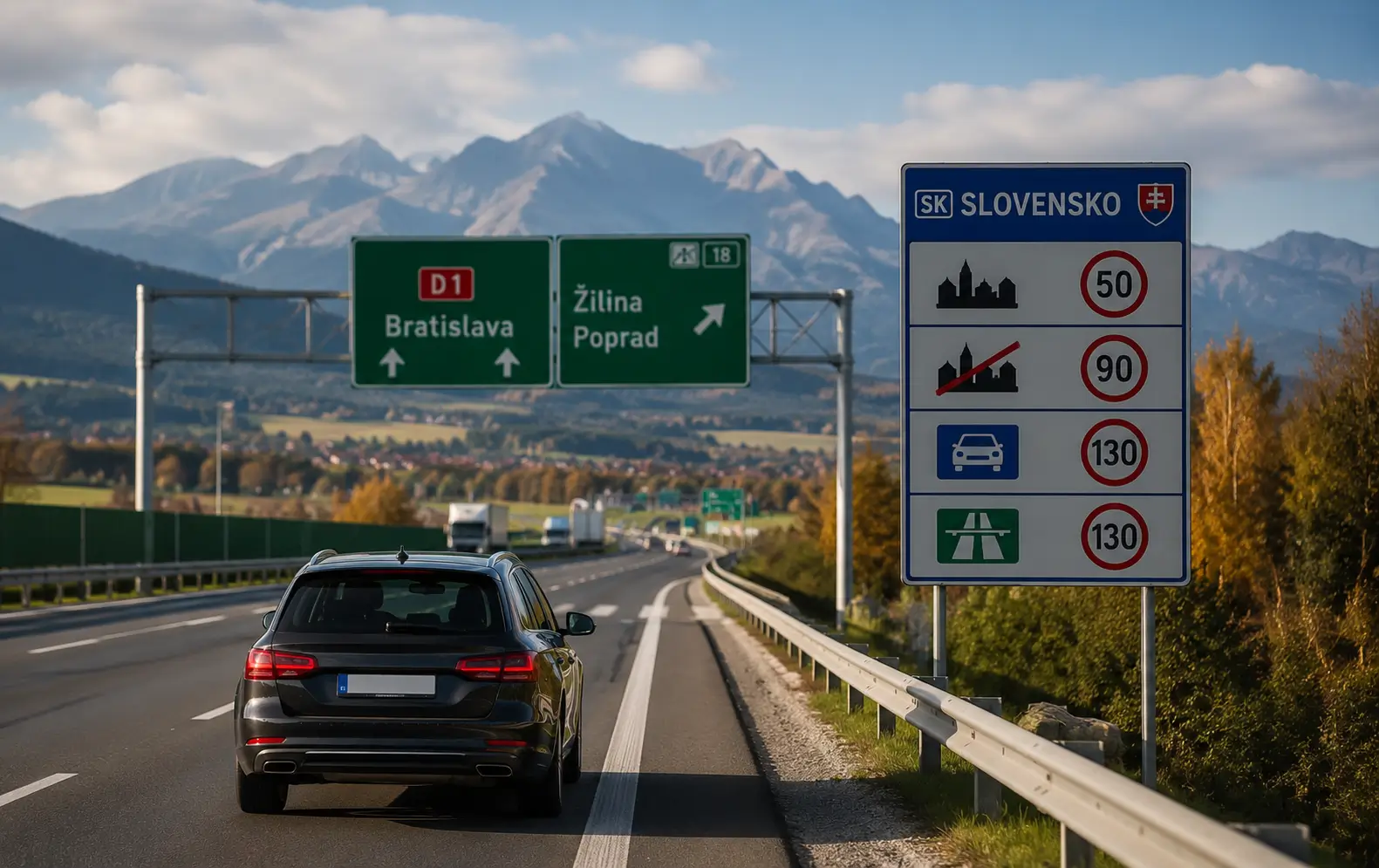
Slovakia’s speed limit is 130 km/h on motorways and expressways, 90 km/h on rural roads, and 50 km/h in built-up areas. The country runs a zero-alcohol policy and charges for the e-vignette on every motorway kilometer.
On 1 May 2026, Slovakia tightened the rules further. The thresholds that trigger the highest speeding fines dropped, and police can now confiscate your licence on the spot.
Most foreign drivers assume Slovak rules are the same as Czech rules. They’re not. Below is what changes for you at the border: the by-road-type limits, the current fines, the zero-alcohol policy, the eznámka (which is no longer free), and the winter-tyre rule that catches a lot of visitors out.
Key Takeaways
- Motorway and expressway: 130 km/h. Rural: 90 km/h. Town: 50 km/h. The same 130 limit applies on motorways that pass through built-up areas (the old 90 km/h reduction was abolished in July 2022).
- BAC limit: 0.0 g/L. Zero tolerance. Up to 0.5 g/L is administrative (€150 to €800, ban up to 3 years). Above 0.5 g/L is criminal.
- Speeding rules tightened on 1 May 2026. The heavy bracket (on-the-spot €250 to €800, administrative €500 to €1,000) now starts at +31 km/h in town and +41 km/h outside (down from +51 and +61), and police can withdraw your licence on the spot.
- You need a vignette on every motorway and expressway. The eznámka is plate-linked and bought online. It is not free in 2026.
- Winter tyres are situational for cars (required only when there is snow, ice, or slush on the road) and calendar-based for trucks (15 November to 15 March).
Slovakia’s Speed Limits by Road Type
The Slovak limits are straightforward and apply nationally unless lower limits are posted. Local signs, roadworks, and weather always override the table.
| Road type | Cars (up to 3.5 t) | Trucks and buses (over 3.5 t) |
|---|---|---|
| Built-up area (obec) | 50 km/h | 50 km/h |
| Rural road / first-class road | 90 km/h | 90 km/h |
| Expressway (rýchlostná cesta) | 130 km/h | 100 km/h |
| Motorway (diaľnica) | 130 km/h | 100 km/h |
| Motorway through a built-up area | 130 km/h | 100 km/h |
Two practical notes for foreign drivers. First, motorways and expressways are treated the same way: same speed limit, same eznámka requirement. Second, the 90 km/h reduction on motorways passing through built-up areas was abolished in July 2022, so 130 stays 130 even on urban motorway sections (unless signs say otherwise).
Vehicles with a trailer over 750 kg follow the truck column.
Speeding Fines and How They Reach You
Slovakia splits speeding fines into two procedures and three bands. The procedure matters: an on-the-spot fine (blokové konanie, capped at €800) is settled by the officer at the roadside. An administrative-proceedings fine (správne konanie, capped at €1,000) is issued later by post and is the one that follows a foreign-plated car home through the EU Cross-Border Enforcement framework.
From 1 May 2026, the thresholds at which each band kicks in dropped, and police gained on-the-spot licence-withdrawal powers.
In built-up areas (cars), from 1 May 2026:
| Over the limit | On-the-spot (blokové) | Administrative (správne) |
|---|---|---|
| Up to +15 km/h | up to €50 | up to €100 |
| +16 to +30 km/h | €30 to €400 | €150 to €600 |
| +31 km/h or more | €250 to €800 | €500 to €1,000, plus on-the-spot licence withdrawal |
Outside built-up areas and on motorways (cars), from 1 May 2026:
| Over the limit | On-the-spot (blokové) | Administrative (správne) |
|---|---|---|
| Up to +25 km/h | up to €50 | up to €100 |
| +26 to +40 km/h | €30 to €400 | €150 to €600 |
| +41 km/h or more | €250 to €800 | €500 to €1,000, plus on-the-spot licence withdrawal |
A worked example: drive at 70 km/h through a 50 km/h village (so +20 over) and you fall in the middle band, with an on-the-spot fine somewhere between €30 and €400 at officer discretion. On a motorway, the same heavy band only triggers at 171 km/h or more (+41 over the 130 limit).
There is no penalty-points system, but police can take your licence after three administrative offences of more than €60 within 12 months. Slovakia is in the EU Cross-Border Enforcement framework (Directive 2015/413), so an administrative-procedure fine can be pursued in your home country.
The “Slovakia is the same as Czechia” mistake costs people money here. The Czech motorway limit, fine structure, and vignette price are all different. Don’t carry Czech assumptions across the border.
The Zero-Alcohol Rule
Slovakia’s legal blood-alcohol limit is 0.0 g/L. Zero tolerance applies to every driver, with no novice or professional split, and to cyclists on public roads.
The penalty structure is two-tier:
- Up to 0.5 g/L: administrative offence. Fine €150 to €800, driving ban up to 3 years.
- Above 0.5 g/L: criminal offence. Fine up to €330,000 (means-tested), driving ban 1 to 10 years (potentially lifetime), imprisonment up to 12 years.
Foreign drivers sometimes assume “zero tolerance” means a small drink is overlooked. It is not. Roadside breath tests are routine. If you’ve had a drink the night before and you’re on the road early, you can still be over the limit.
The Slovak e-Vignette You Also Need
If you use any motorway or expressway in Slovakia, you need a valid eznámka (the Slovak e-vignette). It is plate-linked and digital. There is no physical sticker.
Is it still free? No. Slovakia waived the car vignette during a 2024 transitional window. In 2026 the eznámka is paid again, with statutory prices set by NDS (the National Motorway Company). Enforcement is camera-based, with roadside patrol checks against the NDS database.
You can choose from short and long validity tiers: a few days, a month, or a year. To see the current price you’ll actually pay, including any service fee, check Vignetim’s Slovak vignette page. Since Slovakia is fully digital, the buying process is the same as in any of the other digital-vignette countries: pick the dates, enter the plate, pay, and you’re covered before you join the motorway.
A note on terminology. Slovakia is a vignette country, not a distance-tolled one for cars. The truck system (e-myto) is separate and runs on a different model. If you’re driving a passenger car, you only need the eznámka.
Winter Rules That Trigger Lower Limits
Slovakia splits its winter-tyre rule by vehicle class:
- Cars (up to 3.5 t): situational. Winter tyres (M+S or 3PMSF) are required only when there is a continuous layer of snow, ice, or slush on the road. There is no calendar requirement for cars.
- Trucks (over 3.5 t) and buses: calendar. Winter tyres are required 15 November to 15 March, regardless of conditions.
- Minimum tread depth: 3 mm.
- Penalty: typically €50 on the spot, up to €100 in administrative proceedings, up to €150 in total.
A foreign-driver tip: even though cars are technically situational, police can stop you if the conditions clearly call for winter tyres and you’re on summers. If your trip touches the High Tatras, Veľká Fatra, or any mountain pass from late November onward, fit winter tyres. The same is true for Slovenia, where the speed limits and the vinjeta apply in parallel just like Slovakia’s framework here.
Final Thoughts
Slovak rules are simpler than most foreign drivers expect, but the details matter. Motorway 130, rural 90, town 50. Zero alcohol. A paid eznámka on every motorway kilometer. Situational winter tyres for cars. And from 1 May 2026, tighter speeding rules with on-the-spot licence withdrawal.
If you’re crossing into Slovakia, sort the eznámka before you join the motorway and stick to the posted limits, especially in built-up sections where they drop fast. You can pick up your Slovak vignette in a few minutes and keep your travel documents in one place. Then enjoy the drive.
Frequently Asked Questions
What is the speed limit on Slovak motorways?
130 km/h for cars, including on motorway sections that pass through built-up areas. The old 90 km/h reduction on urban motorways was abolished in July 2022.
Is the Slovak e-vignette still free for cars?
No. It was free during a transitional period in 2024 and is paid again in 2026. Buy online and link it to your plate before you join the motorway. Vignetim’s Slovak vignette page shows the current price.
What is Slovakia’s drink-drive limit?
0.0 g/L for every driver, with no exceptions. Up to 0.5 g/L is administrative; above 0.5 g/L is a criminal offence.
Are Slovak and Czech traffic rules the same?
No. The motorway limits, fine brackets, and vignette pricing are all different. Don’t assume Czech rules carry across the border.
Do I need winter tyres in Slovakia?
As a car driver, only when there is snow, ice, or slush on the road. Trucks and buses must fit winter tyres from 15 November to 15 March regardless of conditions.
Will a Slovak speeding fine reach me at home?
Yes. Slovakia uses the EU Cross-Border Enforcement framework (Directive 2015/413). A fine issued against your foreign-plated car can be pursued in your home country.
Sources
- Národná diaľničná spoločnosť (NDS), issuing authority for the eznámka and motorway operator
- eznámka, official portal, statutory pricing and enforcement rules
- Slovak Ministry of the Interior, proposed sanctions for speeding and phone use at the wheel, source for the 1 May 2026 amendment, lowered thresholds, and on-the-spot licence withdrawal
- Zákon č. 8/2009 Z.z. o cestnej premávke, primary Slovak road traffic law and the fine framework (§ 137)
- European Transport Safety Council, Drink-driving in Slovakia, BAC limit and penalty schedule
- EU Cross-Border Enforcement Directive 2015/413, the framework that makes Slovak administrative-procedure fines enforceable against foreign plates
- US Embassy in Slovakia, Driving in Slovakia, foreign-driver context
Ramis Kalkan
Ramis Kalkan leads growth at Vignetim. He writes about everything that makes European road trips smoother, from digital vignettes to eSIMs. Based in Ankara, usually mid-way through planning his next drive.