Speed Limits in the Czech Republic: What Foreign Drivers Need to Know
You cross from Germany on the D5 at 130, then meet a stretch of the D3 where the signs say 150. Czech limits shift fast, the alcohol rule is absolute zero, and the fines got steeper in 2024. Here’s the full picture for foreign drivers.
 Ramis Kalkan
Updated: 8 min read
The speed limit in the Czech Republic for cars is 50 km/h in built-up areas, 90 km/h outside towns, 110 km/h on expressways, and 130 km/h on motorways. One stretch of motorway now allows 150 km/h under a live trial, and the alcohol rule is an absolute 0.0.
Most foreign drivers arrive from Germany on the D5 toward Prague, or from Austria and Slovakia in the south, and assume the motorway number holds all the way. It doesn’t. The limit drops to 90 the moment a motorway ends and a first-class road begins, and to 50 at the edge of every town. Speed cameras sit exactly where those limits change, and the fines got steeper after the 2024 traffic-law reform.
This guide covers the full speed limit in the Czech Republic by road type, the new 150 km/h pilot on the D3, the 2026 fines, the zero-alcohol rule, and the e-známka you’ll also need on the motorway. Every figure here traces to an official source.
Key Takeaways
- Czech car limits: 50 km/h in town, 90 outside town, 110 on expressways, 130 on motorways.
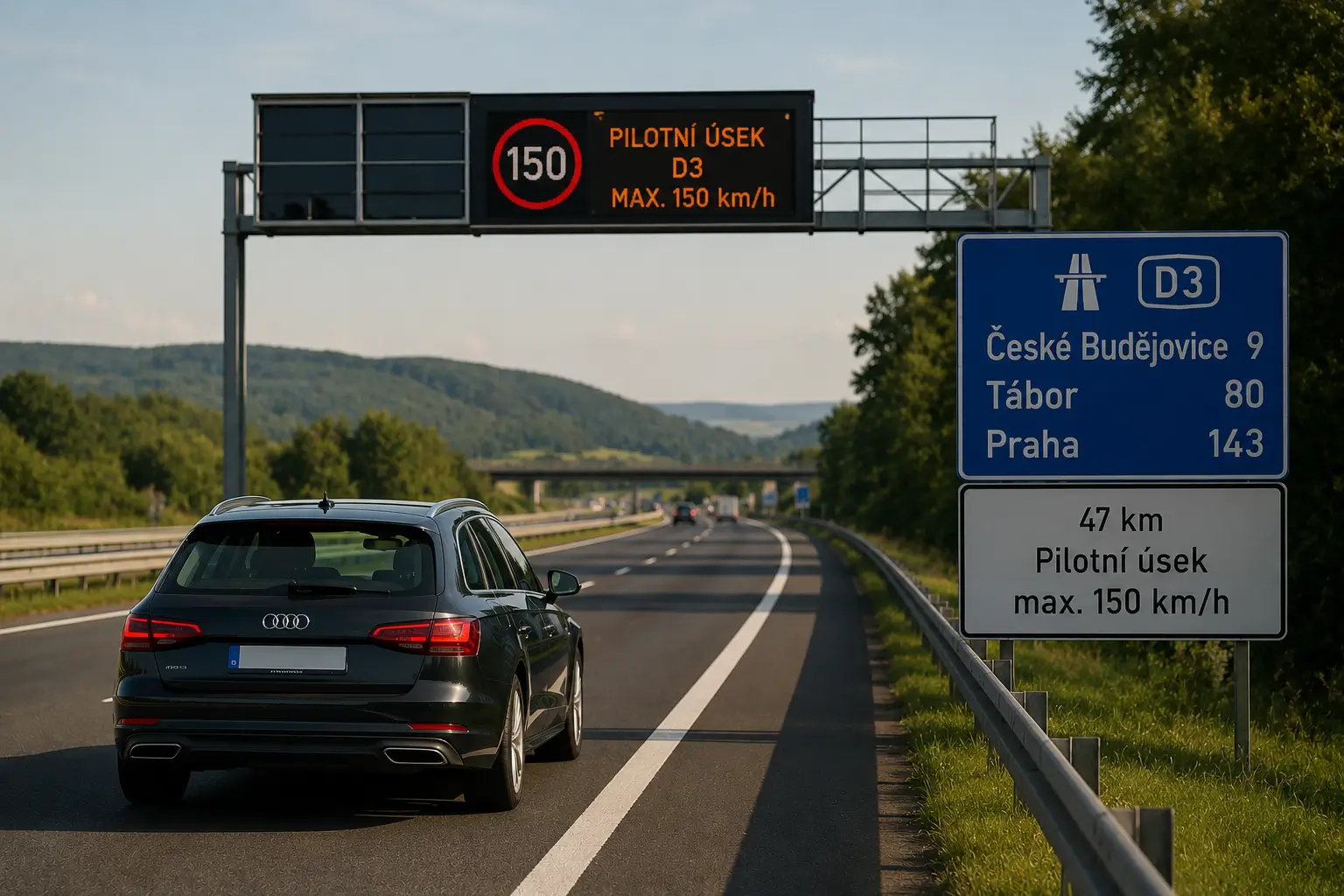
- A 150 km/h trial runs on a 47 km section of the D3 near České Budějovice, on variable signs, extended to the end of 2026. It only shows 150 in good conditions.
- The drink-drive limit is 0.0. Any trace of alcohol is an offence, with fines from around 7,000 CZK (about €280).
- Speeding fines rose under the 2024 reform. The worst brackets reach around 25,000 CZK (about €1,000) plus penalty points and a driving ban.
- You also need an e-známka (digital vignette) to use Czech motorways. There is no sticker. It is linked to your plate.
The Czech Republic’s Speed Limits by Road Type
These are the default limits for cars and vehicles up to 3.5 tonnes, set out in Act No. 361/2000 Coll. and summarised by the European Commission’s Your Europe portal. Local signs always override the defaults.
| Road type | Cars (up to 3.5t) | In a built-up area |
|---|---|---|
| Built-up area (town) | 50 km/h | 50 km/h |
| Outside built-up areas | 90 km/h | – |
| Expressway (silnice pro motorová vozidla) | 110 km/h | 80 km/h |
| Motorway (dálnice) | 130 km/h | 80 km/h |
| Residential / pedestrian zone | 20 km/h | 20 km/h |
A few things that catch foreign drivers out:
- The built-up area rule starts at the white town-name sign, not the first house. The 50 limit holds until the same sign appears crossed out.
- Both the motorway (dálnice) and the expressway (silnice pro motorová vozidla) drop to 80 km/h where they pass through a built-up area, which happens around some city bypasses.
- Many roads that look like motorway on a map are first-class single carriageways, where the 90 km/h rural limit applies even when traffic moves faster.
- A car towing a trailer is capped lower, and vehicles with snow chains fitted are limited to 50 km/h.
The 150 km/h Pilot on the D3 (and What It Means)
The Czech Republic is testing a 150 km/h limit on a 47 km section of the D3 motorway between the Planá nad Lužnicí and Úsilné junctions, near České Budějovice. The road authority ŘSD launched the trial on 5 October 2025, and it has been extended to the end of 2026 while the data is reviewed.
The 150 figure is not a free pass. The section uses variable-message signs, and 150 only appears when conditions are right: dry road, clear weather, free-flowing traffic, and no roadworks. The rest of the time the same signs show 130 or lower. A second section on the D11 near Hradec Králové has been discussed, but it is not approved and depends on how the D3 trial performs.
The practical rule for a foreign driver is simple. Drive to the number on the sign above the lane, not the number in a headline. If the sign shows 130, the limit is 130, even on the D3.
Speeding Fines and the 0.0 Alcohol Rule
Czech speeding penalties became tougher under the traffic-law reform that took effect on 1 January 2024. There are two tracks. A police patrol can issue an on-the-spot fine, and more serious cases go to a full administrative procedure with higher penalties, penalty points, and a possible driving ban. The Czech Republic still uses the koruna (CZK), so the euro figures below are rough conversions for reference.
The most serious speeding (more than 40 km/h over the limit in a town, or more than 50 km/h outside) reaches around 25,000 CZK (about €1,000), with penalty points and a licence suspension on top, per BESIP and Act No. 361/2000. Smaller overspeeds carry lower fines, but the camera tolerance is minimal, so a “few km/h over” is not the safe margin some drivers assume.
The alcohol rule leaves no room at all:
- The Czech drink-drive limit is 0.0. Any measurable alcohol in your breath or blood is an offence.
- A positive reading carries a fine from around 7,000 CZK (about €280) and can reach 75,000 CZK (about €3,000) for higher levels, with penalty points and a ban, as set in Act No. 361/2000 Coll.
- Refusing a breath test is treated as the most serious case, with a fine up to 75,000 CZK.
Foreign-plate fines do not disappear at the border. The Czech Republic shares driver details with other EU countries under the EU’s cross-border enforcement framework, so a camera fine can follow you home.
The Vignette You Also Need (e-známka)
To use a Czech motorway you need a valid e-známka, the country’s digital vignette. The Czech Republic dropped the windscreen sticker in 2021. The vignette is now linked to your registration plate, and roadside cameras check it automatically.
The e-známka is one of many European vignette systems, so on a longer trip across the continent you’ll often need more than one. Cars and vehicles up to 3.5 tonnes use the time-based vignette, sold in short-term, monthly, and annual tiers. Heavier vehicles use a separate distance-based toll, not the vignette.
If you’re driving a car, the vignette is all you need on the motorway. For current prices and validity options, sort your Czech vignette (e-známka) before you cross the border.
Winter Tyres and Mandatory Equipment
The Czech winter-tyre rule is conditional, not a fixed-date blanket rule. Between 1 November and 31 March, you must fit winter tyres when there is snow, ice, or slush on the road, or when those conditions can be expected, according to Your Europe and the Czech Ministry of the Interior. On a clear, dry winter day the rule may not bite, but conditions in the highlands change fast, so winter tyres for the whole window are the safe choice.
A few more rules apply year-round:
- Daytime running lights are mandatory at all times, even in summer.
- A first-aid kit must be carried in the car.
- Snow chains must be used where a sign requires them, and the limit drops to 50 km/h when they are fitted.
This is also where driving in Czechia differs from its neighbours. Drivers often treat the Czech Republic and Slovakia as the same place, but the rules are not identical. Our guide to Slovakia’s speed limits covers the differences for the next leg, and if your route runs on toward Budapest, the speed limits in Hungary change again.
Conclusion
The speed limit in the Czech Republic is straightforward once you know the four bands: 50 in town, 90 outside town, 110 on expressways, and 130 on motorways. Watch for the 80 km/h drop where a motorway runs through a city, the variable 150 signs on the D3, and the cameras at every limit change. Keep your alcohol level at a true zero, and remember the 2024 reform made the fines bite harder.
The motorway is also where you need the e-známka, linked to your plate before you drive. If you’re crossing several countries, sort the Czech one alongside the rest so the whole route is covered before you leave.
Ready to drive? Get your Czech Republic vignette sorted before you reach the first motorway sign.
Frequently Asked Questions
What is the speed limit on Czech motorways?
The speed limit on Czech motorways (dálnice) is 130 km/h for cars. A 47 km section of the D3 near České Budějovice is trialling 150 km/h on variable signs until the end of 2026, but it only shows 150 in good weather and free-flowing traffic. Where a motorway passes through a built-up area, the limit drops to 80 km/h.
Is the speed limit in the Czech Republic 150 km/h now?
Not generally. The standard motorway limit is still 130 km/h. A single 47 km section of the D3 motorway is testing 150 km/h under a pilot extended to the end of 2026, and only on variable-message signs in good conditions. Everywhere else, 130 is the maximum.
What is the drink-drive limit in the Czech Republic?
The Czech drink-drive limit is 0.0. Any measurable alcohol is an offence. Fines start at around 7,000 CZK (about €280) and reach 75,000 CZK (about €3,000) for higher readings, with penalty points and a possible driving ban. There is no “one beer” allowance.
Do I need a vignette to drive in the Czech Republic?
Yes, if you use the motorways. The Czech Republic requires a digital vignette (e-známka) linked to your plate for cars on the motorway network. There is no physical sticker. You can sort it before you cross the border.
Are winter tyres mandatory in the Czech Republic?
Between 1 November and 31 March, winter tyres are required when there is snow, ice, or slush on the road, or when such conditions can be expected. It is a condition-based rule rather than a fixed date, but fitting winter tyres for the whole window is the safe approach.
Do Czech speeding fines reach foreign drivers at home?
Yes. The Czech Republic exchanges driver details with other EU countries under the cross-border enforcement framework, so a camera fine can be sent to your home address. Fines rose under the 2024 reform, with the worst speeding reaching around 25,000 CZK plus penalty points and a ban.
Sources
Ramis Kalkan
Ramis Kalkan leads growth at Vignetim. He writes about everything that makes European road trips smoother, from digital vignettes to eSIMs. Based in Ankara, usually mid-way through planning his next drive.