Winter Tyres Belgium: What the Law Actually Requires
Belgium has no winter-tyre law, yet it is one of the few western European countries that still permits studded tyres. Most sites get the stud rule backwards. Here is what the Wegcode actually says.
 Ramis Kalkan
Updated: 9 min read
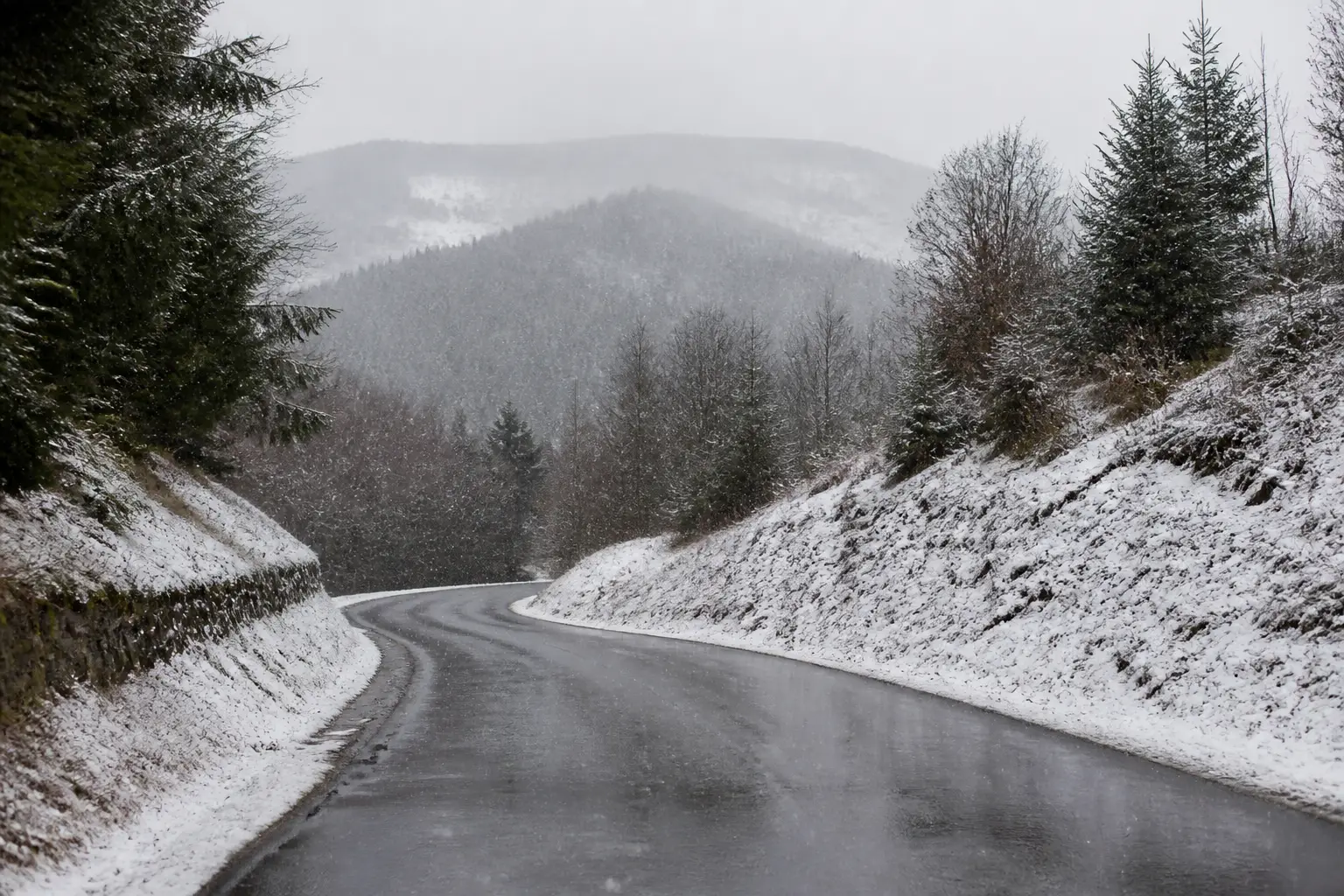
No. Belgium has no winter-tyre law, calendar or situational, for cars, vans, lorries, buses, trailers or motorhomes (Wegcode, verified 2026-09-11). Skip winter tyres and nothing happens on that count, but the general 1.6 mm tread floor, plus the chain and stud rules below, still apply to you, Belgian plate or foreign.
That puts Belgium in a small group with no duty at all, alongside the Netherlands, Ireland, Portugal and the United Kingdom. See our winter tyre rules across Europe guide for all six regimes drivers actually meet on the continent.
Belgium’s road charging is just as unusual: cars pay nothing on Belgian motorways today, a status our guide to driving in Belgium covers alongside the low-emission zones that catch far more foreign drivers than any tyre rule does. Check Belgium’s speed limits too before a winter drive.
Key Takeaways
- No winter-tyre duty for any vehicle class. The only mandatory figure is the year-round 1.6 mm tread floor.
- Snow chains may be fitted only in snow or black ice, a permission, not a duty.
- Studded tyres are banned by default, but a standing 1976 order permits them from 1 November to 31 March.
- Foreign plates are bound by the Wegcode’s tread, chain and stud rules, but not by the narrower Belgian-plated rule in KB 1968.
- The real roadside cost of a tread violation is €64, not the €2,000 ceiling everyone quotes.
What Belgian Law Actually Requires
The core rule sits in one article. Wegcode Art. 81.4.4 states: “Slechts bij sneeuw of ijzel mogen de banden van sneeuwkettingen voorzien worden. Spijkerbanden zijn verboden.”
In English: tyres may be fitted with snow chains only in snow or black ice, and studded tyres are prohibited. That is a permission and a default ban, not an order to fit anything.
Two calendar windows exist, and both are permissive, not mandatory. Studded tyres are allowed 1 November to 31 March.
A narrower window lets Belgian-plated cars run a downrated M+S tyre 1 October to 30 April (KB 1968 Art. 34 §3 1°). Neither creates a duty.
The rule is also moving house. From 1 June 2027, Belgium’s road code splits regionally: Flanders (BVR 2024, Art. 42), Brussels (BBHR 2024, Art. 23) and Wallonia (BWR 2025, Art. 15 §2).
Each region keeps the same chain and stud text, just under a new regional minister.
Cars, Vans, Lorries, Buses and Trailers: Where the Rules Differ
The “no duty” finding holds across every class: cars, light vans up to 3.5 tonnes, lorries, buses, trailers, caravans and motorhomes. None face a winter-tyre mandate.
Buses and coaches carry one construction requirement others don’t: KB 1968 Art. 34 §2 requires drive-wheel clearance for chains, at least 60 mm for vehicles up to 5,000 kg and 80 mm above that. It’s a build check, not a duty to carry chains.
Heavy vehicles over 7.5 tonnes face a separate, tyre-unrelated rule: no overtaking during precipitation, snow included, on motorways, expressways and 4+ lane roads (Wegcode Art. 17.2, 6°).
One exemption runs the other way: the 3.5-tonne studded-tyre weight cap is waived for priority vehicles, winter road-service vehicles, tow trucks, minibuses, buses and coaches (MB 1976, Art. 2).
The Only Tyre Marking Belgian Law Names, and the Tread Depth Rules
Belgian law names exactly one marking, once, undefined: KB 1968 Art. 34 §3 1° requires “M+S” on the tyre for the Belgian-plated, downrated October to April window, with no technical standard attached.
The 3PMSF Alpine snowflake symbol that neighbouring countries require never appears in Belgian law. There is no M+S to 3PMSF transition here, because Belgium never had a duty for one to attach to.
Tread depth is the enforceable number. Every vehicle on a Belgian road, any plate, needs at least 1.6 mm in the main grooves, no canvas or casing visible (Wegcode Art. 81.4.1); mopeds get 1 mm. The “4 mm in winter” figure often quoted has no basis in Belgian law, it is a manufacturer recommendation only.
A stricter rule applies only to Belgian-plated cars: more than 1.6 mm over three-quarters of the tread, with at least six wear-indicator rows, or four on rims of 12 inches or smaller (KB 1968 Art. 34 §3 2°). It does not bind a foreign-registered car, as the next section explains.
Snow Chains and Studded Tyres: What’s Allowed and When
Snow chains: permitted, never required
Chains go on only in snow or black ice (Wegcode Art. 81.4.4). There is no sign or route that makes chains compulsory, and no textile-sock provision exists. One quiet detail: a car at its periodic roadworthiness test must not have chains fitted at the time.
Studded tyres: permitted 1 November to 31 March
The default is a ban, “Spijkerbanden zijn verboden,” but the same article lets the minister authorise them, and a standing order (MB 28 September 1976) has done so since 1976. The regime:
- Vehicles up to 3.5 tonnes and their trailers, waived for priority, winter road-service, tow, minibus, bus and coach vehicles.
- Radial tyres only, one stud per point, base diameter up to 7 mm (plus 0.5 mm tolerance).
- Maximum 110 studs under 13 inches, 130 from 13 inches up.
- All wheels studded if fitted (one of a twin pair suffices); no tyre more than 20% below the highest stud count on the vehicle.
- A coupled trailer must be studded too, unless behind a slow vehicle or under 500 kg, capped at 30% spread.
- Speed capped at 90 km/h on motorways and 4+ lane roads, 60 km/h elsewhere, on top of Belgium’s ordinary speed limits.
- A rear plate reproducing sign C43 (“60 km”) is compulsory on the vehicle and any unstudded trailer, removed once the studs are.
No municipal charge or permit fee applies.
Foreign-Registered Vehicles: The Question Everyone Asks
The split answer, and the one most guides get wrong. The Wegcode is purely territorial, governing every public road with no nationality carve-out, so the 1.6 mm tread floor and the chain and stud rules bind every vehicle regardless of plate.
KB 1968 is narrower. Its scope article limits the whole decree to vehicles “die rijden onder dekking van een Belgische inschrijvingsplaat,” driving under a Belgian plate (KB 1968 Art. 2 §1). So the October to April M+S window and the stricter M1 tread rule do not, on their face, bind a foreign car.
One open point: Wegcode Art. 81.4.2 cross-references tyre technical rules generally, and whether that pulls KB 1968 back in against foreign plates is unsettled by any source found. Treat it as open, not answered.
Crossing a border changes the rule instantly. The Netherlands is also “none,” but bans metal chains and studs outright rather than permitting a season. France‘s duty exists only inside named mountain communes. Germany‘s is nationwide and situational, fitted winter tyres required the moment roads turn icy, snowy, slushy or frosty, with the 3PMSF marking Belgium never adopted.
Penalties If You’re Stopped
There is no winter-tyre fine, because there is no winter-tyre duty. The tread rule defaults to a first-degree offence (Wet 16 March 1968, Art. 29 §2), statutory range €80 to €2,000.
Vias, the federal road-safety institute, publishes a different 2026 tariff: €100 to €2,500, plus an on-the-spot payment of €64 and a €10.67 surcharge, rising to €94 for an amicable settlement and €127 for a payment order. Both figures are logged here, unresolved between statute and Vias table.
Keep the stages apart: the €64 roadside payment and the €2,000 or €2,500 ceiling are different stages of one offence, not alternatives. The ceiling is a court’s theoretical maximum, not what lands on a driver at the roadside. No immobilisation, no licence withdrawal, at this level.
Traps: What Other Sites Get Wrong About Belgium
“Studded tyres are banned in Belgium.” The most common error, repeated even in Wikipedia’s country table. The default is a ban, but a standing 1976 order permits studs 1 November to 31 March under the regime above.
“Belgian tyre law has no calendar dates.” Wrong. Two windows exist, the stud window and the Belgian-plated M+S window, both permissive, not duties, but real dates worth knowing.
“The fine is up to €2,500.” Technically the court ceiling, practically misleading. A driver pays €64 at the roadside, not the headline figure.
Assuming KB 1968 covers every car. Its scope article limits it to Belgian-plated vehicles, so the M+S window and the stricter tread rule are not, on their face, a foreign driver’s problem.
Confusing “spijkerbanden” with “spijkers.” Belgian law separately regulates orange and white road-marking studs, unrelated hardware; a raw “spijker” search wrongly implies extra tyre-stud rules.
The Short Version
Belgium asks nothing of your tyres for winter, no calendar and no situational trigger, for any vehicle class. The number that matters year-round is the 1.6 mm tread floor, binding on every plate.
What Belgium does allow, unlike most western neighbours, is studded tyres on a seasonal window competitors often miss or misreport as a ban. Chains go on only when snow or ice is actually there, never as a standing duty. If stopped over tread, the real number is the €64 roadside payment, not the €2,000 ceiling.
Pack for the country either side of your Belgian leg, and check your tread before you go. If tolls and low-emission zones are on your route too, our guide to driving in Belgium covers what else changes at the border.
Frequently Asked Questions
Do you need winter tyres in Belgium?
No. There is no winter-tyre law, calendar or situational, for any vehicle class. The only year-round figure is the 1.6 mm tread floor.
Are winter tires mandatory for foreign drivers in Belgium?
No mandate exists for anyone. But the Wegcode’s tread, chain and stud rules bind every vehicle on a Belgian road, whatever plate it carries.
Are studded tyres legal in Belgium?
Yes, 1 November to 31 March, under a standing 1976 order: vehicles up to 3.5 tonnes, radial tyres, a 7 mm stud cap, speed limits of 90 km/h on motorways and 60 km/h elsewhere, and a compulsory rear plate.
Are snow chains required in Belgium?
No. Chains may be fitted only in snow or black ice, a permission, not a duty.
What is Belgium’s minimum tyre tread depth?
1.6 mm in the main grooves for cars, vans, lorries and buses, 1 mm for mopeds, year-round, under Wegcode Art. 81.4.1, regardless of plate.
What is the fine for worn tyres in Belgium?
The practical roadside cost is €64 plus a €10.67 surcharge. The statutory ceiling is €80 to €2,000, though Vias’s 2026 table gives €100 to €2,500. These are stages of one offence, not alternatives.
Does the 3PMSF snowflake symbol apply in Belgium?
No. It appears nowhere in Belgian law. The only marking named is M+S, once, for a Belgian-plated-only option that isn’t compulsory.
Will Belgium’s winter tyre rules change in 2027?
The substance won’t, the authority will. From 1 June 2027, Flanders, Brussels and Wallonia each take over the same chain and stud rules under their own regional codes.
Sources
- wegcode.be (Vias institute mirror), Wegcode, KB 1 December 1975, Art. 81.4
- wegcode.be (Vias institute mirror), Ministerieel besluit 28 September 1976, studded tyres
- wegcode.be (Vias institute mirror), KB 15 March 1968, Art. 34
- wegcode.be (Vias institute mirror), KB 3 June 2024, federal road code from 1 June 2027
- wegcode.be, Vias institute 2026 traffic-offence tariff table
Ramis Kalkan
Ramis Kalkan leads growth at Vignetim. He writes about everything that makes European road trips smoother, from digital vignettes to eSIMs. Based in Ankara, usually mid-way through planning his next drive.