3PMSF Meaning: The Alpine Snowflake Symbol Explained
The snowflake on a tyre and the letters M+S are not the same claim, and the law does not treat them the same way. Germany, France and Austria each set a different test, so the same tyre can pass in one country and fail in the next.
 Ramis Kalkan
Updated: 9 min read
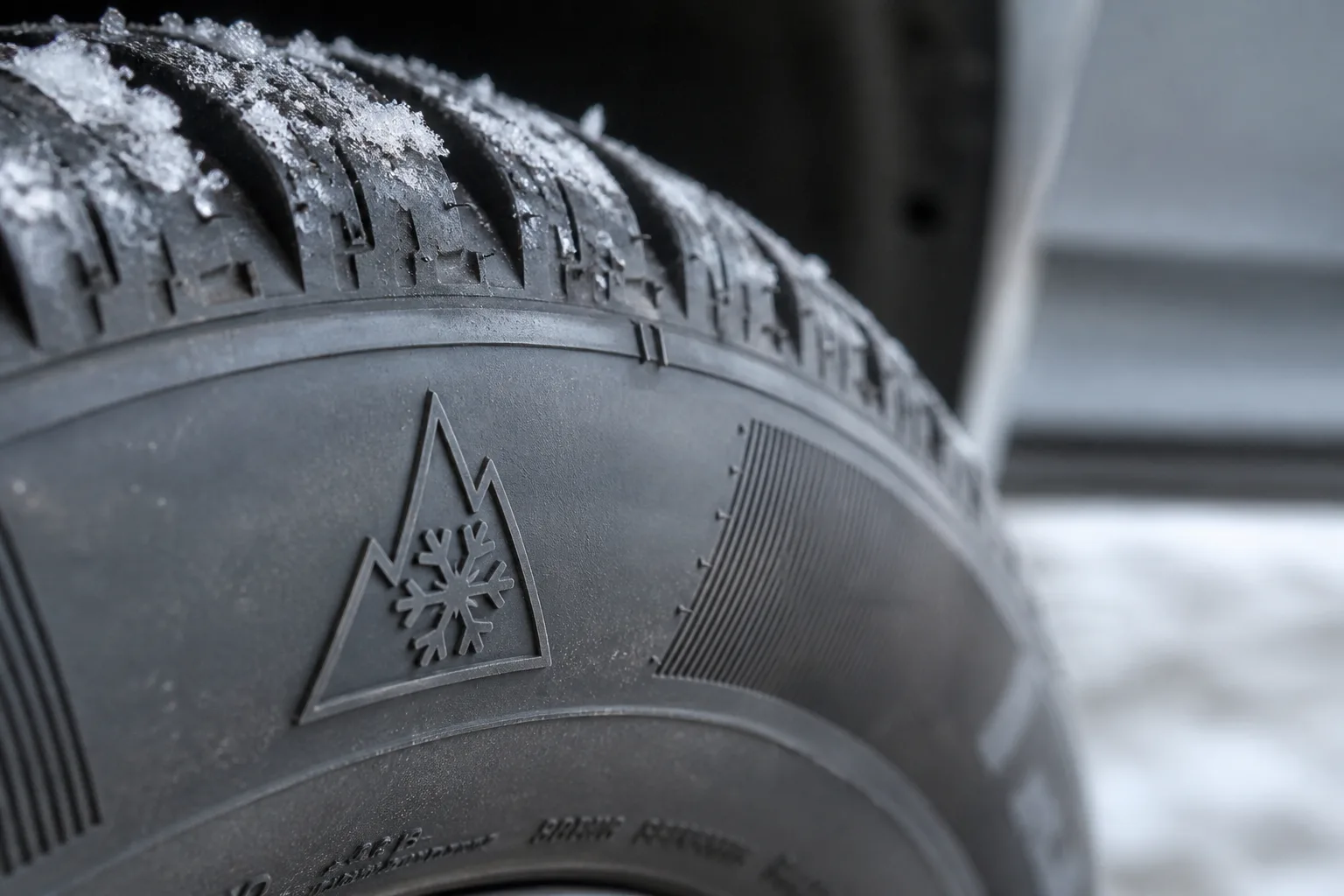
3PMSF stands for three-peak mountain snowflake. It is the small pictogram of a mountain with a snowflake inside it, moulded into a tyre sidewall to show the tyre passed the winter traction test set out in UNECE Regulation No. 117 (Germany, StVZO section 36 Abs. 4, read 2026-09-11).
That sounds like one simple fact, but the countries that require it do not agree on what “require” means. Germany makes the symbol mandatory on its own. France asks for it alongside a second marking. Austria’s law does not name it at all. A tyre that clears winter driving in one of these countries can fail the test in the next one, and most drivers never find out until a checkpoint or a crash makes it matter.
This page covers what the symbol certifies, how it differs from the older M+S marking, and what Germany, France and Austria each actually demand. If your route also crosses a toll road or needs a vignette, check the vignette and toll rules for your route before you leave, because a compliant tyre and an unpaid toll notice cause the same kind of trip delay.
Key Takeaways
- 3PMSF means three-peak mountain snowflake, the pictogram issued under UNECE Regulation No. 117 (Germany, StVZO section 36 Abs. 4, read 2026-09-11).
- M+S is a looser label. Belgium’s traffic code names M+S tyres but sets no technical standard behind the letters (Belgium row, master matrix, verified 2026-09-11).
- Germany has required the Alpine symbol since 1 October 2024, and plain M+S no longer qualifies (StVZO section 36 Abs. 4, read 2026-09-11).
- France requires the Alpine symbol and an M+S-family marking together, since 1 November 2024, and only inside prefect-designated communes (Code de la route D.314-8, read 2026-09-11).
- Austria’s statute names no marking at all. Its transport ministry’s own guidance accepts only M+S-family lettering, not the snowflake alone (BMIMI FAQ, read 2026-09-11).
What Is the 3PMSF Symbol?
The three-peak mountain snowflake is a specific pictogram, not a marketing word. Germany’s road traffic code spells out a two-part test behind it: the tread must improve snow performance over a normal tyre, and the tyre must carry the Alpine symbol issued under UNECE Regulation No. 117 (StVZO section 36 Abs. 4, read 2026-09-11). A tyre has to clear both parts. UNECE Regulation No. 117 decides which tyres may carry the pictogram, so it is not a phrase a tyre maker prints on its own judgement. German law names no product category called “all-season tyre” either: one counts as a winter tyre only if it clears both parts of that test, and as a summer tyre if it does not (StVZO section 36 Abs. 4, read 2026-09-11).
3PMSF vs M+S: Not the Same Kind of Claim
M+S stands for “mud and snow”, and in places it once carried legal weight close to the Alpine symbol. But the two markings do not rest on the same foundation. The Alpine symbol answers to one named regulation everywhere it appears. M+S does not: Belgium’s traffic code names M+S tyres in its studded-tyre substitution rule but sets no technical standard behind the letters (Belgium row, master matrix, verified 2026-09-11), and Romania’s regulator does not treat M+S as a legal term at all, calling it “a press gloss, not statute” (Romania row, master matrix, verified 2026-09-11). M+S is a claim a manufacturer prints on the sidewall. The Alpine symbol is a claim a regulation has to grant first.
The clock on that difference has run out in two of the three countries here. Germany’s grandfather clause for plain M+S tyres, limited to tyres made on or before 31 December 2017, expired on its own built-in date, 30 September 2024 (StVZO, repealed section 36 Abs. 4a, read 2026-09-11). France ran the reverse rule until 31 October 2024, when plain M+S stopped being sufficient under its decree’s original 2020 wording (Code de la route D.314-8, read 2026-09-11). Both countries moved the same direction, two winters ago.
Why Countries Disagree on Which Marking Satisfies the Law
The symbol is one pictogram, but Germany, France and Austria write three different rules around it.
Germany requires the Alpine symbol, on its own
German law has no calendar dates for winter tyres. The duty triggers only when the road is icy, snowy, slush-covered or frost-covered, and at that moment every wheel must carry a tyre that passes the two-part test above (StVO section 2 Abs. 3a and StVZO section 36 Abs. 4, read 2026-09-11). Plain M+S has not been enough since 1 October 2024. A driver caught with non-compliant tyres in those conditions faces a 60 EUR fine, rising to 80 EUR with obstruction, and the vehicle’s keeper can be fined a separate 75 EUR even if someone else was driving (BKatV rows 5a, 5a.1 and 213a, read 2026-09-11). The full situational trigger and fine ladder are covered in our guide to winter tyres in Germany.
France requires the Alpine symbol and M+S together
France asks for more markings in fewer places. Its winter-equipment duty is not national. It applies only inside communes a department prefect has designated by decree, across roughly 34 departments concentrated in the Alps, Pyrenees, Massif Central, Jura, Vosges and Corsica (Sénat written question 06613, government answer published 2026-02-12), and only from 1 November to 31 March. Where the duty applies, a tyre counts as a winter tyre only if it carries the Alpine symbol and an M+S-family marking at the same time, stated jointly, not as a choice (Code de la route D.314-8 section V, read 2026-09-11). Our page on winter tyres in France covers exactly which departments this reaches.
Austria’s statute names no marking at all
Austria’s vehicle code sets its winter-tyre duty by describing tyres “designated” for snow or slush use with an adequate tread depth. It names no marking at all, not M+S and not the Alpine symbol (KFG section 102 Abs. 8a, read 2026-09-11). The marking list drivers rely on comes from the transport ministry’s guidance instead, and it accepts only five M+S-family variants: M+S, M.S., M&S, MS and M/S, with no snowflake-alone option (BMIMI FAQ, infothek.bmimi.gv.at, read 2026-09-11). Most 3PMSF tyres also carry M+S lettering, so this rarely changes what a driver buys, but a tyre marked with the Alpine symbol alone does not clear the ministry’s own formula. Our guide to winter tyres in Austria covers the full situational window.
What to Check on Your Own Sidewall Before a Winter Drive
- Look for the pictogram itself. A small mountain outline with a snowflake inside it, near the tyre size markings, is the Alpine symbol. Letters alone, such as M+S, are a different claim.
- Check whether both markings are present. In a designated French commune, you need the Alpine symbol and an M+S-family marking on the same tyre, not either alone (Code de la route D.314-8, read 2026-09-11).
- Do not rely on tyre age to guess. Germany’s old allowance for plain M+S tyres covered only tyres made on or before 31 December 2017, and it expired in September 2024 regardless of condition (StVZO, repealed section 36 Abs. 4a, read 2026-09-11). A tyre bought new today needs the Alpine symbol on its own merits.
Calendar windows, tread-depth floors, chain rules and studded-tyre seasons all vary on top of the marking question. Our winter tyre rules for Europe guide lays out the country-by-country picture in one place.
The Short Version
3PMSF means three-peak mountain snowflake, the pictogram a tyre earns under UNECE Regulation No. 117, and it is a more regulated claim than the older M+S lettering, which several countries’ own law treats as an unstandardised label. What the symbol buys a driver still depends on the border ahead: Germany makes it mandatory on its own with no calendar date attached, France wants it paired with M+S only inside designated mountain communes, and Austria’s statute names no marking at all while its ministry’s accepted list skips the snowflake by itself. Check your sidewall against the country you are driving into, and check the toll and vignette picture for the same route on our vignette and toll page while you are at it.
Frequently Asked Questions
What does 3PMSF mean on a tyre?
Three-peak mountain snowflake, the pictogram issued under UNECE Regulation No. 117. German law defines it as part of a two-part test that also requires the tread to be built for snow performance (StVZO section 36 Abs. 4, read 2026-09-11).
Is 3PMSF the same as the snowflake symbol?
Yes. “3PMSF”, “Alpine symbol” and “snowflake symbol” all name the same mountain-and-snowflake pictogram on the tyre sidewall.
Does M+S mean the same thing as 3PMSF?
No. M+S stands for “mud and snow” and carries no fixed technical standard in several of the countries this page covers, unlike the Alpine symbol, which answers to one named regulation everywhere it appears (see the comparison above).
Does Austria accept the Alpine symbol by itself?
Not under the transport ministry’s published list, which names five M+S-family variants and no snowflake-alone option, even though the underlying statute names no marking at all (KFG section 102 Abs. 8a and BMIMI FAQ, read 2026-09-11).
Does France accept the Alpine symbol without M+S?
No. Where France’s duty applies, the tyre must carry the Alpine symbol and an M+S-family marking together, in force since 1 November 2024 (Code de la route D.314-8 section V, read 2026-09-11). Before that date, M+S alone was sufficient under the decree’s original 2020 wording.
What happens if my tyres only have old M+S markings in Germany?
They no longer qualify. The transitional allowance covered only tyres made on or before 31 December 2017 and expired 30 September 2024 by its own built-in date (StVZO, repealed section 36 Abs. 4a, read 2026-09-11). Driving in triggering conditions on non-compliant tyres carries a 60 EUR driver fine, 80 EUR with obstruction, plus a separate 75 EUR keeper fine (BKatV rows 5a, 5a.1 and 213a, read 2026-09-11).
Do winter tires and 3PMSF tyres mean the same thing?
Not automatically. In Germany, a “winter tire” or “all-season tire” only qualifies if it clears the same two-part test: snow-built tread, plus the Alpine symbol under UNECE Regulation No. 117 (StVZO section 36 Abs. 4, read 2026-09-11). The marketing name does not decide the legal question.
Sources
- Germany, StVO section 2 Abs. 3a and StVZO section 36 Abs. 4 – Federal Ministry of Justice consolidated law text
- Germany, BKatV Anlage – fine catalogue
- France, Code de la route article D.314-8 – Legifrance
- France, Senat written question 06613 on winter-equipment enforcement
- Austria, KFG 1967 section 102 – RIS open-data API
- Austria, transport ministry FAQ on winter tyre markings
Ramis Kalkan
Ramis Kalkan leads growth at Vignetim. He writes about everything that makes European road trips smoother, from digital vignettes to eSIMs. Based in Ankara, usually mid-way through planning his next drive.