Winter Tyres France: What the Law Actually Requires
Most guides treat French winter tyre rules as one national law. They are not. The duty only exists inside prefect-named communes, the tyre rule differs from the chain rule, and the fine everyone quotes has a catch nobody mentions.
 Ramis Kalkan
Updated: 10 min read
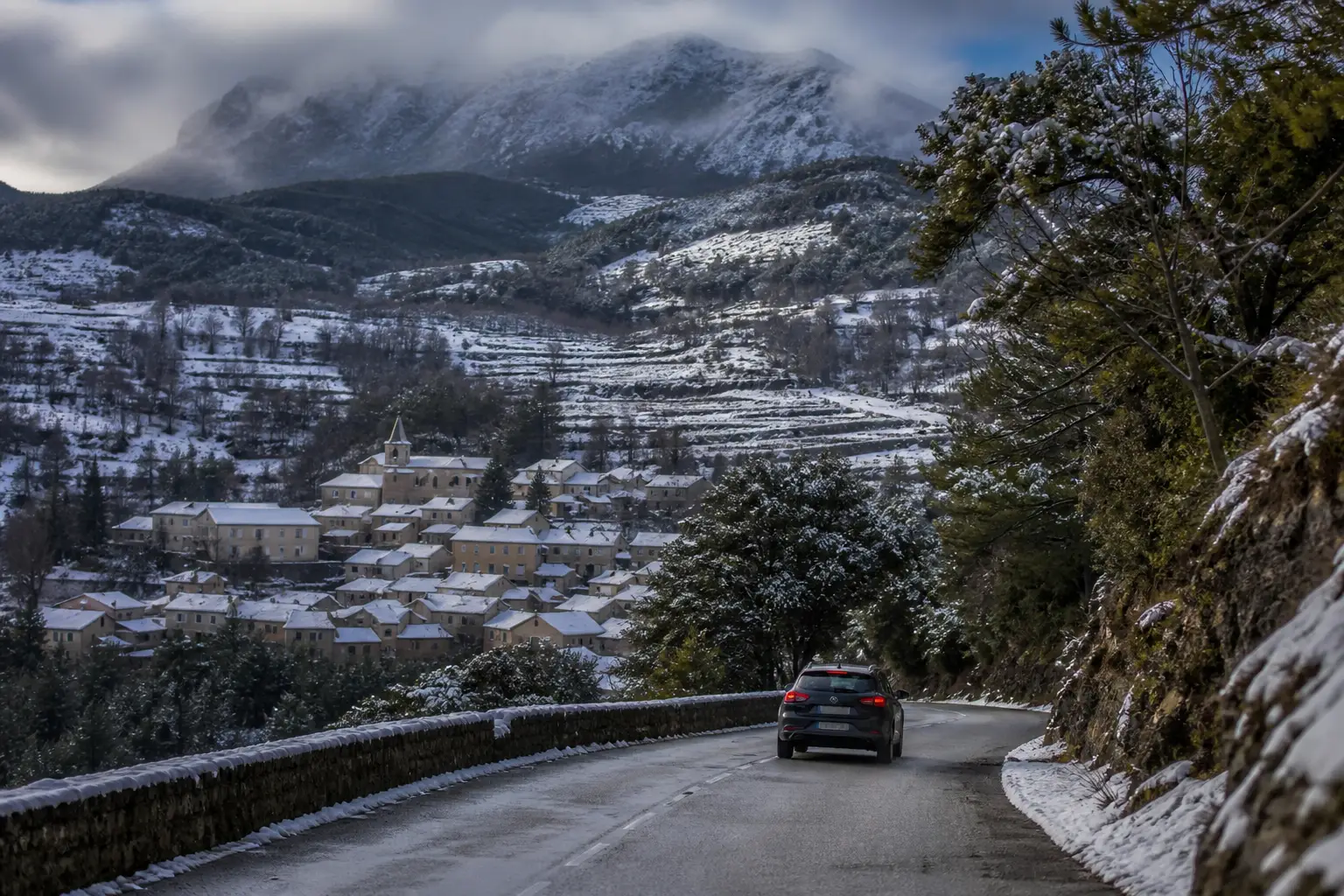
Do you need winter tyres in France? The winter tyres France rule only applies inside certain mountain communes. It only runs from 1 November to 31 March.
Everywhere else, including every ordinary autoroute in the lowlands, no winter tyre law applies. There is no single national rule. The answer depends entirely on where you drive, and when.
This guide covers the real version of that rule. It covers the roughly 34 departments it can touch. It covers how cars differ from lorries and buses, which tyre marking the law actually names, and what happens to a foreign-plated car, the question almost nobody answers cleanly. For the bigger picture, see our guide to winter tyre rules across Europe, and check our full France driving guide for the rest of the trip.
Where and When France Requires Winter Tyres
France has no nationwide winter tyre law. Instead, Article D.314-8 of the Code de la route lets each mountain department’s prefect draw the map. The prefect names specific communes, after consulting a regional “comité de massif,” and the duty only applies inside those named communes. The French Senate puts the current scope at roughly 34 departments, across the Alps, the Pyrenees, the Massif Central, the Jura, the Vosges, and Corsica.
Where a commune is named, the calendar is fixed by the statute itself: “La période hivernale débute le 1er novembre et se termine le 31 mars de l’année suivante,” the winter period runs 1 November to 31 March every year. Once that window opens inside a named commune, the duty applies whether or not there is snow on the road that day.
Plan further than the French mountains too. Cross into Switzerland or Italy over the Alps and you meet a separate, stricter set of rules the moment you’re across the border.
Cars, Vans, Lorries and Buses: The Rule for Each Vehicle Class
Cars and light vans (M1/N1)
For an ordinary car or a van up to 3.5 tonnes, the law allows two routes. Carry chains or snow socks fitted to at least two drive wheels, or fit winter tyres instead. Here is the detail most guides get wrong: the winter tyre route needs tyres on at least two wheels of each axle.
On a standard two-axle car, that means all four tyres, not just the driven pair. Only the chain route is limited to two wheels. A motorhome on a car or van chassis follows this same rule.
Lorries and buses without a trailer
A coach or lorry with up to three axles has a stricter tyre route. Chains still work on two drive wheels. Choosing winter tyres instead means fitting them on at least two wheels of the main steering axle and at least two drive wheels, both together.
Lorries with a trailer or semi-trailer
An articulated lorry, one towing a trailer or semi-trailer, loses the tyre route completely. The law names only one option here: chains on at least two drive wheels. Winter tyres alone, however marked, do not satisfy this rule. A vehicle with a permanent, ministerially approved anti-slip system is exempt from the whole duty.
Motorhomes, caravans and motorcycles
A motorhome on an M1 or N1 chassis follows the car and van rule above. A caravan towed behind a car carries no separate, published duty; the rule attaches to the towing vehicle. Motorcycles and mopeds sit outside the winter equipment rule entirely, since the statute lists only cars, vans, buses, coaches and lorries.
Which Tyre Marking France Actually Requires
Since 1 November 2024, French law requires two markings together, not one. Article D.314-8 states that a qualifying tyre carries “la présence conjointe du marquage du symbole alpin et de l’un des marquages ‘M+S’, ‘M.S.’ ou ‘M&S’,” meaning the tyre needs the 3PMSF Alpine symbol and an M+S mark, together, on the same tyre.
That is a change from the original 2020 wording, which let a plain M+S tyre qualify alone, with no snowflake. That easier rule ended 31 October 2024, so “M+S alone is fine” describes a rule that lapsed roughly two years before this guide was written. All-season tyres qualify too, provided they carry the same joint marking; France has no separate legal category for them.
On tread depth, the law is less precise than most drivers expect. Article R.314-1 only requires visible tread across the whole tyre, with no canvas showing through anywhere. No millimetre figure appears in that article. The “1.6 mm” minimum quoted by tyre shops is a genuine industry convention, not the statute’s figure, and there is no separate, stricter number for winter tyres.
Snow Chains and Studded Tyres
Snow chains
French law is narrow about where chains can actually be used, not just carried. Article R.314-3 states chains may be used only on snow-covered roads. Textile snow socks count as an equal device; a Rhône prefecture notice lists accepted equipment as “chaînes à neige métalliques ou textiles,” metal or textile snow chains.
A prefect can also add extra, road-specific restrictions during a bad storm, using separate traffic-control powers. Watch the roadside signage on any mountain pass rather than assuming the departmental rule is the only one in force that day.
Studded tyres
Studded tyres are allowed in France, but only through a licensed exception. The base rule, also in Article R.314-3, bans metal that can protrude from the tread, and a separate ministerial order lifts that ban under specific conditions. What that order actually sets, including any calendar window or speed cap, is not something we could confirm at an official source.
Some guides quote a fixed season and a speed limit, but neither figure is verifiable in the primary text. Check current conditions with a tyre dealer before fitting studded tyres for a French winter trip, rather than relying on a number repeated online.
Foreign-Registered Vehicles: What the Law Says
This is the question almost every foreign driver asks, and the honest answer is that the law simply does not address it. Article D.314-8 is written entirely in EU vehicle categories: cars, vans, buses, coaches and lorries by their technical class. It never mentions registration, plates, or nationality, and no prefecture page names foreign-plated cars either.
That silence cuts one clear way in practice. The duty attaches to the vehicle’s category and to being physically inside a named commune during the window, not to where the car is registered. A foreign-plated car parked inside a designated Alpine commune in January sits inside the same rule as a French car, by the same reasoning. But no French authority has made an official statement naming foreign vehicles, so treat this as the law being silent, not as a confirmed rule written for tourists.
The Fine for Driving Without Winter Tyres in France
Here is the part that surprises people who look into it. Article D.314-8 does not carry a penalty clause of its own. The fine widely quoted online, around €135, comes from the generic tariff used for a broad category of Code de la route offences, not from a clause written into the winter tyre rule itself.
The standard fixed penalty is €135, dropping to €90 if paid within 15 days, or rising to €375 if missed. The statutory ceiling, if the case reached a court, is €750.
The correction that matters most sits behind those numbers. A French government answer published on 12 February 2026, replying to a Senate question, confirms the decree needed to apply a sanction to D.314-8 has never been published. The rule has been applied “de manière pédagogique, sans sanction,” purely as guidance, since it began in 2021, including through the 2025/2026 winter.
Whether that changes for 2026/2027 is not confirmed anywhere we could check. Do not plan around either assumption. The equipment rule itself has not gone away, and a driver without the right kit is still exposed if the position changes, or if the vehicle is immobilised under the separate, general tyre-condition rules, which carry their own penalties.
Winter Tyre Myths in France That Other Sites Get Wrong
- “Winter tyres on the drive wheels are enough.” Wrong for cars. The tyre option needs all four tyres, two per axle. Only the chain option is limited to the drive wheels.
- “Plain M+S tyres are still legal.” Not since 1 November 2024. The law now needs the Alpine symbol and M+S together, on the same tyre.
- “You will definitely be fined €135.” The fine exists on paper, but the enforcing decree for this specific rule has never been published.
- “The rule covers 48 departments.” That 48 is a commune count for one department, Pyrénées-Orientales. The Senate’s department-level figure is roughly 34.
- “1.6 mm is the legal minimum.” That number comes from the tyre trade, not the statute, which only requires visible tread with no canvas showing.
The Short Version
Winter tyres in France are not a national requirement. They apply only inside prefect-named communes across roughly 34 mountain departments, only from 1 November to 31 March, and the exact rule changes by vehicle type: four tyres for an ordinary car, a stricter steering-and-drive rule for buses and lorries, chains only once a trailer is attached. The tyre marking that counts is the Alpine symbol together with M+S, and the widely quoted €135 fine has never actually been enforced against this specific rule, though that could change.
Plan the rest of a winter trip too. Coming down through Belgium or the UK, remember French speed limits also drop in bad weather. Continuing over the Alps into Switzerland, budget for the Swiss vignette before the border, since France’s toll autoroutes stop where the Swiss system begins.
Frequently Asked Questions
Do I need winter tires in France in 2026?
Only inside a mountain commune a prefect has named, and only between 1 November and 31 March. Outside those communes and that window, French law does not require winter tyres.
Is the winter tyre rule the same across all of France?
No. It is regional, not national. Roughly 34 departments have named communes, mostly in the Alps, the Pyrenees, the Massif Central, the Jura, the Vosges, and Corsica. The rest of France has no such duty.
Can I use snow chains instead of winter tyres in a designated commune?
Yes, for a car or van. Chains or snow socks on at least two drive wheels satisfy the duty, as an alternative to fitting winter tyres on all four wheels. Chains may only be used on snow-covered roads.
Do all four tyres need to be winter tyres, or just two?
For a car or light van, all four. The winter tyre route requires two wheels of each axle, so a standard two-axle car needs four. Only the chain option is limited to two wheels.
Are studded tyres legal in France?
Yes, through a licensed exception to the general ban on protruding metal. The exact calendar window and any speed cap are not confirmed at an official source, so check with a tyre dealer before fitting them.
Does the winter tyre rule apply to foreign-registered cars?
The law never mentions nationality or plate origin. The duty attaches to the vehicle’s category and to being inside a named commune during the window, so a foreign-plated car looks covered by the same logic, though no official statement says so directly.
What is the fine for not having winter tyres in France?
On paper, €135, reduced to €90 within 15 days, or raised to €375 if missed, with a €750 ceiling. In practice, the government confirms the sanctions decree for this specific rule has never been published, so it has applied without sanction since 2021.
Do lorries need winter tyres in France?
Depends on the lorry. One without a trailer can use winter tyres on the steering and drive axles instead of chains. One towing a trailer cannot use winter tyres at all; chains are the only route the law allows.
Sources
- Légifrance, Code de la route, Article D.314-8
- Légifrance, Code de la route, Article D.314-8 (current marking rule)
- Légifrance, Décret n° 2020-1264 du 16 octobre 2020
- Légifrance, Code de la route, Article R.314-1
- Légifrance, Code de la route, Article R.314-3
- French Senate, written question n°06613
- Préfecture des Pyrénées-Orientales, winter equipment notice
- Préfecture du Rhône, winter equipment obligation
Ramis Kalkan
Ramis Kalkan leads growth at Vignetim. He writes about everything that makes European road trips smoother, from digital vignettes to eSIMs. Based in Ankara, usually mid-way through planning his next drive.