Winter Tyres Netherlands: What the Law Requires in 2026
The Netherlands has no winter-tyre law at all, calendar or situational. What it does have is a flat, year-round ban on metal snow chains and studded tyres, and that ban catches foreign drivers who assume Dutch rules match Germany or Austria.
 Ramis Kalkan
Updated: 10 min read
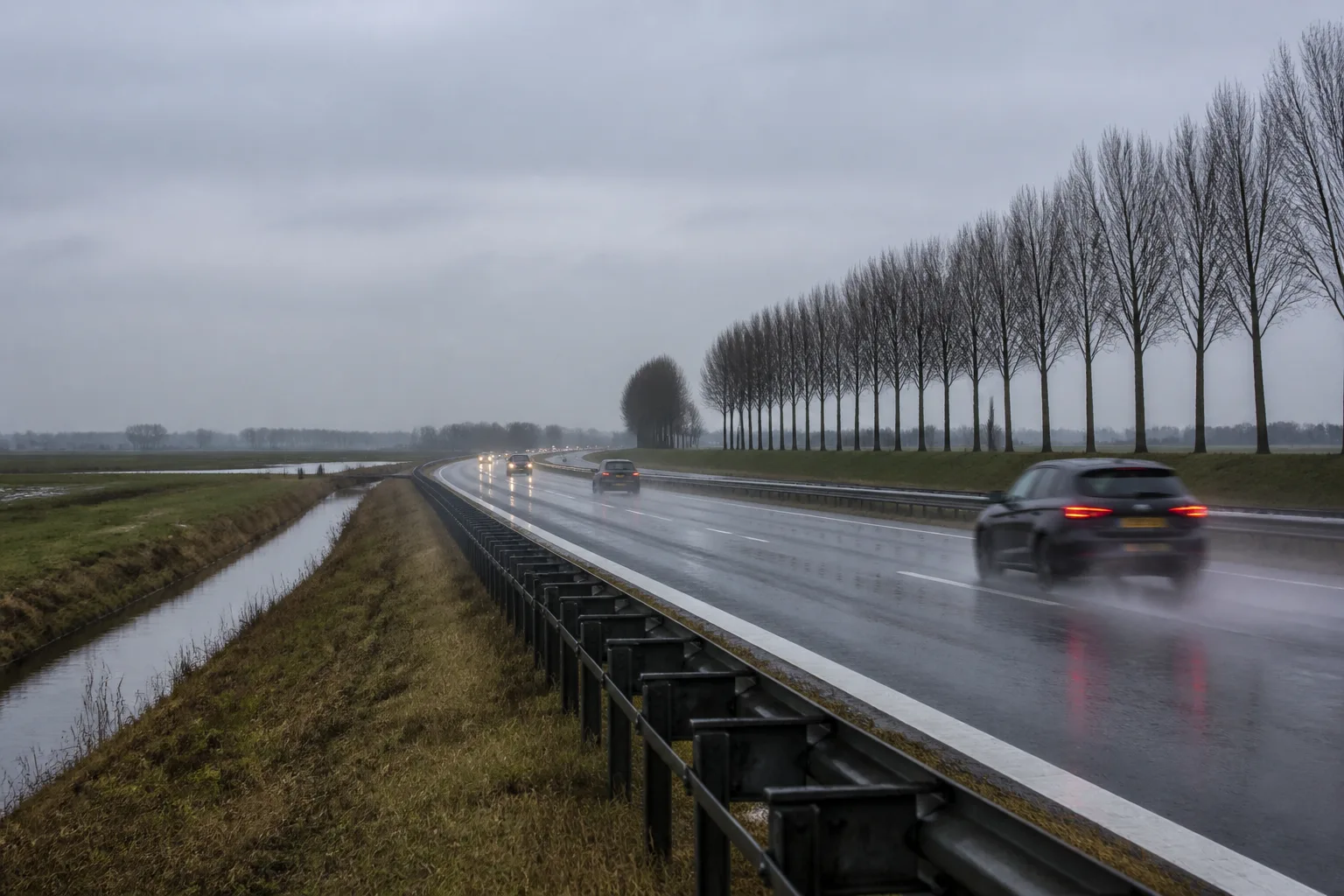
No. The Netherlands has no winter-tyre law, no calendar window, and no situational trigger for cars, vans, lorries, or buses. What it does have is a flat, year-round ban on metal snow chains and studded tyres, and that ban applies to you even on foreign plates.
That fact separates the Netherlands from the Alpine countries most winter trips plan around. Nothing switches on in November and nothing switches off in April. But two things you might pack for a ski trip through Germany or Austria are illegal the moment you cross into the Netherlands, and one of them carries a €320 fine.
Key Takeaways
- The Netherlands has no winter-tyre duty for any vehicle class. A search of the current road-traffic texts for “winter,” “M+S,” and “3PMSF” returns zero hits.
- Metal snow chains are banned year-round, on every vehicle, with only an emergency-services exception. The fine is €320 (Wet Mulder, feitcode P 321).
- Studded tyres are banned year-round too, drafted as a ban on metal elements that can protrude from the tread. Fines run €190 to €420 by tyre count.
- The 1.6 mm figure often quoted as a “winter minimum” is the general, year-round tread minimum. There is no separate winter figure, because Dutch law has no winter-tyre category.
- Foreign-plated drivers are bound by both bans exactly like Dutch drivers, and a driver with no known Dutch address faces immediate payment demands or a clamped vehicle, not a letter in the post.
The Regime: No Mandate, Two Bans
Dutch traffic law runs on three instruments: the Wegenverkeerswet 1994 (the parent Act), the RVV 1990 (behaviour rules), and the Regeling voertuigen (vehicle-technical regulation). None creates a winter-tyre obligation. Searching the current RVV 1990 text, in force 01-07-2026, for “winter,” “sneeuwketting” (snow chain), “spijker” (stud), “profiel” (tread), “M+S,” and “3PMSF” returns zero hits, for every vehicle class, including lorries, buses, trailers, caravans, and motorhomes.
The only winter-adjacent material is permissive. Article 34 lid 1 allows front fog lights in fog, snowfall, or heavy rain. Sign J36, “IJzel of sneeuw” (black ice or snow), is an advisory hazard warning. Neither attaches an equipment duty.
The one clause that applies to everyone, year-round, is the general danger clause: Wegenverkeerswet 1994, Article 5, in force 01-09-2026: “Het is een ieder verboden zich zodanig te gedragen dat gevaar op de weg wordt veroorzaakt of kan worden veroorzaakt.” Everyone is prohibited from behaving in a way that causes or could cause danger on the road. It names no equipment, and it is a criminal offence, not the administrative fine that covers the tyre violations below.
Continuing past the border changes the picture fast. Germany and Austria run their own duties, covered in our winter tyre rules for Europe guide and the 3PMSF Alpine symbol both name in law, unlike the Netherlands. If your winter drive touches Dutch paid roads, our Netherlands page covers tolled crossings like the A24 before you set off.
The Marking the Law Never Names, and the Tread Depth It Does
Dutch law names no winter tyre marking. Not M+S, not the 3PMSF snowflake. RDW, the Dutch vehicle authority, confirms this framing directly, live-checked 2026-09-11: “Let dan op het sneeuwvloksymbool op de zijkant. Banden met dit symbool zijn in een aantal landen in de winter verplicht.” Tyres carrying the snowflake are mandatory in winter “in a number of countries.” RDW is describing other countries’ rules, not a Dutch one.
What Dutch law does regulate is tread depth, and this is a year-round figure, not a winter one:
| vehicle class | minimum tread depth | article |
|---|---|---|
| Passenger cars | 1.6 mm | Regeling voertuigen Art. 5.2.27 lid 4 |
| Lorries, buses, trailers | 1.6 mm | Art. 5.3.27 / 5.3.72 / 5.12.27 lid 4 |
| Motorcycles | 1.0 mm | Art. 5.4.27 lid 4 |
| Mopeds | no numeric figure, tread pattern must be present | Art. 5.6.27 lid 4 |
RDW states the car figure in plain language too: “De minimaal vereiste profieldiepte is 1,6 mm.” Neither source ties it to winter. Check it before any long drive, summer or winter.
Snow Chains: A Flat Ban, Not a Regulated Season
Some countries let drivers fit chains on a signed mountain pass in a defined window. The Netherlands does neither. Metal snow chains are banned outright, year-round, under Regeling voertuigen Article 5.18.32a lid 1: “Banden van motorvoertuigen mogen niet zijn voorzien van sneeuwkettingen die bestaan uit metalen elementen.” Tyres may not be fitted with chains made of metal elements. The wording sits at the “motorvoertuigen” level with no weight qualifier, so it reads as covering lorries and buses the same way it covers cars.
The sole exception, lid 2: emergency-service vehicles on an urgent task may use metal chains. There is no calendar trigger, no permit, and no route where chains become legal for an ordinary driver.
Two points the authorities have not settled, so this guide will not guess. Whether textile snow socks count as legal is unconfirmed, since the ban text is limited to metal elements. Whether an unfitted set of chains can legally sit in the boot is unconfirmed too.
Studded Tyres: Banned Everywhere, Every Class, No Window
The same flat logic applies to studs. Dutch law does not even use the word “spijkerbanden”; it bans the mechanism instead. For cars, Regeling voertuigen Article 5.2.27 lid 7: “Het loopvlak van de banden mag geen metalen elementen bevatten die tijdens het rijden daarbuiten kunnen uitsteken.” The tread may not contain metal elements that can protrude while driving. Parallel provisions cover lorries, buses, motorcycles, mopeds, and trailers.
There is no permitted season and no speed cap, because none are allowed at all. For cars, lorries, and buses, this requirement is not checked during the periodic APK roadworthiness inspection. It is a road-use rule enforced by police, not a garage test.
Foreign-Registered Vehicles: The Question Everyone Actually Asks
Driving in on foreign plates, here is the direct answer. There is no winter-tyre duty to bind you, because there is no such duty for anyone, Dutch or foreign. But the chain ban and the stud ban apply to you exactly as they apply to a Dutch-registered driver. The enforcement articles are addressed to “de bestuurder van een voertuig,” the driver of a vehicle, with no nationality or registration qualifier (Regeling voertuigen Art. 5.1.1 lid 1 sub c for studs; Art. 5.1.2 for chains).
Where it gets more serious for a foreign driver is the procedure. Under the WAHV (“Wet Mulder”), Article 31 lid 1: if an officer finds the driver has no known Dutch residence, they may demand the fine and costs be paid immediately in full, or that security be posted on the spot. Lid 2 goes further: where the registered keeper has no known Dutch address, the vehicle can be impounded or clamped. So the practical risk for a tourist carrying chains from an Austrian ski trip is not a letter that arrives weeks later. It is a roadside demand for immediate payment.
This page covers the Netherlands only. The moment you continue into a country with its own mandate, like Germany, that country’s law takes over at the border. Our winter tyres Germany guide covers what changes, and if your route runs through Belgium first, our winter tyres Belgium guide covers that leg.
Penalties: On-the-Spot Amounts
These are fixed Mulder administrative tariffs, read from the WAHV tariff annex, current as of 01-09-2026 and unchanged from the prior 01-01-2026 version. They are set amounts, not a range with a ceiling.
| offence | fine | feitcode |
|---|---|---|
| Metal snow chains fitted (car) | €320 | P 321, Art. 5.18.32a |
| Studded/protruding tread, 1 / 2 / 3 tyres | €190 / €280 / €420 | N 270 i/j/k |
| Tread below the class minimum, 1 / 2 / 3 tyres | €190 / €280 / €420 | N 270 r/s/t |
Lower tariff bands exist for other categories, such as mopeds, but those sit outside this guide’s scope.
The general danger clause (WVW 1994 Art. 5) carries a separate sanction. Under Article 177 lid 1, a breach is punishable by detention of at most six months or a third-category fine, a criminal sanction on a different legal track from the table above. The euro value of a “third-category fine” was not verified in the source checked here, so this guide states the sanction as written rather than attaching an unverified number.
Traps: What Other Sites Get Wrong
“1.6 mm is the Dutch winter-tyre minimum.” It isn’t. It is the year-round minimum for passenger cars. There is no separate winter figure, because Dutch law has no winter-tyre category to attach one to.
A blanket “chains and studs are banned,” without the qualifier. The chain ban covers metal chains specifically; the stud ban covers tread elements that can protrude while driving. That precision is exactly why Dutch tyre shops can lawfully sell snow chains: those chains are for a customer driving on to a country where chains are legal, not for use on Dutch roads.
Treating “no mandate” as “foreign drivers are unaddressed.” Not the same finding. The Netherlands has no winter-tyre mandate for anyone, but its chain and stud bans explicitly bind foreign-plated drivers, plus a harsher WAHV Article 31 procedure for anyone with no known Dutch address.
Our speed limit in the Netherlands guide covers figures that change by road type and weather, which matter more to a Dutch winter drive than any tyre marking does.
The Short Version
The Netherlands asks nothing of your tyres in winter: no calendar window, no situational trigger, no marking named in law, for cars, vans, lorries, or buses. The 1.6 mm figure quoted everywhere is the general tread minimum, not a winter one.
What it does ask is that you leave two things at home. Metal snow chains are banned year-round, fine €320. Studded tyres are banned year-round, fines €190 to €420 by tyre count. Both bans bind foreign plates exactly as they bind Dutch ones, and a driver with no known Dutch address risks immediate payment demands or a clamped vehicle rather than a fine in the post.
Pack for the countries either side of the Netherlands, not for the Netherlands itself, and check your own tread depth before you leave. That is the one number Dutch law will actually enforce.
Frequently Asked Questions
Are winter tyres required in the Netherlands?
No. There is no winter-tyre duty in Dutch law, calendar or situational, for cars, vans, lorries, or buses.
Are winter tires mandatory for foreign drivers in the Netherlands?
No mandate exists for anyone. But the chain ban and the stud ban apply to foreign plates exactly as they apply to Dutch ones, and a driver with no known Dutch address can face immediate payment demands or impoundment.
Is the 1.6 mm tread depth a winter rule?
No. It is the general, year-round minimum for passenger cars (Regeling voertuigen Art. 5.2.27 lid 4). There is no separate winter minimum.
Are snow chains legal in the Netherlands?
Metal chains are banned year-round for every vehicle, except emergency vehicles on an urgent task. The fine for fitting them is €320.
Are studded tyres allowed in the Netherlands?
No. Studded tyres are banned year-round for every vehicle class, drafted as a ban on metal tread elements that can protrude while driving.
What is the fine for studded tyres in the Netherlands?
€190 for one affected tyre, €280 for two, and €420 for three (feitcode N 270 i/j/k).
Can I drive through the Netherlands with chains fitted from a ski trip in Austria?
No. The ban applies regardless of where the chains were legal. Remove them before entering the Netherlands to avoid the €320 fine.
Does the Netherlands name the 3PMSF snowflake symbol in law?
No. RDW describes the snowflake only as a requirement of other countries, not of the Netherlands.
Sources
- wetten.overheid.nl – Wegenverkeerswet 1994 (WVW 1994)
- wetten.overheid.nl – Reglement verkeersregels en verkeerstekens 1990 (RVV 1990)
- wetten.overheid.nl – Regeling voertuigen
- wetten.overheid.nl – Wet administratiefrechtelijke handhaving verkeersvoorschriften (WAHV / “Wet Mulder”)
- RDW (Rijksdienst voor het Wegverkeer) – tips for a safe vehicle
Ramis Kalkan
Ramis Kalkan leads growth at Vignetim. He writes about everything that makes European road trips smoother, from digital vignettes to eSIMs. Based in Ankara, usually mid-way through planning his next drive.