Winter Tyres Germany: What the Law Actually Requires
There is no October deadline for winter tyres in Germany. The duty triggers on weather, not a date, and the driver and the car’s keeper can each be fined separately. Here is exactly what the law asks for.
 Ramis Kalkan
Updated: 9 min read
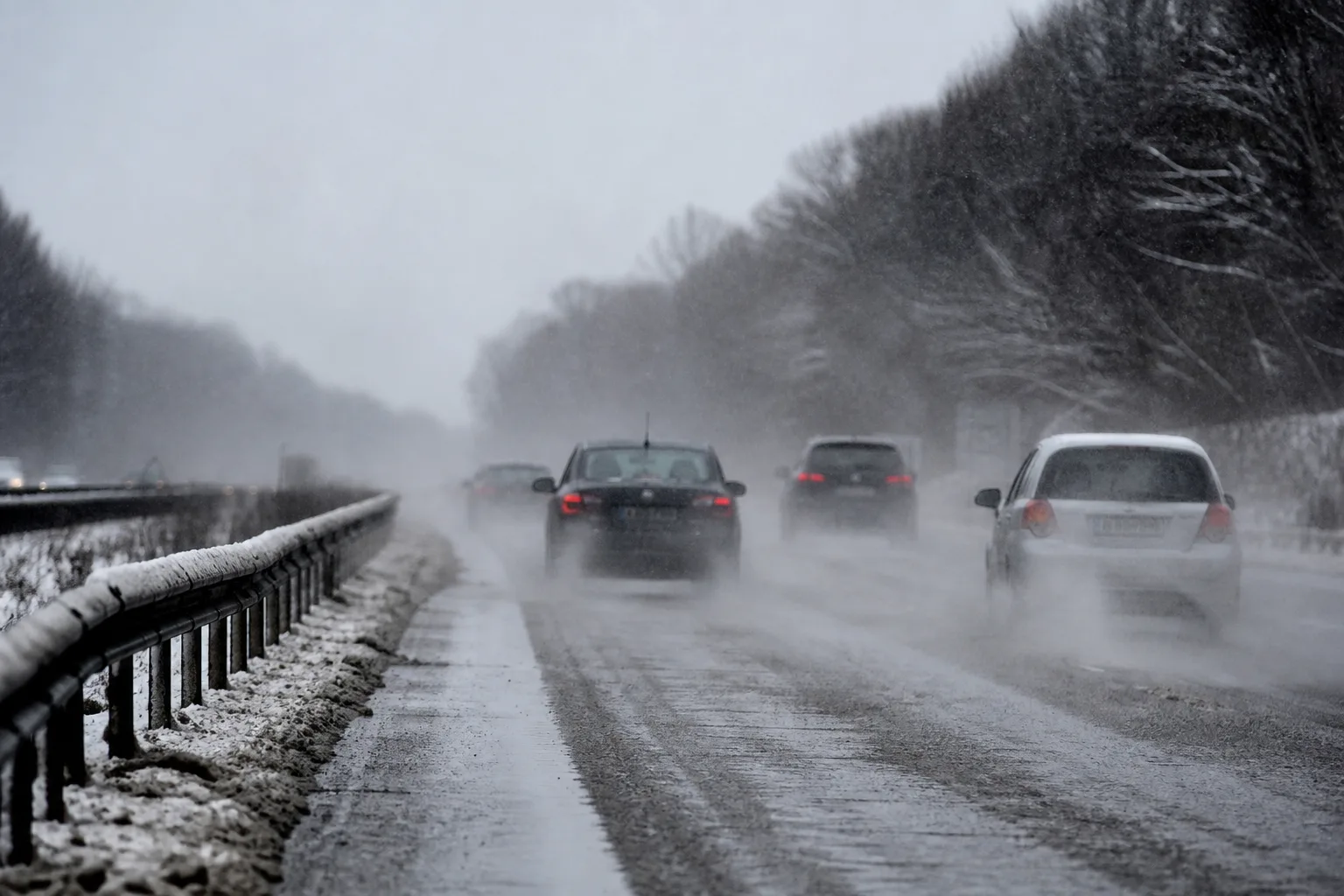
Yes, Germany requires winter tyres, but only while the road actually needs them. The duty switches on the moment a road is icy, snow covered, slushy or frosted, not on a fixed calendar date. Drive on the wrong tyres in those conditions and both the driver and the person who owns the car can be fined separately.
There is no “1 November to 15 April” window in German law, whatever a tyre shop poster says. The rules also reshape at almost every border once your trip continues past Germany. Our winter tyre rules across Europe guide is the comparison point for the rest of the route, and our Germany page covers what else to plan for the trip.
Key Takeaways
- Germany’s rule is triggered by weather, not a calendar. No fixed start or end date exists anywhere in the law (Section 2, paragraph 3a, Straßenverkehrs-Ordnung).
- Since 1 October 2024, plain M+S tyres no longer count. The tyre needs the Alpine three-peak-mountain-snowflake symbol (Section 36, paragraph 4, Straßenverkehrs-Zulassungs-Ordnung).
- The driver pays 60 euros for a bare breach and 80 euros if traffic is obstructed. The vehicle’s keeper can be fined a separate 75 euros (Bußgeldkatalog-Verordnung, rows 5a, 5a.1 and 213a, verified 11 September 2026).
- Foreign-registered cars are bound by the same rule. German law expressly extends the tread-depth requirement to foreign EU and EEA vehicles.
- Studded tyres are effectively banned everywhere in Germany, with no confirmed regional exception.
When Winter Tyres Become Mandatory in Germany
The trigger is five named road conditions, not a season. German law lists them exactly: black ice, snow-slipperiness, slush, ice-slipperiness, and frost or rime-slipperiness.
The operative rule reads, in translation: the driver of a motor vehicle may only drive it in those conditions if all wheels carry tyres that meet the marking requirements set out below. That is Section 2, paragraph 3a, sentence 1 of the Straßenverkehrs-Ordnung, current text verified 11 September 2026.
Nothing in that sentence mentions a month. A full search of the current statute turns up no “15 April” or “1 October” cutoff at all. “October to Easter” is a recommendation from tyre retailers and motoring clubs, not a legal deadline, and the rule was last amended on 30 January 2026 without adding one. Watch the forecast and the road surface, not the calendar.
Cars, Vans, Lorries, Buses, Trailers and Motorhomes
The rule does not treat every vehicle the same way.
| Vehicle type | What the law asks for |
|---|---|
| Cars (M1) and light vans up to 3.5 tonnes (N1) | All four wheels must carry compliant tyres. No drive-axle exception. |
| Buses and lorries over 3.5 tonnes (M2, M3, N2, N3) | Only the driven axles and the front steering axles need compliant tyres, at minimum. |
| Trailers | Not bound by the tyre-marking duty at all. The general 1.6 mm tread floor still applies to them. |
| Motorhomes registered as M1 | Follow the ordinary car rule: all wheels compliant. |
| Motorcycles and mopeds | Exempt entirely, since 1 June 2017. |
A motorhome registered M1 takes the car rule above. A towed trailer does not need matching winter tyres, only tyres that clear the general 1.6 mm floor.
The Alpine Symbol: The Marking the Law Actually Names
German law runs a two-part test: the tyre’s tread pattern, compound or construction must improve grip on snow, and it must carry the Alpine symbol, the three-peak-mountain-snowflake pictogram set out in UNECE Regulation No. 117 (Section 36, paragraph 4, Straßenverkehrs-Zulassungs-Ordnung). See what that symbol looks like, and where else it applies, in our 3PMSF Alpine symbol guide.
Plain M+S marking used to be a valid stand-in, but that grandfather clause expired at the end of 30 September 2024. It only ever covered M+S tyres made on or before 31 December 2017. Since 1 October 2024, an M+S-only tyre no longer satisfies the law, even one fitted before the cutoff. An all-season tyre counts as equivalent to a winter tyre only if it also carries the Alpine symbol. Without it, the marketing name changes nothing.
Tread depth follows a separate, simpler rule: 1.6 mm across the main grooves. That floor applies to winter and summer tyres alike, and to trailers as well as motor vehicles (Section 36, paragraph 3, Straßenverkehrs-Zulassungs-Ordnung). Germany sets no higher legal minimum for winter use, whatever figure a tyre brand’s own advice quotes.
Snow Chains and Studded Tyres
Snow chains: only where the sign says so
There is no nationwide snow-chain law in Germany. Chains become compulsory only on a specific stretch of road where the sign “Zeichen 268, Schneeketten vorgeschrieben” (snow chains required) is posted. That sign appears most often on Alpine and mountain-pass sections in southern Bavaria (StVO Anlage 2, item 42).
The legal definition of a “Schneekette” requires metal links that touch the road surface. A textile snow sock, with no chain links at all, does not meet that definition, so it will not satisfy the sign’s requirement where Zeichen 268 is posted.
Studded tyres: effectively banned everywhere
Germany has no dedicated studded-tyre law. Instead, a general clause bans any tyre surface that can damage a paved road (Section 36, paragraph 1, sentence 3, Straßenverkehrs-Zulassungs-Ordnung), and studs fall foul of it. There is no seasonal window and no speed cap, because there is no permitted use to cap.
That is a sharper line than several neighbours draw. Austria and Switzerland both allow studded tyres in a set season with a speed cap, covered in our guides to winter tyres in Austria and winter tyres in Switzerland. Cross into Germany on studs bought for one of those countries and you are no longer legal.
Foreign-Registered Vehicles
Germany’s rule does not exempt foreign plates. Section 2, paragraph 3a addresses the driver’s conduct, not the vehicle’s country of registration. Its short exemption list names vehicle types only, with no carve-out for where the car is registered.
The law goes further than most neighbours here. Section 31d, paragraph 4 expressly extends the 1.6 mm tread-depth floor to tyres on foreign-registered EU and EEA vehicles. The fine catalogue’s own tread-depth rows cite that same section, so the rule was drafted to be enforceable against a foreign plate, not to overlook one. For a rental car, liability sits with the person driving at the time, because the statute addresses “the driver,” not the owner.
If your trip continues onward, the rules keep changing at the border. Denmark applies a similar open-ended fitness test rather than a date; our guide to winter tyres in Denmark covers it. The Netherlands has no winter-tyre duty at all, the subject of our guide to winter tyres in the Netherlands.
What a Violation Costs
Germany fines the driver and the vehicle’s keeper on two separate lines, and most competitor guides only mention the first one.
| Offence | Who pays | Amount | Points |
|---|---|---|---|
| Driving without compliant tyres in triggering conditions | Driver | 60 euros | 1 |
| Same offence, with obstruction to other traffic | Driver | 80 euros | 1 |
| Allowing the vehicle to be used this way | Keeper (Halter) | 75 euros | 1 |
| Dangerous-goods vehicle failing the same duty | Driver | 140 euros | 1 |
Source: Bußgeldkatalog-Verordnung Anlage, rows 5a, 5a.1, 213a and 6, verified 11 September 2026. These are fixed catalogue rates for an ordinary first offence, not a range, and there is no separate “endangerment” tier in the official tariff, whatever figure circulates online.
There is a civil-law consequence too. With comprehensive (Kasko) cover, a claim following a crash on non-compliant tyres can see the insurer proportionally reduce the payout for gross negligence. That is Section 81, paragraph 2 of the VVG (Insurance Contract Act). The reduction has no fixed percentage; courts assess it case by case.
Traps: What Other Guides Get Wrong
- “Winter tyres are required from October to Easter.” Not in Germany. That date range is retailer advice, not statute; the trigger is the road condition at the time of driving.
- “M+S marking still counts.” It stopped on 1 October 2024. The Alpine symbol is now the only marking the law accepts.
- “You’ll pay 100 euros plus a point for endangering traffic.” That tier does not exist in the official catalogue. The real figures are 60, 80 and 75 euros.
- “Trucks and buses must carry chains from 1 November to 15 April.” That claim appears in neither statute. It most likely describes a different country’s rule, migrated into aggregator content about Germany.
- “There’s a stretch near the Austrian border where studs are allowed.” No federal source confirms it. Treat studded tyres as banned everywhere in Germany.
The Short Version
Germany’s winter-tyre rule follows the weather, not the date. From the moment a road turns icy, snowy, slushy or frosted, every wheel of a car or light van needs a tyre carrying the Alpine symbol. Heavy vehicles need it on their driven and front steering axles at minimum. Trailers are exempt from the marking duty but still owe the general 1.6 mm tread floor, and motorcycles are exempt outright.
Get it wrong and two separate fines are possible: 60 or 80 euros for the driver, and a further 75 euros for the vehicle’s keeper. None of that changes for a foreign-registered car or a rental. Snow chains stay optional except where a sign says otherwise, and studded tyres have no legal window at all.
Once the road clears, Germany’s Autobahn network returns to its usual mix of unrestricted stretches and signed limits, covered in our guide to the speed limit in Germany.
Frequently Asked Questions
Does Germany have a winter tyre law?
Yes, but it triggers on road conditions, not a date. Whenever a road is icy, snow covered, slushy or frosted, every wheel of a car must carry a compliant tyre.
Do I need winter tires in Germany as a tourist driving a foreign-plated car?
Yes. The rule binds every driver regardless of where the car is registered, and a separate provision extends the tread-depth requirement expressly to foreign EU and EEA vehicles.
Is M+S marking enough for winter tyres in Germany?
No, not since 1 October 2024. The tyre must carry the Alpine three-peak-mountain-snowflake symbol; M+S alone no longer satisfies the law, even on a tyre bought before the cutoff.
Are snow chains required in Germany?
Only where the road sign “Zeichen 268” is posted, mostly on Alpine and mountain-pass roads in southern Bavaria. There is no nationwide chain requirement.
Are studded tyres legal in Germany?
No. A general road-damage clause effectively bans them everywhere, with no season, permit or confirmed regional exception.
What is the fine for driving without winter tyres in Germany?
The driver pays 60 euros, rising to 80 euros if traffic is obstructed, both with one point. The vehicle’s keeper can also be fined a separate 75 euros.
Do rental cars in Germany need winter tyres?
The fine for driving on non-compliant tyres in triggering conditions falls on the person driving at the time, since the law addresses the driver’s conduct, not the owner.
What is the minimum tyre tread depth in Germany?
1.6 mm across the main grooves, for summer and winter tyres alike, and for trailers as well as motor vehicles. There is no higher legal minimum for winter tyres specifically.
Sources
- gesetze-im-internet.de, Straßenverkehrs-Ordnung Section 2
- gesetze-im-internet.de, Straßenverkehrs-Zulassungs-Ordnung Section 36
- gesetze-im-internet.de, Straßenverkehrs-Zulassungs-Ordnung Section 37
- gesetze-im-internet.de, Straßenverkehrs-Zulassungs-Ordnung Section 31d
- gesetze-im-internet.de, Bußgeldkatalog-Verordnung Anlage
- gesetze-im-internet.de, Versicherungsvertragsgesetz Section 81
Ramis Kalkan
Ramis Kalkan leads growth at Vignetim. He writes about everything that makes European road trips smoother, from digital vignettes to eSIMs. Based in Ankara, usually mid-way through planning his next drive.