Winter Tyres Austria: Rules, Fines and Snow Chains
Austria’s winter tyre law is situational, not seasonal, and it catches out more foreign drivers than any other Alpine rule. Here is the exact trigger, the tyre marking Austria actually names, and what changes for vans, motorhomes and lorries.
 Ramis Kalkan
Updated: 10 min read
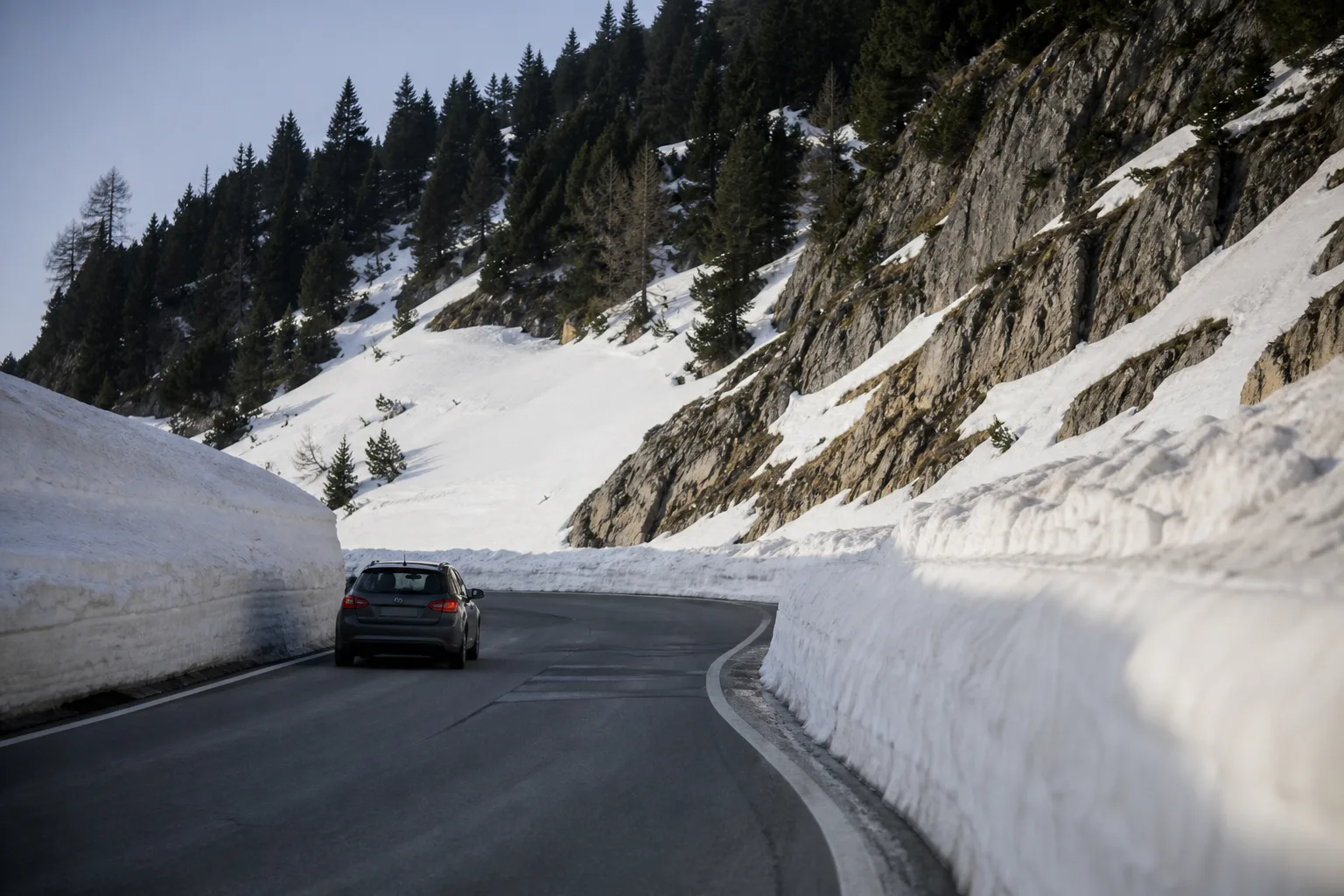
Yes, but only some of the time. Austria requires winter tyres or snow chains on a car between 1 November and 15 April, and only while the road is actually snowy, slushy or icy. Drive that stretch on a dry day in January on summer tyres and you break no law. Get stopped on a snowy road without them, and the fine starts small, but the exposure does not stop there.
That situational design is the most misunderstood part of winter tyres in Austria. Most competing guides flatten it into a plain date rule, then apply the same date to lorries, buses and motorhomes, where it does not work. This guide follows the actual statute, KFG section 102, paragraph 8a.
Do You Need Winter Tyres in Austria?
For a car (class M1) or a light van up to 3.5 tonnes (class N1), the law states the trigger in one phrase: “bei winterlichen Fahrbahnverhältnissen wie insbesondere Schneefahrbahn, Schneematsch oder Eis”. That means “in wintry road conditions, in particular a snow-covered carriageway, slush or ice.” Inside the window of 1 November to 15 April, if that condition is present, you must run winter tyres on all four wheels, or snow chains on at least two drive wheels. Outside that condition, inside the same window, summer tyres stay legal.
The same rule also covers a class most guides skip: the closed-cabin, four-wheel light quadricycle, a microcar category that includes Aixam and Ligier-type vehicles, named in the statute alongside cars and vans.
Tyres are only one part of a winter trip into Austria. Every motorway and expressway also runs on a separate charge, covered on our Austria page, and mountain routes carry their own speed limits that drop hard around passes. Prepare for all three, not just the tyres.
Cars, Vans, Motorhomes, Lorries and Buses: Who the Rule Actually Binds
The class a vehicle falls into decides everything, and one classification trap costs more readers than any other line in this guide.
- Cars, light vans and light quadricycles (M1, N1): situational, 1 November to 15 April, as above.
- Motorhomes, including ones over 3.5 tonnes: still class M1. KFG section 2, item 28a, defines a Wohnmobil (motorhome) as M1 regardless of mass, so a heavy camper takes the situational car rule, not the absolute lorry rule. This is the biggest correction for anyone driving a motorhome into Austria.
- Lorries (N2, N3): an absolute duty. Winter tyres on at least one drive axle are required 1 November to 15 April regardless of weather, and chains must be carried for at least two drive wheels across the same window.
- Buses (M2, M3): the same absolute duty, but the tyre window is shorter, 1 November to 15 March. The chain-carrying duty still runs to 15 April, a full month after the tyre duty ends.
- Trailers and caravans: no winter tyre or chain duty. The statute names motor-vehicle classes only. A trailer still meets the general tread minimum, and studded tyres on it need every axle under 1,800 kg.
- Motorcycles and mopeds: fully exempt. The statute’s operative classes never include two- or three-wheelers.
A short exemption list also covers heavy vehicles: tyres marked “spezial”, security, army and fire-brigade vehicles unsuited by design, test or transfer drives, and vehicles built only for snow-free roads.
Which Tyres Actually Count
Austria’s marking rule trips up drivers coming from Germany, and it runs the opposite way from what most people expect.
The transport ministry accepts five markings, and only five: M+S, M.S., M&S, MS, M/S. The Alpine three-peak-mountain-snowflake symbol, 3PMSF, is accepted when a tyre also carries it, but it never qualifies alone. Most 3PMSF tyres carry M+S lettering too, so the gap rarely bites in the shop, but do not repeat the common claim that the snowflake alone is enough here. Read more about what the 3PMSF symbol actually certifies.
Do not import Germany’s rule either. German law requires the 3PMSF symbol, and some plain M+S tyres lost status there from 2018. That change never happened in Austria: its tread regulation was amended as recently as 2024 with no marking requirement added. Driving on to Germany? Check its rule separately.
Minimum tread depth for a winter tyre is 4 mm radial or 5 mm diagonal up to 3.5 tonnes, rising to 5 mm and 6 mm above it. Below that, a tyre does not become illegal outright. It just stops counting as a winter tyre. It stays legal as an ordinary tyre down to the general minimum of 1.6 mm (2 mm over 3.5 tonnes, 1 mm on mopeds).
Snow Chains: When and Where
Chains are a lawful stand-in for winter tyres only when the road is continuously, or nearly continuously, covered with snow or ice. On a wet or patchy road, chains do not satisfy the duty on their own.
Where a road carries the sign “SCHNEEKETTEN VORGESCHRIEBEN” (snow chains mandatory), chains become compulsory on at least two drive wheels, regardless of the road surface. That sign binds “Kraftwagen”, the legal term for a multi-track vehicle with at least four wheels, so it does not reach motorcycles. A second sign, with a red diagonal bar through the same symbol, marks where the requirement ends.
No fixed, official list of chain-duty passes exists. Routes such as the Reschenpass or Arlbergpass are commonly named, but the sign can legally appear anywhere conditions call for it, so treat any “these are the chain-duty passes” list as incomplete.
Chains sold in Austria should meet ÖNORM V 5117 or V 5119, or an equivalent EU standard. Textile snow socks sit in a genuine grey area: no source confirms whether they satisfy a chain requirement, so treat that question as unresolved.
Studded Tyres in Austria
Austrian law frames this as a summer ban, not a winter permission: studded tyres may not be used in June, July, August or September, so in practice they run 1 October to 31 May. They are limited to vehicles up to 3,500 kg, and every wheel that drives the car must be studded; you cannot stud one axle only.
Two protrusion limits apply. A new tyre’s studs must sit between 1 mm and 1.5 mm; in use, wear can take that up to a maximum of 2 mm before the tyre falls out of compliance. Speed is capped at 80 km/h on ordinary roads and 100 km/h on a motorway. Austria charges no municipal fee for studded tyres, unlike some Nordic countries. A studded vehicle also carries a rear sticker, which must come off once the studs do.
Foreign-Registered Vehicles
This is the question every foreign driver actually asks, and the law answers it plainly: the duty follows the road, not the plate.
KFG section 1 sets the scope of the whole Act on any vehicle “used on roads with public traffic” in Austria, with no exception for where it is registered. Section 102’s winter tyre paragraph binds “der Lenker”, the driver, with no nationality qualifier anywhere in its exemption list. Cross into Austria on a German, Italian, Slovenian or Hungarian plate, and the same rule applies as to an Austrian-registered car.
Enforcement can move faster for a non-resident. A winter-equipment breach falls under KFG section 134’s general powers. Police can demand a provisional security deposit of up to €2,180 on the spot. They can also interrupt the journey by taking the keys or documents, and hold the vehicle as security if that interruption is not lifted within 72 hours.
Penalties
There is no single fixed roadside tariff for a winter-equipment offence. Austria’s general roadside fine, an Organstrafverfügung under VStG section 50, is capped at €90. The transport ministry itself cites both about €35 and, elsewhere, at least €60 for a winter-tyre stop, and both fit inside that €90 ceiling. A figure of around €100 “on the spot” shows up on some motoring-club pages. That cannot be an on-the-spot ticket at all, since it exceeds the statutory cap. Anything higher can only come from a formal decision by the authority.
That authority-issued penalty has real teeth: KFG section 134 sets a general ceiling of €10,000, with imprisonment of up to six weeks as a backstop if the fine cannot be collected. The ceiling applies equally to a driver or an owner; there is no separate €5,000 driver figure in the statute, despite that split circulating online.
Traps: What Other Sites Get Wrong
- “You can be fined roughly €100 at the roadside.” You cannot, legally. The cap is €90; a higher figure has to come from a formal decision, not a police stop.
- “The chain-duty passes are a fixed list.” They are not. The sign can legally appear on any road conditions warrant, so a named list of passes is never complete.
- “A €5,000 driver fine and a €10,000 owner fine.” Not in the statute. KFG section 134 sets one €10,000 ceiling that applies to driver or owner alike.
The Short Version
Winter tyres in Austria are a situational duty for cars, vans and motorhomes: 1 November to 15 April, and only while the road is genuinely snowy, slushy or icy. Lorries and buses face a stricter, weather-independent calendar, with a bus’s chain-carrying duty outlasting its tyre duty by a month. The accepted marking is the M+S family, not the snowflake symbol alone, and the rule binds every driver on an Austrian road regardless of where the car is plated. The roadside fine sits under €90; the real exposure, if a crash follows a summer-tyre stop in the snow, is the authority-level penalty. Sort your tyres first, then check the Austria vignette and toll rules and the country’s speed limits. For the wider picture, the winter tyre rules for Europe cover how neighbours compare, including Germany, Italy and Switzerland.
Frequently Asked Questions
Do you need winter tyres in Austria all winter, or only when it snows?
Only when it snows, within the window. Between 1 November and 15 April, winter tyres or chains are required on a car only while the road is actually wintry, snow-covered, slushy or icy. On a dry road inside that same window, summer tyres remain legal.
Is Austria strict about winter tires for foreign cars?
Yes. The duty is set by the road, not the plate. Any vehicle used on an Austrian public road falls under the same rule as an Austrian-registered one, with no exemption for foreign registration.
Does a motorhome need lorry-grade winter tyres in Austria?
No. A motorhome is legally classed as M1 regardless of its weight, so it follows the situational car rule, not the absolute rule that applies to lorries over 3.5 tonnes.
Is the 3PMSF snowflake symbol required on Austrian winter tyres?
No. Austria’s ministry accepts the M+S family of markings (M+S, M.S., M&S, MS, M/S) as the qualifying test. The 3PMSF snowflake is accepted alongside that marking but is not sufficient by itself.
Are snow socks a legal substitute for chains in Austria?
There is no confirmed answer either way. No law or ministry source addresses textile snow socks directly, so treat the question as open rather than assuming they satisfy a chain requirement.
When are studded tyres allowed in Austria?
From 1 October to 31 May. The law frames it as a ban during June, July, August and September, on vehicles up to 3,500 kg, with speed capped at 80 km/h on ordinary roads and 100 km/h on motorways.
What happens if the police stop me on summer tyres in the snow?
The roadside fine is capped at €90, with the ministry citing figures of about €35 or at least €60 in practice. A larger penalty, up to €10,000, can follow from the authority, and a non-resident driver may also face an on-the-spot security deposit of up to €2,180.
Sources
- RIS: Kraftfahrgesetz (KFG) 1967, section 102
- RIS: Kraftfahrgesetz (KFG) 1967, section 134
- RIS: Kraftfahrzeug-Durchführungsverordnung (KDV) 1967, sections 4 and 58
- RIS: Straßenverkehrsordnung (StVO) 1960, section 52
- RIS: Verwaltungsstrafgesetz (VStG), sections 50 and 37a
- BMIMI Infothek: FAQ on winter tyres
Ramis Kalkan
Ramis Kalkan leads growth at Vignetim. He writes about everything that makes European road trips smoother, from digital vignettes to eSIMs. Based in Ankara, usually mid-way through planning his next drive.