Winter Tyres Italy: What the Law Actually Requires
Italy does not have one winter-tyre law. It has a power to make ordinances, and the duty exists only on the roads where one is in force. Here is how to read the sign, the vehicle differences, and the fine that follows if you ignore it.
 Ramis Kalkan
Updated: 10 min read
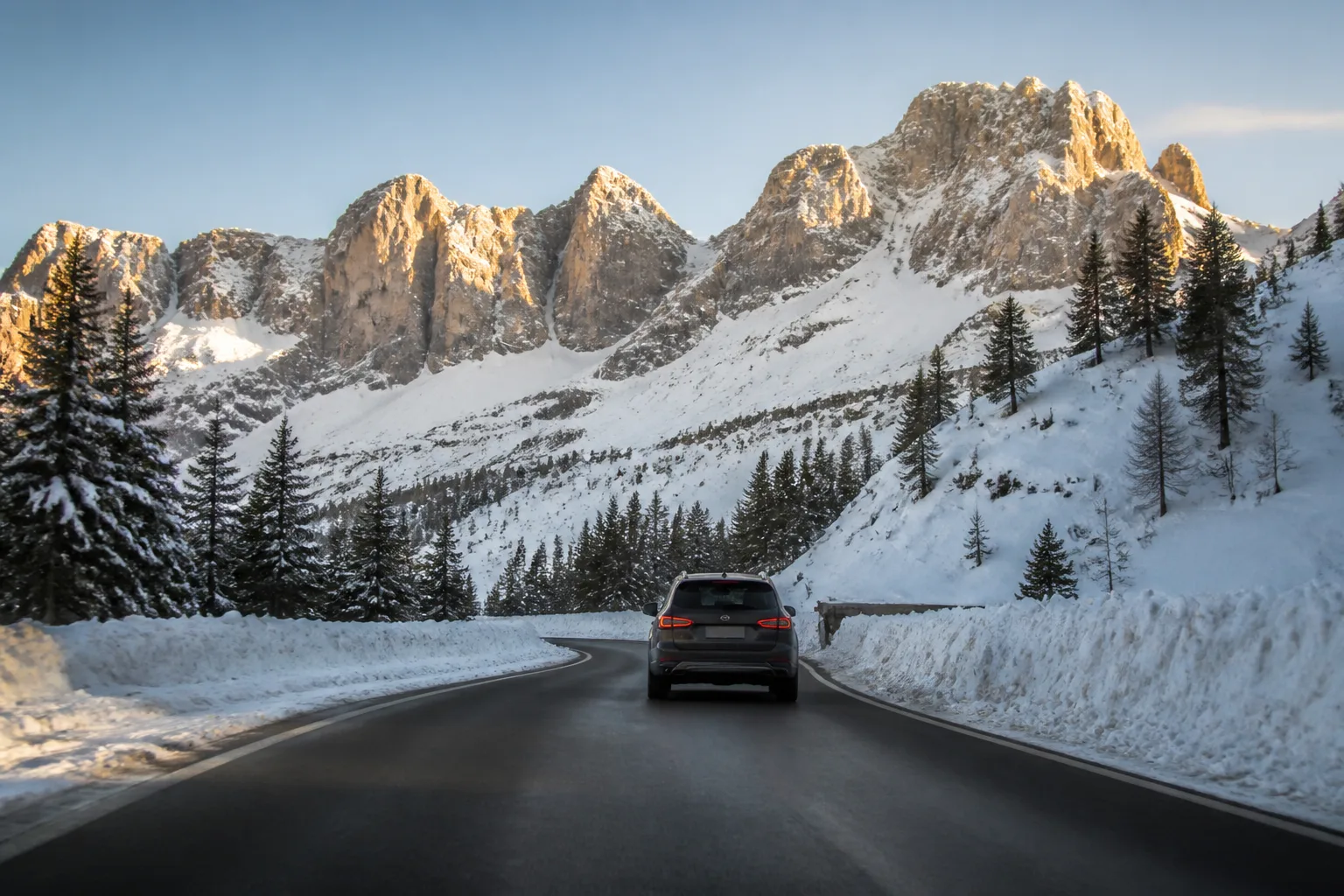
Winter tyres Italy law comes down to one question: is there a sign on your road? Yes, you may need winter tyres, but not everywhere and not all the time. The duty exists only on roads where the road owner has issued an ordinance, usually 15 November to 15 April. Ignore a posted sign and you risk a fine of 87 to 344 euros on an extra-urban road or motorway.
That single fact, no blanket national law, is why most guides get Italy wrong. This one is built from the Codice della Strada itself, and it is one spoke of our full winter tyre rules across Europe.
Key Takeaways
- No national calendar. The duty exists only where a road owner’s ordinance is in force (D.Lgs. 285/1992, Art. 6 c.4 lett. e).
- Carried chains satisfy a standard ordinance; a stricter order can demand winter tyres only.
- The statute names no tyre marking, so a flat “M+S is enough” claim is not reliable.
- Studs are permitted up to 3.5 tonnes. No other stud figure is confirmed.
- Nothing in the law exempts a foreign-registered car.
- The fine: 87 to 344 euros extra-urban and motorway, 42 to 173 euros in town.
The Italian Winter Tyre Law: An Ordinance, Not a Calendar
Most countries fix a date and a rule. Italy fixes a power and lets road owners decide when to use it. Article 6, paragraph 4, letter e) of the Codice della Strada lets a road owner require:
“che i veicoli siano muniti ovvero abbiano a bordo mezzi antisdrucciolevoli o pneumatici invernali idonei alla marcia su neve o su ghiaccio”
In plain English: vehicles must be fitted with, or carry on board, anti-skid devices or winter tyres suited to snow or ice. Those words, “muniti ovvero”, “fitted or”, settle the chains question at statute level: fitting winter tyres and carrying chains are equally legal under this base power.
A stricter power sits in letter f-bis. Ahead of heavy snowfall, outside built-up areas, a road owner can order the exclusive use of winter tyres, and chains in the boot stop being enough. “Winter tyres or chains” is the wrong answer for every Italian road at every time.
Four bodies issue these orders: ANAS on state roads and motorways, the regional president on regional roads, the provincial president on provincial roads, the mayor on municipal roads, and the concessionaire on toll roads. That is why the season, and the roads it covers, changes stretch by stretch.
The confirmed 2025/26 window on ANAS’s Piedmont roads runs 15 November 2025 to 15 April 2026. The 2026/27 dates were not yet published as of this article’s verification date, so treat next winter’s dates as provisional until the new ordinance appears.
Cars, Vans, Lorries, Buses, Trailers and Motorbikes
The base rule covers “i veicoli”, vehicles in general, with no carve-out by class in the statute. An ordinance binds every motor vehicle on the road it covers, unless it says otherwise.
Cars and light vans up to 3.5 tonnes follow the mechanism above: fitted winter tyres, or carried chains, satisfy a standard ordinance.
Heavy vehicles generally follow the same base duty, but some roads go further. On two ANAS roads in Piedmont, the SS21 and SS28, vehicles over 3.5 tonnes must have chains mounted, not carried, once conditions turn slippery. That is a rule for those two roads only, not a national heavy-vehicle law.
Motorcycles and mopeds face a riding condition instead of an equipment duty: the ANAS ordinance lets them travel “solo in assenza di neve o ghiaccio sulla strada e di precipitazioni nevose in atto”, only when there is no snow or ice on the road and no snowfall in progress. They carry no chains-or-tyres requirement; they simply cannot use the road while it is snowing or icy.
Motorhomes and caravans are not addressed separately in the sources behind this guide, so no chain rule for trailers is printed here.
Tyre Markings, Tread and Snow Chains
This is where competitor content diverges sharply from the statute. Article 6 c.4 lett. e) names no marking at all, only tyres “suited to driving on snow or ice.” Two public bodies fill that gap and disagree: the Polizia di Stato names M+S, MS, M-S or M&S as sufficient, while ACI’s consumer portal adds the 3PMSF alpine symbol. Because the statute is silent and the two sources conflict, “M+S is enough in Italy” cannot be printed as flat fact.
A separate claim, that 3PMSF became mandatory on 1 October 2024 and plain M+S stopped being legal, does not survive a check against the ordinance text. It most likely mixes up the EU’s tyre-labelling rules, which govern what a new tyre may be sold as, with the ordinance duty that governs what you may drive on.
On tread depth, we print only what is solid. Figures of 1.60mm for cars, 1.00mm for motorcycles and 0.50mm for mopeds are commonly attributed to DPR 495/1992, but the article usually cited, Article 237, is only a referral clause with no numbers, so those figures stay out. What is confirmed: ACI recommends keeping winter tread above 3 to 4mm as a safety margin, explicitly calling this advice, not a legal minimum.
Snow chains stay a lawful substitute under the base ordinance, and stop working under an f-bis order. The sign marking a chains-or-tyres duty is a mandatory regulatory sign, not a warning triangle: DPR 495/1992, Article 122, names it “CATENE PER NEVE OBBLIGATORIE” (figure II.87), and the same sign with a diagonal red band marks where the duty ends.
Studded Tyres in Italy
Studded tyres are permitted in Italy, but only up to a point. The Polizia di Stato states it plainly: studs are “ammesso in Italia limitatamente ai veicoli di massa complessiva fino a 3,5 tonnellate”, permitted only for vehicles up to 3.5 tonnes gross weight.
Beyond that confirmed cap, be careful what you read elsewhere. A package of figures often quoted alongside it, a season window, speed caps, an all-wheels-and-trailer rule, mud flaps, a stud protrusion limit and a stud count, traces back only to secondary aggregators and an unlocated 1966 circular. None of it is confirmed, so none of it appears here.
Foreign-Registered Vehicles: Does the Rule Apply to You?
This is the question most drivers actually ask, and the statute answers it by staying silent. Article 6 uses the word “i veicoli”, the vehicles, throughout, with no mention of registration country, and the ANAS Piedmont ordinance draws the same blank. No ministry or police source states outright that the rule “binds foreign plates”. The correct framing is the reverse: nothing in the ordinance power exempts a foreign-plated car. A car from Germany, France or the United Kingdom is bound by whatever sign is posted on the road, exactly like a car with an Italian plate.
This matters most on the Alpine passes into Italy’s neighbours. The ANAS Piedmont ordinance alone names more than sixty state roads, including the SS20 at Colle di Tenda, the SS24 at Monginevro and the SS25 at Moncenisio toward France, and the SS33 at Sempione toward Switzerland. Running that corridor, check both sides: our guides to winter tyres in France and winter tyres in Switzerland cover the rest of the trip, and drivers on the eastern crossings should read winter tyres in Austria instead.
Before an Alpine winter drive, it is worth five minutes to understand how Italy’s toll system actually charges you, since the autostrada bill is a separate cost from any chains or tyres you buy.
The Penalty: On-the-Spot Fine and the Ceiling
Breach a winter-equipment ordinance on an extra-urban road or motorway and Article 6 c.14 sets the sanction at 87 to 344 euros, the low end an on-the-spot figure, the high end the statutory ceiling. On an urban road, the parallel sanction under Article 7 c.14 runs 42 to 173 euros.
Two other figures circulate and get mistaken for this fine. 41 to 167 euros belongs to a different offence in the same comma, illegal parking. 83 to 332 euros belongs to Article 7 c.14’s clause on restricted traffic zones and bus lanes. Neither is the winter-equipment tariff.
The roadside outcome, in the Polizia di Stato’s own words, is that a non-compliant driver is “intimato… di non proseguire il viaggio se prima non si dota dei predetti dispositivi”, ordered not to continue the journey until fitted with the required equipment. That is a stop-until-compliant outcome, not impoundment. No insurance consequence is confirmed anywhere, so none appears here.
Traps: What Other Guides Get Wrong About Italy
- “Italy has a national 15 November to 15 April law.” The single most common error. The legal position is per-road ordinance, not a statute with a date in it, even though the Polizia di Stato’s own public page simplifies to a flat calendar.
- “M+S is always enough.” Cannot be printed as flat fact: the Polizia di Stato and ACI name different lists, and the statute names none.
- “3PMSF has been mandatory since 1 October 2024.” Does not survive verification, and most likely confuses the EU’s tyre-labelling regime with the ordinance duty.
- “Heavy vehicles over 3.5 tonnes must have chains mounted everywhere.” Confirmed only on the SS21 and SS28 in Piedmont, not as a national rule.
- Fine figures that do not match. 41 to 167 euros and 83 to 332 euros, sometimes quoted for winter tyres, belong to parking and restricted-zone offences instead.
The Short Version
Italy runs no single winter-tyre law. It runs a power, exercised road by road, and “15 November to 15 April” is a convention, not a statute. Your obligation on any day is set by the ordinance in force on that road and the sign posted at its start.
Carry chains and you satisfy most ordinances. Only a stricter, snowfall-triggered order forces winter tyres specifically. The marking question has no clean legal answer, so a snowflake-marked tyre is the safer bet. Studs are legal up to 3.5 tonnes and nothing more is confirmed. A foreign plate gets no exemption, and the fine runs 87 to 344 euros outside town, 42 to 173 euros inside it.
Before winter tyres become the story of your trip, check how Italy’s toll system works and read what Italy’s speed limits do once it rains or snows: precipitation drops the motorway limit from 130 to 110 km/h, enforced by average-speed cameras.
Frequently Asked Questions
Do I need winter tyres in Italy?
Only where a road owner’s ordinance requires them, typically 15 November to 15 April on the roads it covers. No single national law applies everywhere, so check the sign on the road you are driving.
What is the fine for not having winter tyres or chains in Italy?
87 to 344 euros extra-urban or motorway (Art. 6 c.14), or 42 to 173 euros in town (Art. 7 c.14).
Are snow chains a legal alternative to winter tyres in Italy?
Yes, under the standard ordinance. A stricter, snowfall-triggered order can require winter tyres exclusively.
Is M+S tyre marking enough for Italy’s winter tyre rule?
The statute names no marking. The Polizia di Stato accepts M+S, MS, M-S or M&S, while ACI adds the 3PMSF alpine symbol. Because the two public sources disagree, no single marking is officially sufficient.
Do foreign-registered cars have to follow Italy’s winter tyre rules?
Yes. The statute says “vehicles” throughout, with no mention of registration country, so nothing exempts a foreign-plated car.
Are studded tyres legal in Italy?
Yes, up to 3.5 tonnes gross weight. Beyond that confirmed limit, the season, speed cap and stud-count figures in wide circulation could not be verified, so treat them with caution.
Can motorcycles ride on snow-covered roads in Italy?
Only when there is no snow or ice on the road and no snow is currently falling, under the ANAS Piedmont ordinance. That is a riding condition, not an equipment duty.
Sources
Ramis Kalkan
Ramis Kalkan leads growth at Vignetim. He writes about everything that makes European road trips smoother, from digital vignettes to eSIMs. Based in Ankara, usually mid-way through planning his next drive.