
Is It Illegal to Drive in Flip Flops? The UK and Europe Answer
Flip flops won’t get you arrested at the wheel, but they can still cost you a fine, points, or an insurance fight. Here is the UK rule, plus how France, Spain, Germany, and Italy handle summer footwear.
 Ramis Kalkan
Updated: 10 min read
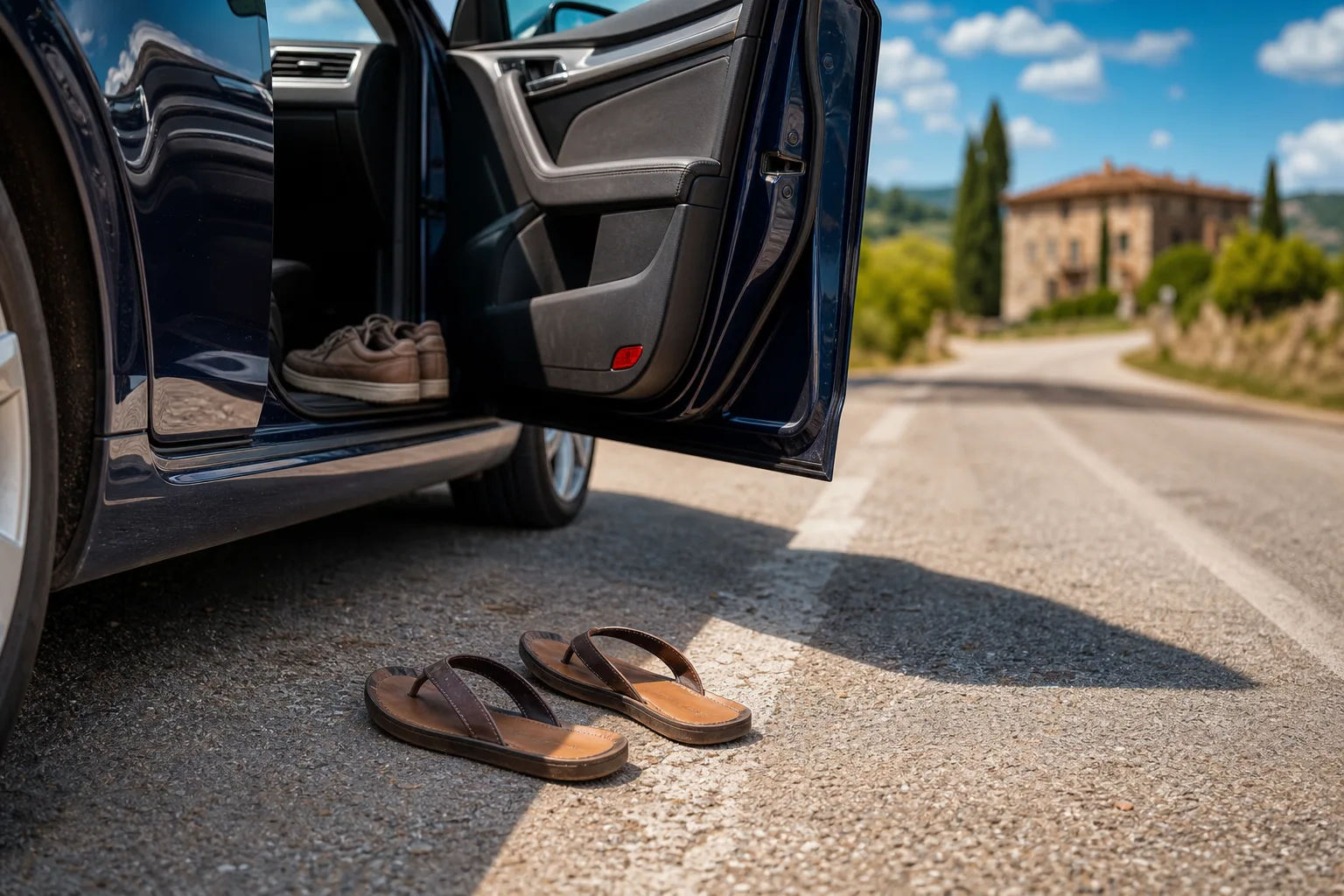
No, driving in flip flops is not illegal in the UK. There is no law that names any type of footwear. What the law does require, through Rule 97 of the Highway Code, is that your clothing and footwear “do not prevent you using the controls in the correct manner”. If flip flops cause you to drive badly, you can be prosecuted for careless driving, which carries 3 to 9 penalty points.
Every summer the same story does the rounds: a driver fined hundreds of pounds “for wearing flip flops”. It’s never quite true, and it’s never quite false either. The footwear is legal. The bad driving it can cause is not.
That distinction matters even more once you cross the Channel. Most of Europe treats summer footwear the same way the UK does, but a couple of countries will fine you under their general vehicle-control rules. This guide covers the UK position first, then how France, Spain, Germany, and Italy handle it, so you know exactly where you stand on a summer road trip.
Key Takeaways
- No UK law bans driving in flip flops, barefoot, or in any specific footwear. Highway Code Rule 97 only requires footwear that does not stop you using the controls correctly.
- If unsuitable footwear contributes to bad driving, the charge is careless driving: a fixed penalty, or 3 to 9 points if it reaches court (endorsement code CD10).
- Spain can fine you up to €80 if an officer decides your footwear compromises control of the car. The rule is general, not flip-flop-specific.
- France, Germany, and Italy have no footwear law either, but each has a control rule that works the same way as the UK’s.
- The rule that applies is always the country you are driving in, not the one on your number plate.
What UK Law Actually Says About Driving in Flip Flops
The Highway Code deals with footwear in one line. Rule 97 says that before setting off, you should ensure “clothing and footwear do not prevent you using the controls in the correct manner”. That is the entire legal footprint of the flip flop in British law.
Two details are worth understanding. First, Rule 97 uses “should”, not “must”. It’s advisory, so breaching it isn’t an offence by itself. Second, the rule still has teeth: if your footwear plays a part in poor driving or a collision, Rule 97 becomes evidence that you failed to drive with due care.
The charge is careless driving, not a footwear offence
If police stop you and decide your driving fell below the standard of a careful driver, the offence is driving without due care and attention under the Road Traffic Act 1988. At the roadside that usually means a £100 fixed penalty and three points. If the case goes to court, the endorsement (code CD10) carries 3 to 9 penalty points and stays on your licence record for four years.
The footwear itself never appears on the charge sheet. A slipped flip flop, a missed brake pedal, a drifting lane position: that’s what gets prosecuted.
Where the insurance risk comes in
Insurers apply the same logic. Wearing flip flops doesn’t void your cover, but if a claim investigation finds your footwear contributed to the crash, the insurer can argue you failed to take reasonable care. That can complicate or reduce a payout. It’s a risk you carry every time the sole of a loose sandal folds under the brake pedal.
Is It Illegal to Drive in Flip Flops Elsewhere in Europe?
The short answer: nowhere in the major European driving destinations is there a specific flip flop ban, but Spain actively fines drivers under a general rule, and every country can treat unsuitable footwear as evidence of careless driving. Here is the country-by-country position.
| Country | Explicit footwear ban? | The rule that applies | Can you be fined? |
|---|---|---|---|
| United Kingdom | No | Highway Code Rule 97 + careless driving (RTA 1988) | Yes, if footwear contributes to bad driving |
| France | No | Code de la route art. R412-6: the driver must stay in a state and position to carry out all manoeuvres without delay | Yes, a second-class fine under R412-6 |
| Spain | No | RGC arts. 3.1 and 17.1: drive with full care and stay in control of the vehicle at all times | Yes, up to €80 at the officer’s judgement (DGT) |
| Germany | No | StVO general duty of care; no footwear rule for private drivers | Only if bad driving results |
| Italy | No | Codice della Strada control duties; the old suitable-footwear rule was abolished | Only if bad driving results |
France deserves a closer look. Article R412-6 requires every driver to be “in a state and position to carry out, conveniently and without delay, all the manoeuvres required”. A gendarme who watches you fumble a pedal in flip flops can write that up on the spot.
The fine sits in France’s second contravention class, and the same logic covers driving in heels or barefoot. If France is on your summer route, the speed rules deserve equal attention, because speed limits in France drop by 20 km/h on wet motorways.
Spain is the country where the summer-footwear fine is most real. The DGT, Spain’s traffic authority, confirms that no rule names chanclas (flip flops), but officers fine drivers up to €80 under the general control articles when footwear visibly interferes with the pedals. Spanish traffic police run summer campaigns on exactly this, so a UK driver heading south should treat it as enforced law, not folklore.
A driver survey reported by the DGT found three in ten drivers wear unsuitable footwear at the wheel, which is why the campaigns keep coming. While you’re checking rules for the trip, Spain’s speed limits have their own quirk worth knowing: a 30 km/h default on most city streets.
Germany and Italy sit at the relaxed end. German traffic law sets no footwear requirement for private drivers, and Italy scrapped its old suitable-footwear rule decades ago. In both countries you are judged purely on the driving. Cause a crash with a flip flop wedged under the brake, and the general duty of care catches you exactly as it would at home.
The rule that actually applies on a road trip
Whatever your home country allows, the law of the country you are driving through is the one that counts. A UK driver in Spain answers to the DGT’s rules. A Spanish driver in Manchester answers to Rule 97. Footwear rules are not the only thing that quietly changes at the border. Speed limits across Europe shift the same way, at every crossing, and cameras enforce the new number immediately.
Sandals, Sliders, and Heels: Same Rule, Different Shoe
Everything above applies to the whole summer-footwear family. The law never names the shoe. It only cares whether you can operate the pedals safely.
- Sandals with a heel strap are the safest of the group. The strap holds the sole to your foot, which removes the main flip flop failure: the sole folding or sliding off mid-press.
- Sliders and mules behave like flip flops without the toe post. They come off even more easily, so the same Rule 97 logic applies.
- High heels and wedges raise a different problem: the heel lifts your foot’s pivot point off the floor, which reduces pedal feel and control. Same legal position, same careless-driving risk.
- Driving barefoot is also not illegal in the UK. It carries its own grip and injury questions, which deserve their own answer rather than a footnote here.
What Counts as Safe Driving Footwear
Rule 97’s one line converts into a practical checklist. A driving shoe works when it meets four tests:
- The sole grips the pedal, wet or dry, and is no wider than the pedal itself.
- The shoe stays attached to your foot through a fast pedal swap.
- The sole is thin enough to feel how hard you’re braking.
- Nothing about it limits ankle movement or catches on the floor mat.
The practical habit for summer: drive in trainers, keep the flip flops in the footwell passenger side or the boot, and change at the beach. It costs 20 seconds and removes the entire question.
The Short Version
Driving in flip flops is not illegal in the UK or in any major European driving country. It becomes a legal problem the moment it affects your driving: careless driving and 3 to 9 points in the UK, a second-class fine in France, up to €80 in Spain. The safe move costs nothing: sturdy shoes for the drive, flip flops for the beach.
Footwear is the easy part of a summer road trip to sort. If your route crosses borders, the tolls and motorway stickers are the part drivers forget most often: check the vignette and toll requirements by country before you set off, and browse our driving guides for the rules that change once you cross.
Frequently Asked Questions
Can you get points for driving in flip flops in the UK?
Not for the flip flops themselves. If your footwear contributes to poor driving, you can be charged with careless driving, which means a roadside £100 fixed penalty and three points, or 3 to 9 points (code CD10) if it goes to court.
Is it illegal to drive in flip flops in Spain?
There is no specific ban, but Spain is the one major destination where drivers really do get fined for it. Under the general control rules (RGC articles 3.1 and 17.1), an officer who judges your footwear unsafe can issue a fine of up to €80.
Is it illegal to drive in flip flops in France?
No specific law bans them. But article R412-6 of the Code de la route requires you to be in a position to perform every manoeuvre without delay, and footwear that interferes with the pedals breaches it. That carries a second-class fine.
Can you drive in flip flops on the motorway?
Yes, the law is the same on every road type. No UK or major European rule distinguishes motorways from town streets for footwear. The practical stakes are higher at 130 km/h, though: a sole that slips off the brake pedal leaves you far less room to recover.
Can you drive in sandals?
Yes, and sandals with a heel strap are meaningfully safer than flip flops because the sole can’t slide off your foot. The legal test is the same everywhere: the shoe must not stop you operating the controls properly.
Is it illegal to drive in heels?
No country in this guide bans driving in heels. The practical risk is real, though: a raised heel changes your pedal geometry and reduces braking feel. If it leads to bad driving, the same careless-driving rules apply.
Is it illegal to drive in flip flops in Germany or Italy?
No. Neither country has a footwear law for private drivers, and Italy abolished its old suitable-footwear rule decades ago. In both, you are judged on the driving itself under the general duty of care, exactly as in the UK.
Does insurance pay out if you crash wearing flip flops?
Usually yes, because wearing them is legal. But if the investigation finds your footwear contributed to the accident, the insurer can argue you failed to take reasonable care, which can complicate or reduce the settlement.
What shoes are best for driving?
A shoe with a thin, grippy sole no wider than the pedal, a secure fit that survives fast pedal changes, and full ankle movement. Ordinary trainers pass all four tests, which is why they are the default answer.
Sources
- The Highway Code, Rule 97 (gov.uk)
- Penalty points endorsement codes, CD10-CD30 (gov.uk)
- The Highway Code, Annex 5: penalty table (gov.uk)
- Fixed Penalty Order 2013, SI 2013/1569 (legislation.gov.uk)
- Code de la route, article R412-6 (Légifrance)
- DGT: 3 de cada 10 conductores van mal calzados (dgt.es)
- Straßenverkehrs-Ordnung, StVO (gesetze-im-internet.de)
- Codice della Strada (normattiva.it)
Ramis Kalkan
Ramis Kalkan leads growth at Vignetim. He writes about everything that makes European road trips smoother, from digital vignettes to eSIMs. Based in Ankara, usually mid-way through planning his next drive.