The Best Road Trips in Europe: 9 Routes Worth Crossing a Continent For
From a 48 km Alpine toll road with 36 hairpins to Iceland’s 1,320 km Ring Road: nine drives worth crossing a continent for, with the tolls and stickers sorted alongside the scenery.
 Ramis Kalkan
Updated: 9 min read
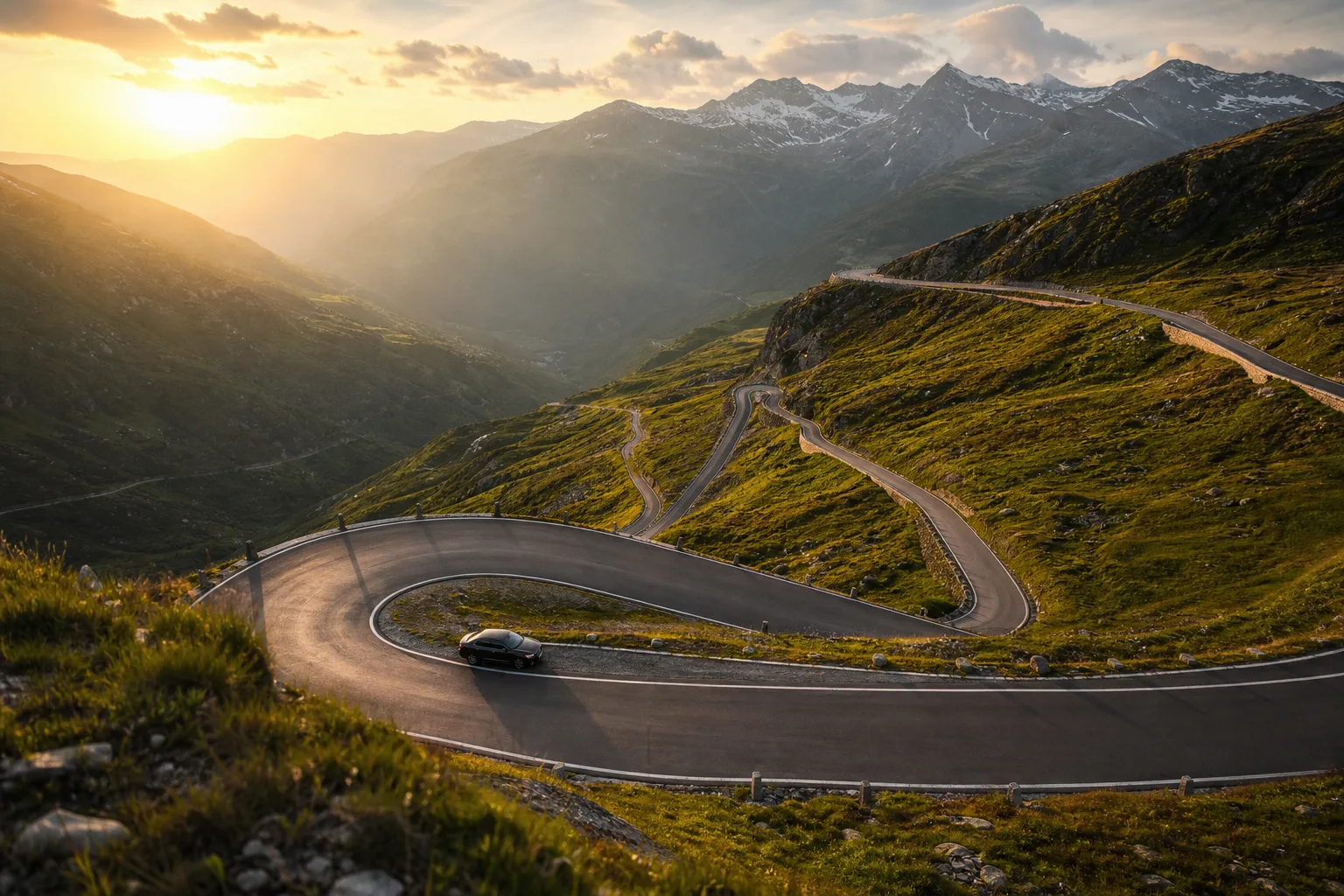
The best road trips in Europe cluster around three kinds of magic: Alpine passes engineered for the view, coastal roads that trade speed for scenery, and long cross-country routes that turn borders into part of the trip. The nine below cover all three, from Austria’s Grossglockner to Turkey’s D400, with the one layer most lists skip: what each route actually asks of you in tolls, stickers, and paperwork.
That practical layer is the difference between a great drive and a great drive interrupted. European routes cross toll systems and vignette borders mid-holiday, and the rules change with the border, not the scenery. Each route card below tells you what to sort before the wheels turn, starting with the vignettes and tolls for the countries on your route.
Key Takeaways
- Europe’s most rewarding drives split into Alpine passes (Grossglockner, Grandes Alpes, Transfăgărășan), coastal classics (Amalfi, Atlantic Ocean Road, D400), and full-circuit routes (Iceland’s Ring Road, Scotland’s North Coast 500).
- High Alpine routes are seasonal: most open from late spring to autumn only, so check the route’s official site before planning shoulder-season trips.
- The paperwork changes per route: some are toll roads in their own right, some sit in vignette countries, and some need nothing but fuel.
- Speed limits, drink-drive rules, and equipment requirements reset at every border along a multi-country route.
The Best Road Trip Routes in Europe at a Glance
| Route | Country | Length | Best season | Paperwork layer |
|---|---|---|---|---|
| Grossglockner High Alpine Road | Austria | 48 km | May-Oct | Own toll + vignette approach |
| Transfăgărășan | Romania | ~90 km pass | Jul-Oct | Rovinieta e-vignette |
| Amalfi Coast (SS163) | Italy | ~50 km | Apr-Jun, Sep | Autostrada tolls on approach |
| Route des Grandes Alpes | France | ~700 km | Jun-Sep | Autoroute tolls optional |
| Romantic Road | Germany | ~460 km | Apr-Oct | None for cars |
| Atlantic Ocean Road | Norway | 8 km | All year | Plate-billed tolls network |
| Ring Road | Iceland | ~1,320 km | May-Sep | Tunnel tolls only |
| North Coast 500 | Scotland | 516 miles | May-Sep | None; left-hand traffic |
| Turkish Riviera (D400) | Türkiye | ~200 km core | Apr-Jun, Sep-Oct | HGS + Green Card |
1. Grossglockner High Alpine Road, Austria
Austria’s showpiece: 48 kilometres and 36 numbered hairpins climbing to the 2,504-metre Edelweissspitze viewpoint beneath the country’s highest peak. It was built in the 1930s purely as a scenic drive, and it still feels that way. The road is a dedicated toll road with its own ticketing, run by the operator Grossglockner Hochalpenstrassen AG, and typically opens from May to early November.
The practical layer: the Grossglockner’s own toll is separate from Austria’s motorway system, but the motorways that get you there need an Austrian vignette. Expect the full Alpine kit: cool temperatures at the top in August, and early closing hours in autumn.
2. Transfăgărășan, Romania
Romania’s road over the Făgăraș mountains climbs to 2,042 metres through hairpin after hairpin. From above, it photographs like a signature on the landscape. Add Poenari Fortress at the southern end and glacial Lake Bâlea at the top, and it earns its reputation as one of Europe’s great mountain drives. It’s high, weather-bound, and generally open only from summer into early autumn, per Romania’s official travel guidance.
The practical layer: Romania’s rovinieta, the country’s e-vignette, covers national roads including the approaches. The pass itself is slow by design: budget hours, not minutes.
3. Amalfi Coast, Italy
The SS163 threads fifty kilometres of cliff between Sorrento and Salerno. It passes Positano’s stacked pastel houses and lemon terraces older than the road itself. It’s Europe’s most famous coastal drive and its most demanding parking situation, which is why the best version runs early morning, shoulder season, southbound for the sea-side lane.
The practical layer: no toll on the SS163 itself, but the autostrada that delivers you there is Italy’s distance-toll network. Summer brings traffic restrictions on parts of the coast road; spring and autumn are the drive this road deserves.
4. Route des Grandes Alpes, France
The long one: roughly 700 kilometres from Lake Geneva to the Mediterranean over a chain of legendary cols, Iseran and Galibier among them, many above 2,000 metres. It’s a week-long drive, won slowly, village by village.
The practical layer: France’s autoroutes are toll roads, but the Grandes Alpes route itself mostly follows free mountain roads. The high cols close outside summer; the route’s official itinerary tracks which sections are open. French speed limits change with weather, a detail that matters on a route that makes its own weather.
5. Romantic Road, Germany
Germany’s gentlest classic: about 460 kilometres from Würzburg to Füssen through walled medieval towns, ending beneath Neuschwanstein castle. It’s the anti-Alpine route: no altitude, just an unmatched density of places worth stopping.
The practical layer: the lightest paperwork on this list. Germany has no vignette for cars, and the route follows ordinary roads where the autobahn’s famous freedoms don’t apply anyway. It’s also the most caravan-friendly drive here.
6. Atlantic Ocean Road, Norway
Eight kilometres that justify a detour of eight hundred. Bridges hop between islets on Norway’s west coast, and the Storseisundet bridge’s famous curve seems to launch into the sea. Visit Norway lists it among the country’s designated Scenic Routes, and in a storm it becomes one of Europe’s most dramatic stretches of tarmac.
The practical layer: Norway runs automatic tolls billed by plate across its road network, so foreign drivers should register for visitor payment. Distances in Norway deceive: the route is short, but everything around it is not.
7. Ring Road, Iceland
Route 1 circles the entire country in about 1,320 kilometres of waterfalls, lava fields, glacier tongues, and black-sand coastline. It’s the best week-long circuit in Europe and the one where weather planning is part of the driving, as Iceland’s own SafeTravel service emphasises year-round.
The practical layer: Iceland has no motorways at all, and Iceland’s speed limits top out at 90 km/h, which suits a route where every second corner argues for stopping. The Ring Road proper is paved and 2WD-friendly; the interior F-roads are a different sport with different vehicle rules.
8. North Coast 500, Scotland
Scotland’s 516-mile circuit from Inverness around the Highlands’ northern edge: sea lochs, single-track roads with passing places, and beaches that would be famous anywhere warmer than Scotland. The official NC500 route guidance covers the etiquette that makes it work, especially letting faster traffic pass on single-track sections.
The practical layer: this is the list’s left-side entry. If you’re arriving from the continent, the switch is the story: the UK is one of only four European countries that drive on the left. No tolls on the route, generous free scenery, midges included at no extra charge.
9. The Turkish Riviera: D400 from Antalya to Fethiye
The D400 hugs Turkey’s Mediterranean coast for a spectacular stretch between Antalya and Fethiye: sea on one side, pine and mountain on the other, with Kaş and Kalkan as the postcard stops. Türkiye’s official tourism guidance ranks the Turquoise Coast among its signature journeys, and the road itself is modern and well-surfaced.
The practical layer: Turkey is the list’s most paperwork-distinct entry: an HGS toll account for the motorways that get you south, a Green Card for insurance, and the strict 2026 enforcement rules. Our complete guide to driving in Turkey covers all three before your first Turkish kilometre.
Planning the Drive: The Layer That Makes It Smooth
Three habits separate the smooth version of these trips from the stressful one:
- Sort the stickers and tolls per country, before departure. A route like Geneva-to-Amalfi crosses a vignette country, a toll network, and a free-roads country in one day. Knowing which countries use vignettes is the five-minute pre-trip check.
- Assume the rules reset at every border. Limits, alcohol rules, and equipment lists are national, and enforcement starts at the boundary line.
- Keep data alive across borders. Navigation, weather, and pass-status checks all live on your phone; a regional travel eSIM carries them across every crossing on one profile.
The Short Version
The best road trips in Europe range from an afternoon (Atlantic Ocean Road, Amalfi) to a full week (Ring Road, Grandes Alpes, NC500), and the greatest of them are seasonal, so the route’s official site is always the first stop. Pick by appetite: altitude in Austria, Romania, and France; coastline in Italy, Norway, and Turkey; circuits in Iceland and Scotland; storybook towns in Germany. Then make the boring layer boring again, tolls sorted, stickers bought, data working, and browse our road-trip guides for the country-by-country rules along whichever route wins.
Frequently Asked Questions
What is the best road trip in Europe?
For a single day’s drive, the Grossglockner High Alpine Road is the most concentrated spectacle in Europe. For a week, Iceland’s Ring Road is unmatched. The honest answer depends on appetite: altitude, coastline, or circuit.
What is the most beautiful drive in Europe?
The Atlantic Ocean Road in Norway and the Transfăgărășan in Romania trade the title depending on taste, sea drama versus mountain drama. Both are short enough to drive twice.
When is the best time for a European road trip?
Late May to early October for the Alpine routes, which close seasonally, and shoulder months (May, June, September) for coastal classics like Amalfi, where summer traffic dulls the fun. Iceland and Scotland reward summer’s long daylight.
Do I need a vignette for a European road trip?
Depends on the route. Austria, Romania, Slovenia, Switzerland, and several other countries require vignettes; France and Italy run distance tolls instead; Germany needs nothing for cars. Check each country on your route before departure.
How many days do you need for a European road trip?
The routes here span half a day (Atlantic Ocean Road) to seven-plus days (Ring Road, Route des Grandes Alpes, NC500). A satisfying multi-country Alpine loop fits comfortably in five to seven days.
Can I do these routes in a rental car?
Yes, all nine are paved, standard-car routes; only Iceland’s optional F-road detours demand more. Check the rental’s cross-border policy when a route spans countries, and who pays the tolls and vignettes.
Which European road trip is best for a first-timer?
The Romantic Road: no altitude, no tolls, short daily distances, and towns doing the heavy lifting. It teaches continental driving gently, and it leaves the Alpine passes as the sequel.
Which European road trips are toll-free?
Scotland’s North Coast 500 and Germany’s Romantic Road carry no route tolls at all. Norway bills its toll network automatically by plate, and Iceland charges one tolled tunnel; the Alpine and Mediterranean routes generally involve a vignette or toll network somewhere on the approach.
Sources
- Grossglockner High Alpine Road: official operator site
- Romania official travel: Transfăgărășan
- Visit Norway: the Atlantic Ocean Road
- SafeTravel Iceland: driving in Iceland
- North Coast 500: official route information
- Romantic Road: official route association
- Route des Grandes Alpes: official route itinerary
- Italia.it: official Italian tourism portal
- GoTürkiye: the Turquoise Coast
Ramis Kalkan
Ramis Kalkan leads growth at Vignetim. He writes about everything that makes European road trips smoother, from digital vignettes to eSIMs. Based in Ankara, usually mid-way through planning his next drive.