European Number-Plate Country Codes: The Full List
That oval code on the car ahead tells you where it’s from, if you can decode it. Every European plate code in one table, and the one sticker rule UK drivers still get wrong.
 Ramis Kalkan
Updated: 7 min read
Number plate country codes are the letters on a European car’s oval sticker or blue plate strip that name its country of registration: D is Germany, CH is Switzerland, A is Austria, and EST is Estonia. These codes are set internationally as “distinguishing signs” under the UN road traffic conventions, and the UNECE keeps the official list. The full European table is below.
Once you can read them, motorway traffic turns into a geography lesson. The D on the Audi that just passed, the PL on the truck ahead, the mysterious FL on a car from a country of 40,000 people. And for UK drivers heading to the continent, the code on your own car carries a real rule since 2021, including one sticker requirement that still catches people out in Spain.
Key Takeaways
- Number plate country codes are official “distinguishing signs” under the UN road traffic conventions; the UNECE maintains the definitive list.
- The famous false friends: D is Germany (Denmark is DK), E is Spain (Estonia is EST), and CH is Switzerland (from the Latin Confoederatio Helvetica).
- An EU plate’s blue strip with the code and stars counts as the distinguishing sign inside most of Europe, so EU cars rarely need a separate oval sticker.
- The UK switched its code from GB to UK in September 2021. A plate with the UK identifier covers you in most countries, but Spain, Cyprus, and Malta still require the separate UK sticker.
The Full Table of European Country Codes
The list below follows the official UNECE register of distinguishing signs for vehicles in international traffic, covering the countries a European road trip actually meets.
| Code | Country | Code | Country | |
|---|---|---|---|---|
| A | Austria | L | Luxembourg | |
| AL | Albania | LT | Lithuania | |
| AND | Andorra | LV | Latvia | |
| B | Belgium | M | Malta | |
| BG | Bulgaria | MC | Monaco | |
| BIH | Bosnia and Herzegovina | MD | Moldova | |
| BY | Belarus | MNE | Montenegro | |
| CH | Switzerland | N | Norway | |
| CY | Cyprus | NL | Netherlands | |
| CZ | Czech Republic | NMK | North Macedonia | |
| D | Germany | P | Portugal | |
| DK | Denmark | PL | Poland | |
| E | Spain | RO | Romania | |
| EST | Estonia | RSM | San Marino | |
| F | France | S | Sweden | |
| FIN | Finland | SK | Slovakia | |
| FL | Liechtenstein | SLO | Slovenia | |
| GR | Greece | SRB | Serbia | |
| H | Hungary | TR | Türkiye | |
| HR | Croatia | UA | Ukraine | |
| I | Italy | UK | United Kingdom | |
| IRL | Ireland | V | Vatican City | |
| IS | Iceland |
Two housekeeping notes on the table. Greece is officially registered as GR on plates even though its internet code is EL in EU paperwork. And the UK row is the newest change on the list, covered in detail below.
The Codes That Fool Everyone
A handful of codes reliably lose pub quizzes and roadside guessing games:
- D is Germany, from Deutschland. Denmark is DK.
- E is Spain, from España, which bumps Estonia to EST.
- CH is Switzerland: Confoederatio Helvetica, the country’s Latin name, chosen to avoid picking between its four language communities.
- A is Austria, not Albania (AL) or Andorra (AND).
- FL is Liechtenstein, from Fürstentum Liechtenstein, since L was taken by Luxembourg.
- The Slavic trio: SK is Slovakia, SLO is Slovenia, SRB is Serbia. Three different countries, three codes people swap constantly.
- NMK is North Macedonia, updated from MK after the country’s 2019 renaming.
- V is Vatican City, the rarest sighting in European traffic.
The Blue EU Strip vs the Oval Sticker
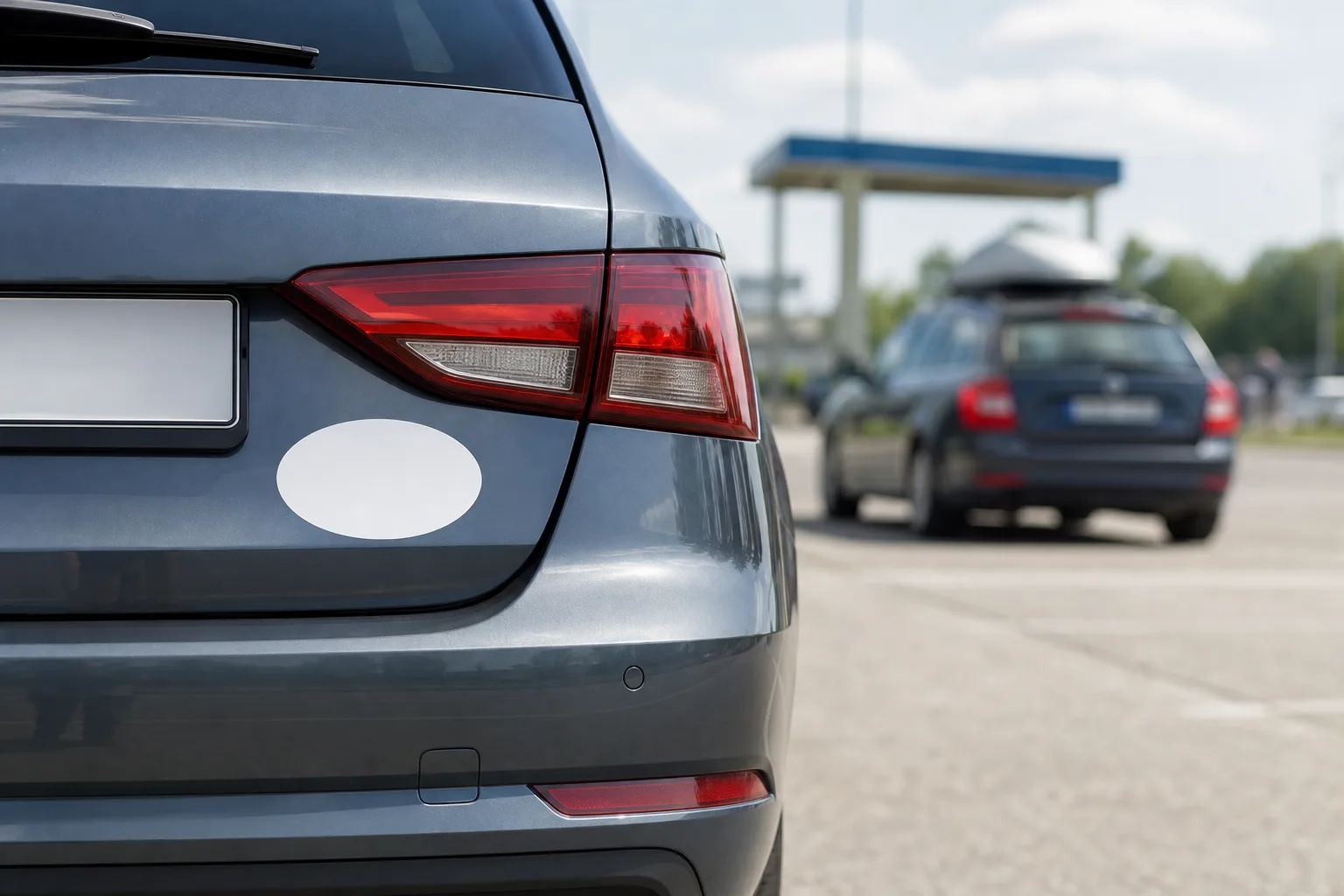
The classic white oval sticker and the blue strip on the left edge of an EU plate do the same legal job: both display the distinguishing sign the UN conventions require on vehicles in international traffic.
For cars registered in the EU, the blue Euro-strip with the country code under the circle of stars counts as the distinguishing sign across the EU, which is why a French car drives to Italy with no extra sticker. Cars from non-EU countries, or cars whose plates carry no identifier at all, fall back on the oval sticker. If your plate shows no country code, the sticker is the fix everywhere.
UK Drivers: GB Became UK, and One Sticker Rule Remains
The United Kingdom changed its distinguishing sign from GB to UK in September 2021, and the UNECE list reflects it. For drivers, gov.uk’s rule set is short:
- A plate with the UK identifier and Union flag covers you in most European countries with no extra sticker.
- Plates with the old GB identifier, a Euro-flag GB strip, a national England/Scotland/Wales flag, or no identifier need a separate UK sticker on the rear of the car.
- Spain, Cyprus, and Malta are the exception: gov.uk advises displaying the UK sticker there regardless of what the plate shows.
The sticker costs little and weighs nothing, which makes it cheap insurance for a southern European route. The rest of the pre-trip checklist is where the real money hides: vignettes and tolls vary country by country, and they’re the documents drivers actually forget.
Spotting Number-Plate Codes on a Road Trip
Plate-spotting is the oldest back-seat game in Europe, and the codes give it structure: one point for DK, five for MNE, bragging rights for V. It pairs well with the continent’s other roadside trivia, like why the UK, Ireland, Malta, and Cyprus drive on the left while everyone else keeps right, mapped in the full list of left-driving countries and explained in the history of why Britain stayed left.
The practical version of the game matters more: the codes around you hint at the traffic culture ahead. A motorway filling with I and SLO plates means the Alps are coming, and with them different speed limits at every border.
The Short Version
European number plate country codes come from the official UNECE list of distinguishing signs: D for Germany, E for Spain, CH for Switzerland, and the rest of the table above. EU cars carry theirs in the blue plate strip; others use the oval sticker. UK drivers switched from GB to UK in 2021 and still need the physical sticker in Spain, Cyprus, and Malta. Keep the table bookmarked for the trip, and browse our road-trip guides for the rules that change once you’ve worked out where everyone’s from.
Frequently Asked Questions
What country is D on a number plate?
Germany, from Deutschland. Denmark uses DK. The single-letter codes generally went to early signatories of the road traffic conventions: D, F (France), I (Italy), E (Spain), B (Belgium), A (Austria), H (Hungary), L (Luxembourg), N (Norway), S (Sweden), P (Portugal), M (Malta), and V (Vatican City).
What country is CH on a car?
Switzerland. CH stands for Confoederatio Helvetica, the country’s neutral Latin name, which avoided choosing between its German, French, Italian, and Romansh names.
Do I still need a GB sticker to drive in Europe?
No, GB stickers were replaced in September 2021. If your plate carries the UK identifier with the Union flag, most countries need nothing extra. You need a UK sticker if your plate has the old GB identifier or no identifier, and in Spain, Cyprus, and Malta regardless of plate.
Is the blue strip on EU plates enough, or do I need an oval sticker?
Within the EU, the blue strip with the country code counts as the distinguishing sign, so no separate sticker is needed. Cars without any plate identifier, and drivers heading to countries with stricter display rules, fall back on the oval sticker.
What country is FL on a number plate?
Liechtenstein, from Fürstentum (principality of) Liechtenstein. L was already taken by Luxembourg.
What country is E on a number plate?
Spain, from España. It’s the reason Estonia carries EST instead: E was already taken when Estonia’s code was registered.
What’s the difference between SK, SLO, and SRB?
SK is Slovakia, SLO is Slovenia, and SRB is Serbia. They’re the most commonly confused trio on the list, three separate countries across Central Europe and the Balkans.
Who decides these country codes?
They’re distinguishing signs registered under the UN road traffic conventions (1949 Geneva and 1968 Vienna), and the UNECE maintains the official list that governments notify their codes to.
Sources
Ramis Kalkan
Ramis Kalkan leads growth at Vignetim. He writes about everything that makes European road trips smoother, from digital vignettes to eSIMs. Based in Ankara, usually mid-way through planning his next drive.