Driving in Europe: Requirements and the Pre-Trip Checklist
The documents take ten minutes to sort at home and hours to fix abroad. Everything a European drive requires, from licence and insurance to the sticker rules nobody remembers.
 Ramis Kalkan
Updated: 7 min read
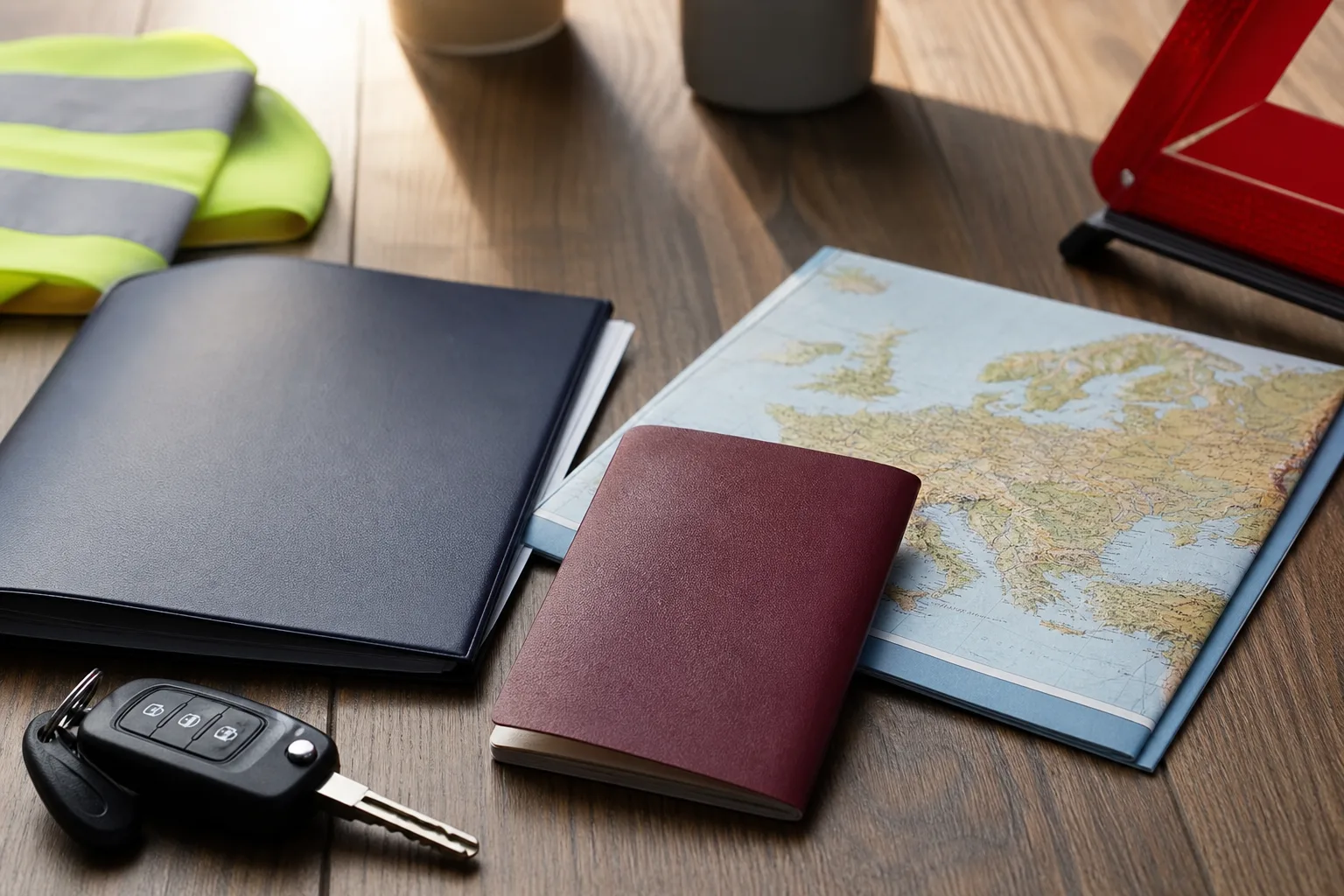
To drive in Europe you need four things in every country: a valid driving licence, proof of motor insurance, the vehicle’s registration document, and personal ID or a passport. On top of that base layer, individual countries add their own requirements: vignettes or toll accounts, mandatory equipment, plate identifiers, and, outside the EU insurance zone, a Green Card. This checklist covers all of it, in the order you should sort it.
The pattern behind every item is the same: ten minutes at home, or hours abroad. A missing vignette is a fine at the gantry. A missing Green Card can stop you at a border. The checklist exists so the trip’s problems stay at the kitchen table, where they’re cheap.
Key Takeaways
- The universal base: valid licence, insurance proof, vehicle registration document, and passport/ID, required everywhere in Europe.
- EU licences work across the EU. UK and other non-EU licences are widely accepted for visits, with an International Driving Permit needed only for specific countries and licence types.
- Insurance is territorial: EU policies cover the EU, but countries like Türkiye and some Balkan states need Green Card confirmation.
- Tolls and vignettes are country-specific and mostly digital; sort them per country before departure.
- Equipment rules (warning triangle, vests, winter gear) are national. Check each country on your route, not just the destination.
The Documents You Need to Drive in Europe
Four items form the non-negotiable base layer, per the EU’s own Your Europe guidance and gov.uk’s requirements for driving abroad:
- Your driving licence. An EU licence is valid across the EU. A UK photocard licence covers visits to the EU without extra paperwork; an International Driving Permit is only needed for some non-EU countries or older paper licences. Check gov.uk’s country list if your licence has anything unusual about it.
- Proof of insurance. Carry the insurance certificate or digital proof. Within the EU and associated countries, your policy’s minimum third-party cover travels with you.
- The vehicle’s registration document. The V5C log book for UK vehicles, or your national equivalent. Hire cars come with their own paperwork; if you’re borrowing a car, carry the owner’s written permission.
- Passport or ID card. The Schengen area removed routine checks, not the requirement to carry identification.
Insurance: Where the Green Card Still Matters
Inside the EU insurance zone, your home policy follows the car. The moment a route leaves that zone, insurance becomes a border document again. Türkiye is the clearest case: EU and UK policies don’t apply by default, and a Green Card with the right country box validated is what border checks want to see. Several Balkan countries sit in the same category depending on your insurer.
The check takes one phone call or app screen: confirm which countries on your route your policy covers, and order the Green Card for the rest before you leave. Allow days, not hours, if your insurer posts physical documents.
Tolls and Vignettes: The Per-Country Layer
No single European toll rule exists, which is exactly why this layer catches drivers. Austria, Switzerland, Slovenia, and others sell time-based vignettes. France, Italy, Spain, and Portugal run distance tolls. Norway bills plates automatically. Germany needs nothing for cars, and Türkiye runs the HGS plate-scan system.
The practical answer is to check the vignette and toll requirements country by country for every country you’ll touch, including short transits: a twenty-minute motorway hop across a corner of Austria needs the same vignette a week’s stay does. Digital vignettes have made the fix trivial to sort from home, and impossible to argue about after the gantry camera has flashed.
Equipment Requirements: National Rules, Not European Ones
Mandatory kit varies by country, and the rules apply to the roads you’re on, not where the car is registered. The recurring items across national rule sets: a warning triangle, reflective vests reachable from the seats, and headlamp beam adjustment for right-hand-drive cars visiting the continent. Winter adds its own layer in Alpine and Nordic countries, from mandated winter tyres in season to chains where signed.
Rather than memorise a matrix, check the national rules for each country on the route via the Your Europe country pages, and keep the common kit permanently in the boot. A triangle and two vests weigh nothing and cover most of the continent’s baseline.
The Rules That Change at Every Border
Documents get you into the country; the rules keep you legal inside it. Three change at every border and deserve a pre-trip skim:
- Speed limits shift with the border, and enforcement starts immediately. Our European speed-limits table covers every country on one page.
- Drink-drive limits range from Europe’s most permissive down to absolute zero, and the strictest countries are the ones drivers least expect. The country-by-country BAC table is the two-minute version.
- Plate identifiers matter for UK cars especially: the UK-identifier plate covers most countries, with a separate sticker still needed in Spain, Cyprus, and Malta, as covered in our number-plate country codes guide.
Connectivity: The Item That Runs Everything Else
Navigation, digital vignette receipts, toll apps, insurance documents, and translation all live on your phone, which makes mobile data the quiet infrastructure of the whole checklist. Sorting a travel eSIM before departure keeps data working across every border on one profile, so the documents above stay reachable exactly when a border official or toll dispute wants them.
The Driving in Europe Checklist
- [ ] Driving licence (check IDP need for unusual cases)
- [ ] Insurance certificate + Green Card where needed
- [ ] Vehicle registration document (or hire/borrow paperwork)
- [ ] Passports/IDs for everyone in the car
- [ ] Vignettes and toll accounts for every country on the route
- [ ] Warning triangle, vests, beam deflectors; winter kit in season
- [ ] UK sticker if your plate needs one (or for Spain, Cyprus, Malta)
- [ ] Travel data/eSIM installed and tested
- [ ] Breakdown cover confirmed for the countries on the route
The Short Version
The requirements for driving in Europe stack in three layers: the universal documents (licence, insurance, registration, ID), the per-country layer (vignettes, tolls, equipment, stickers), and the rules that reset at borders (speed, alcohol, right of way). Sort the first two at home and skim the third per country, starting with the vignette and toll map of your route. Then the drive gets to be about the drive, which is the point of all this homework. The rest of the border-by-border detail lives in our driving guides.
Frequently Asked Questions
What documents do I need to drive in Europe?
Everywhere: a valid driving licence, proof of insurance, the vehicle registration document, and your passport or ID. Some routes add a Green Card (outside the EU insurance zone), an IDP (specific countries and licence types), and country-specific toll stickers.
Do UK drivers need an International Driving Permit for Europe?
Usually not. A UK photocard licence covers visits to the EU. IDPs come into play for some non-EU countries and for older paper licences, and gov.uk maintains the country-by-country list worth checking before unusual routes.
Do I need a Green Card to drive in Europe?
Within the EU and its associated insurance zone, no. For Türkiye and certain Balkan countries, yes or strongly advised, depending on your insurer. Confirm coverage per country with your insurer before departure.
What equipment is mandatory in a car in Europe?
It’s set nationally, but the recurring baseline is a warning triangle and reflective vests, with headlamp beam adjustment for RHD cars on the continent, and winter equipment rules in Alpine and Nordic countries in season. Check each country on your route.
Do I need a vignette to drive through Europe?
For some countries, yes: Austria, Switzerland, Slovenia, and others use vignettes, while France and Italy toll by distance and Germany needs nothing for cars. Even a brief motorway transit triggers the requirement, so check every country on the route.
Can I drive in Europe with my EU licence after moving countries?
Yes, EU licences are mutually recognised across the EU, including after moving, until national exchange rules kick in for residents. Visitors never need to exchange.
Do I need my passport to drive between Schengen countries?
Carry it, yes. Schengen removed routine border checks, not the legal requirement to hold identification, and spot checks reappear during heightened-security periods. Keep passports or ID cards reachable, not buried in the boot.
Is my breakdown cover valid in Europe?
Only if it says so: domestic policies often stop at the border, and European cover is a separate add-on with most providers. Confirm the countries on your route are included before you leave.
Sources
Ramis Kalkan
Ramis Kalkan leads growth at Vignetim. He writes about everything that makes European road trips smoother, from digital vignettes to eSIMs. Based in Ankara, usually mid-way through planning his next drive.