Is It Illegal to Drive Barefoot? The Rule in the UK and Europe
No law names bare feet, but a wet sole on a brake pedal has legal consequences anyway. What the UK’s Rule 97 means in practice, and how France, Spain, Germany, and Italy see it.
 Ramis Kalkan
Updated: 7 min read
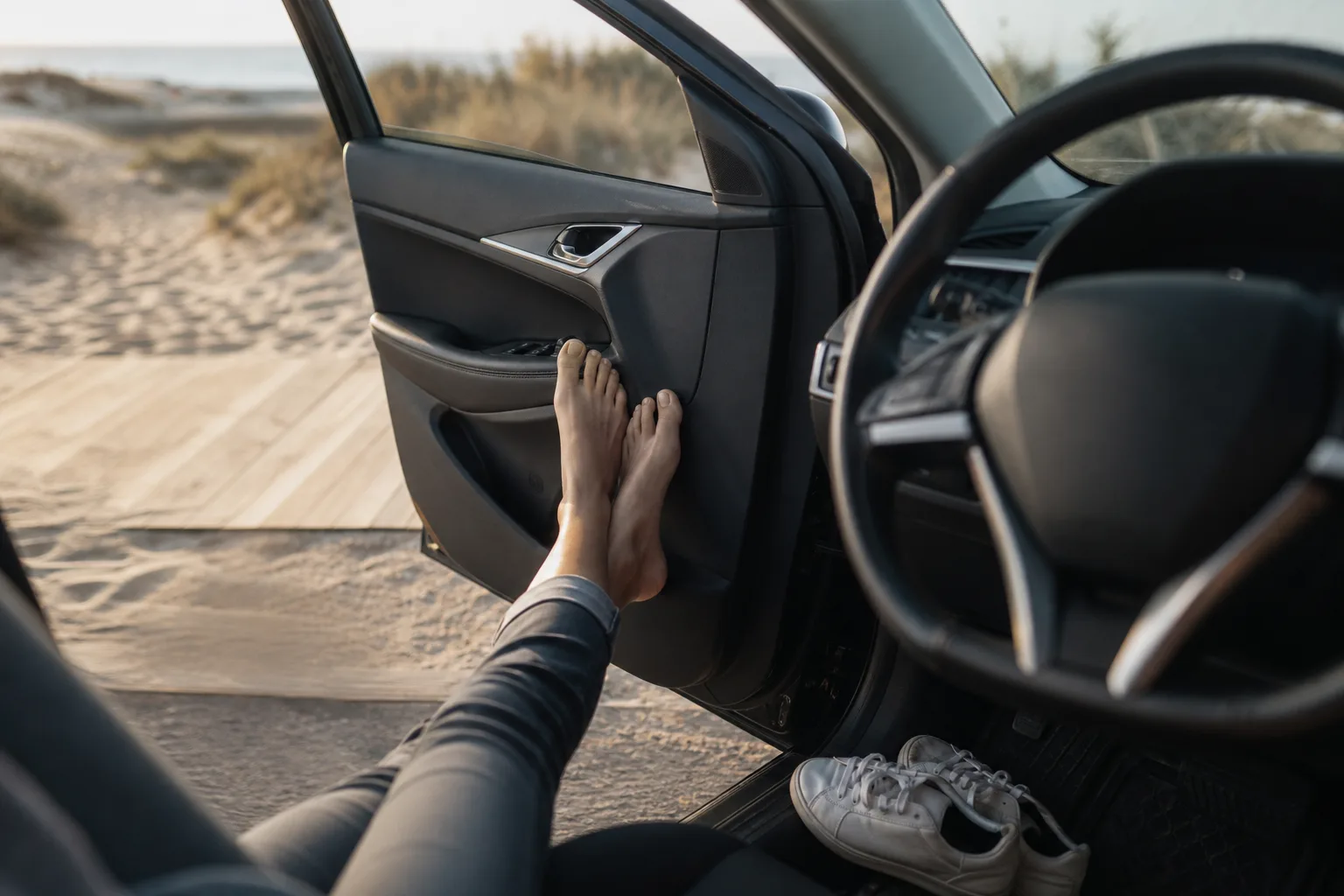
No, it is not illegal to drive barefoot in the UK, and no major European driving country bans it either. What every one of them has instead is a control rule. Highway Code Rule 97 tells UK drivers their footwear must not prevent them “using the controls in the correct manner”. If driving barefoot contributes to bad driving, the charge is careless driving, with 3 to 9 penalty points on the table.
The barefoot question comes up every summer for the same reason: someone drives back from the beach with sandy feet, someone else insists it’s illegal, and nobody in the car can cite the actual rule. This guide settles it with the real sources, covers whether bare feet are genuinely a control problem, and lays out how France, Spain, Germany, and Italy treat the same question.
Key Takeaways
- No UK law bans driving barefoot. Rule 97 of the Highway Code is advisory, and it talks about footwear that interferes with the controls, not the absence of shoes.
- The real exposure is careless driving: a £100 roadside fixed penalty, or 3 to 9 points (code CD10) if a barefoot-related mistake ends up in court.
- France, Germany, and Italy have no barefoot ban either. Spain can fine up to €80 under its general vehicle-control rules if an officer judges your feet compromise control.
- The practical risk is grip: a wet or sandy sole on a brake pedal delivers less braking force exactly when you need more.
- Socks are the worst option of all, less grip than bare skin and less protection than a shoe.
What UK Law Says About Driving Barefoot
Rule 97 of the Highway Code asks drivers to ensure, before setting off, that “clothing and footwear do not prevent you using the controls in the correct manner”. Bare feet aren’t mentioned, and the rule’s own word is “should”, which makes it advisory rather than an offence.
The legal mechanism only engages when something goes wrong. If a police officer or a court decides your driving fell below the careful-driver standard, and bare feet played a part, Rule 97 becomes supporting evidence for a charge of driving without due care and attention. At the roadside that’s typically a £100 fixed penalty and three points. In court, the CD10 endorsement runs from 3 to 9 points and sits on your record for four years.
So the accurate one-line answer: driving barefoot is legal in the UK, and it stops protecting you the moment it makes your driving worse.
How Dangerous Is Driving Barefoot?
The law’s indifference doesn’t settle the practical question. This is where the barefoot case differs from the flip flops question. A flip flop’s failure mode is dramatic: the sole folds or wedges under a pedal. Bare feet fail quietly:
- Wet or sandy skin slides. A beach-day sole on a rubber pedal cover has noticeably less grip, and maximum braking is precisely the moment you can’t afford slip.
- Bare heels deliver less force. Hard braking pushes the pedal through the ball of your foot with your full leg. Without a stiff sole spreading the load, sustained pressure hurts, and drivers instinctively ease off.
- Debris in the footwell hurts at the wrong time. A dropped coin or grit under a bare foot mid-manoeuvre is a distraction with a steering wheel in your hands.
- Socks make everything worse. They combine a shoe’s lack of feel with less grip than skin. If the choice is socks or bare feet, bare feet win, and shoes beat both.
None of this makes a short barefoot drive reckless. It makes it a small, avoidable handicap you’d be carrying during the exact seconds that decide whether a mistake becomes a claim.
Driving Barefoot Across Europe
The pattern across Europe’s main driving destinations mirrors the UK: nobody bans bare feet, everybody requires full control of the car, and one country actively fines under that general rule.
| Country | Barefoot ban? | The rule that applies | Fine risk |
|---|---|---|---|
| United Kingdom | No | Highway Code Rule 97 + careless driving (RTA 1988) | If bare feet contribute to bad driving |
| France | No | Code de la route art. R412-6: driver must be in a position to carry out all manoeuvres without delay | Second-class fine under R412-6 |
| Spain | No | RGC arts. 3.1 and 17.1: full care and control at all times | Up to €80 at the officer’s judgement (DGT) |
| Germany | No | StVO general duty of care; no footwear rule for private drivers | Only if bad driving results |
| Italy | No | Codice della Strada control duties; old footwear rule abolished | Only if bad driving results |
Spain deserves the highlight again: its traffic authority, the DGT, confirms officers can and do fine drivers whose footwear, or lack of it, visibly compromises control of the vehicle. On a summer route south, treat that as enforced law. The same border logic applies to everything else on the dashboard too: speed limits change country by country, and the rules of the country you’re driving through are always the ones that count.
Barefoot vs Flip Flops: Which Is the Bigger Risk?
Mechanically, flip flops are the worse offender. A bare foot can slip; a flip flop can physically jam under the brake pedal or fold mid-press, which is why footwear features in claim investigations more often than bare feet do. Legally the two sit in exactly the same place: no ban, same careless-driving exposure, same Spanish general-rule fine.
The full footwear side of the question, sandals, sliders, and heels included, is covered in our companion guide to driving in flip flops.
What to Do Instead
The barefoot problem has a 20-second solution: keep a pair of flat, grippy shoes in the car. Trainers on the driver’s side floor mat cost nothing, survive sandy feet and beach days, and close the entire legal-practical question before it opens. Drive in the trainers, go barefoot everywhere that matters.
The Short Version
Driving barefoot is not illegal in the UK or anywhere in mainstream driving Europe, and no officer will stop you for bare feet alone. The exposure begins when bare feet contribute to a mistake: careless driving and 3 to 9 points in the UK, general-control fines in France and Spain. Since the fix is a pair of trainers in the footwell, take the free option. And if the barefoot question came up because a European trip is coming, sort the vignettes and tolls for the route while you’re at it, then browse our driving guides for the rest of the border-by-border rules.
Frequently Asked Questions
Is it illegal to drive barefoot in the UK?
No. No UK law prohibits driving barefoot. Highway Code Rule 97 is advisory and concerns clothing or footwear that stops you using the controls correctly. Bare feet only become a legal problem if they contribute to careless driving.
Can you get fined for driving barefoot?
Not for bare feet alone. If barefoot driving contributes to a driving error, a careless-driving charge brings a £100 roadside fixed penalty and three points, or 3 to 9 points through court under endorsement code CD10.
Is it illegal to drive without shoes anywhere in Europe?
No major European driving country has a barefoot ban. Spain is the one to respect in practice: under its general control rules, an officer can fine a driver up to €80 if going shoeless is judged to compromise control.
Is it illegal to drive in socks?
No, the law treats socks like bare feet: no specific rule, same careless-driving exposure. Practically they’re the worst choice, offering less pedal grip than skin and none of a shoe’s protection.
Is driving barefoot dangerous?
Slightly, in specific conditions. Dry bare feet on clean pedals work adequately. Wet, sandy, or tired feet grip worse and deliver less braking force, which is why keeping driving shoes in the car is the standard advice.
Can I drive barefoot on the motorway?
Legally yes, the rules don’t distinguish road types. Practically, motorway speeds shrink your margin for a slipped pedal, so it’s the worst place to test barefoot braking.
Does driving barefoot affect insurance?
Being barefoot doesn’t void cover. But if an investigation finds it contributed to an accident, an insurer can argue you failed to take reasonable care, which can complicate the claim, the same logic that applies to unsuitable footwear.
What should I do after a beach day with no shoes?
Keep flat, grippy shoes in the car and put them on to drive, even for a short hop. Sand on skin is the exact combination that slides on a pedal, and the fix takes seconds.
Sources
- The Highway Code, Rule 97 (gov.uk)
- Penalty points endorsement codes, CD10-CD30 (gov.uk)
- The Highway Code, Annex 5: penalty table (gov.uk)
- Fixed Penalty Order 2013, SI 2013/1569 (legislation.gov.uk)
- Code de la route, article R412-6 (Légifrance)
- DGT: 3 de cada 10 conductores van mal calzados (dgt.es)
- Straßenverkehrs-Ordnung, StVO (gesetze-im-internet.de)
- Codice della Strada (normattiva.it)
Ramis Kalkan
Ramis Kalkan leads growth at Vignetim. He writes about everything that makes European road trips smoother, from digital vignettes to eSIMs. Based in Ankara, usually mid-way through planning his next drive.