Driving in France: What You Actually Need to Carry
Most UK guides to driving in France still tell you to pack a breathalyser. That requirement was removed in 2020. Here is the list that is actually current, plus the rules that catch foreign drivers.
 Ramis Kalkan
Updated: 11 min read
To drive in France you need your full driving licence, the vehicle’s V5C registration document, valid insurance, a warning triangle and a high-visibility vest. If your car is not electric or hydrogen, you also need a Crit’Air sticker before you enter any of the low-emission zones around the larger cities. You do not need a breathalyser, and you have not needed one since 2020.
That last sentence is the reason this guide exists. A large share of the advice aimed at British drivers still lists a breathalyser kit as a legal requirement in France. It was removed from the code de la route more than five years ago, and nobody updated the packing lists.
Key Takeaways
- Carry the licence, the V5C and proof of insurance. Keep them reachable, not in a suitcase in the boot.
- The warning triangle and the hi-vis vest are the two genuinely mandatory items. The vest belongs inside the cabin, because you must already be wearing it when you step out.
- The breathalyser requirement was deleted by decree in May 2020. Ignore any list that still includes it.
- French speed limits fall in the rain. The motorway drops from 130 to 110 km/h, and nobody puts up a sign to tell you.
- Low-emission zones survived a repeal attempt in May 2026. The Crit’Air sticker is still required, and it still has to be ordered before you travel.
What You Must Carry in the Car
France separates two things that British drivers tend to bundle together: the paperwork that proves who you are and what the car is, and the safety equipment that has to be physically present.
The paperwork. Your full driving licence, the V5C logbook (or a hire agreement if the car is rented), and evidence that the car is insured. A UK licence is accepted for visits, and you do not need an International Driving Permit for a holiday or a short business trip. Keep all of it in the cabin. A French officer at a roadside check expects you to produce documents there and then, not to unpack the boot on the hard shoulder.
The equipment. Two items, both set out in article R416-19 of the code de la route:
| Item | What the law actually requires |
|---|---|
| Warning triangle | Must be carried, and must be used to signal the car if it is stopped somewhere it endangers traffic |
| High-visibility vest | Must be worn before you leave a vehicle stopped on the carriageway |
Read the second row again, because the wording changes where you put it. The obligation is not to own a vest, it is to be wearing one when you get out. A vest in the boot is a vest you have to step onto a live carriageway to fetch. Keep it in the door pocket or the glovebox.
The breathalyser is not on the list
For years, French law told drivers to carry a self-test breathalyser while never quite getting round to enforcing it, and the retail industry that grew up around that rule has outlived it.
The obligation is gone. Article R234-7 of the code de la route, in the version in force since 22 May 2020 after amendment by décret n° 2020-605 of 18 May 2020, no longer places any breathalyser duty on a driver. What remains in that article concerns licensed venues, not the person behind the wheel.
You can carry one if you want the reassurance. You cannot be fined for its absence.
Crit’Air and the Low-Emission Zones
This is the requirement that catches people out, because it cannot be solved at the border.
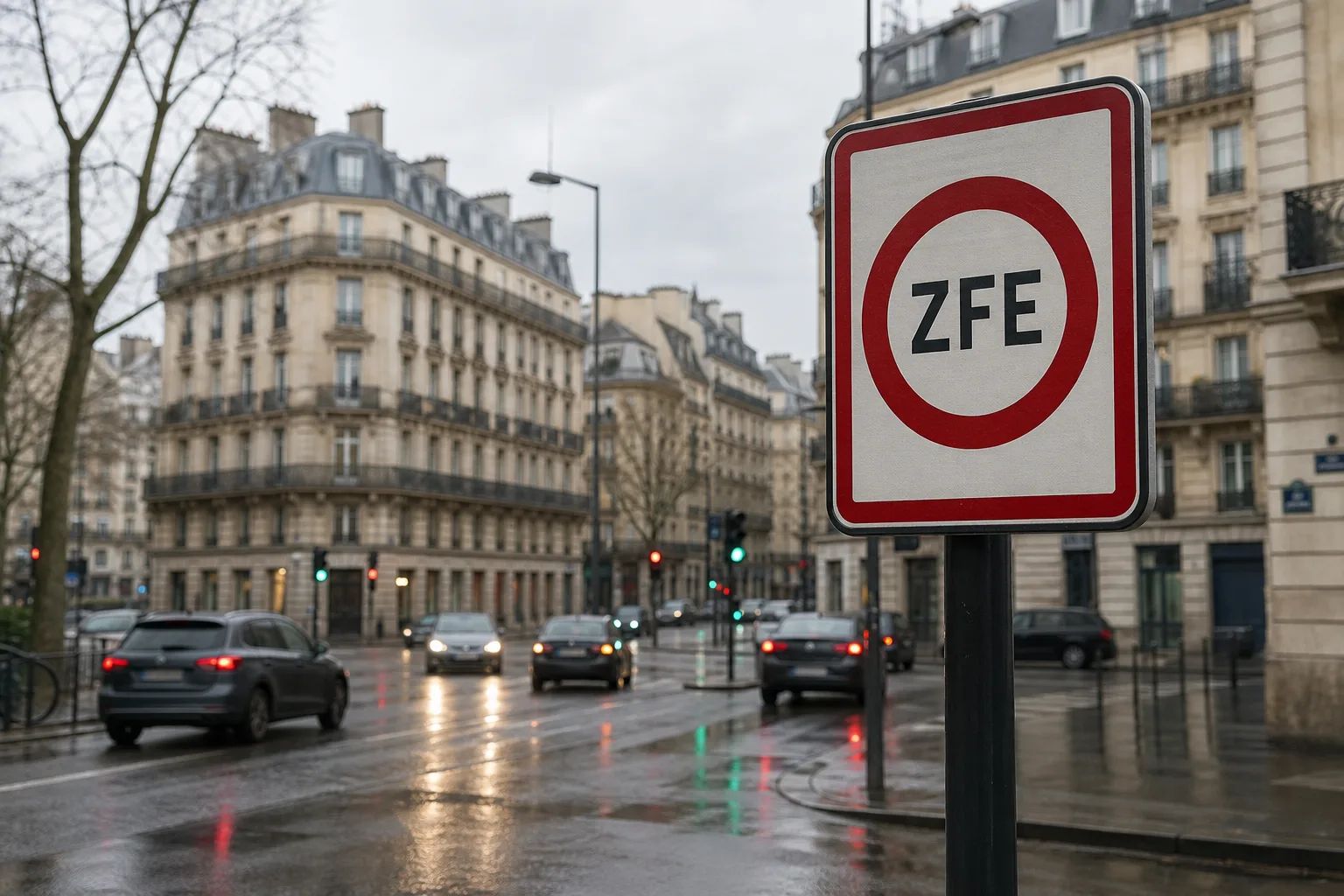
Around two dozen French urban areas run a zone à faibles émissions, and to enter one your car needs a Crit’Air sticker on the windscreen. The sticker classifies the vehicle from E (electric and hydrogen) through classes 1 to 5, based on fuel type and Euro standard. There is no option to buy one at a motorway services on the way in. It is ordered from the government and posted to you.
If you have seen headlines saying France scrapped its low-emission zones, that is half a story. Parliament did vote to delete them. The Conseil constitutionnel then struck the article down on 21 May 2026 in decision 2026-903 DC, on the ground that it was an unrelated rider attached to a simplification bill. The zones survived, the sticker is still required, and the enforcement has if anything got firmer.
One nuance worth holding onto: that ruling was about parliamentary procedure, not about whether the zones are a good idea. The Council explicitly did not judge the substance. A repeal could return in a properly drafted bill, so this is a rule to re-check rather than to consider settled.
Our Crit’Air sticker guide covers the classes, the real cost, the ordering timeline and how to recognise the resale sites that charge ten times the official fee.
Speed Limits, and the Rule That Is Never Signposted
French speed limits are not fixed numbers. They depend on the weather.
| Road | Dry | Rain |
|---|---|---|
| Motorway (autoroute) | 130 km/h | 110 km/h |
| Dual carriageway | 110 km/h | 100 km/h |
| Rural single carriageway | 80 km/h, or 90 where the département restored it | 80 km/h |
| Built-up area | 50 km/h | 50 km/h |
The rain limits are not announced by roadside signs. They apply automatically the moment the road is wet, and the speed cameras do not care that you were not told. Drivers in their first three years on a licence hold the lower figures permanently, in dry weather too.
The rural number is the other trap. The national default dropped to 80 km/h in July 2018, then many départements restored 90 km/h on selected roads, so the honest advice is to read the signs rather than to memorise either figure. The full picture, including how fines are calculated and how they reach a foreign keeper, is in our French speed limits guide.
Alcohol: A Lower Limit Than the UK
France sets the general limit at 0.5 g/L of blood, against 0.8 g/L in England, Wales and Northern Ireland. Drivers holding a probationary licence, which means the first three years, are held to 0.2 g/L.
The practical effect is that a measure which would be legal on the way to Folkestone can be an offence on the far side of the crossing. Our European drink-drive limits guide sets France against the rest of the continent.
How French Tolls Work
French motorways are tolled by distance, not by a windscreen sticker. There is nothing to buy before you cross the border, which is why France sits outside the vignette system entirely.
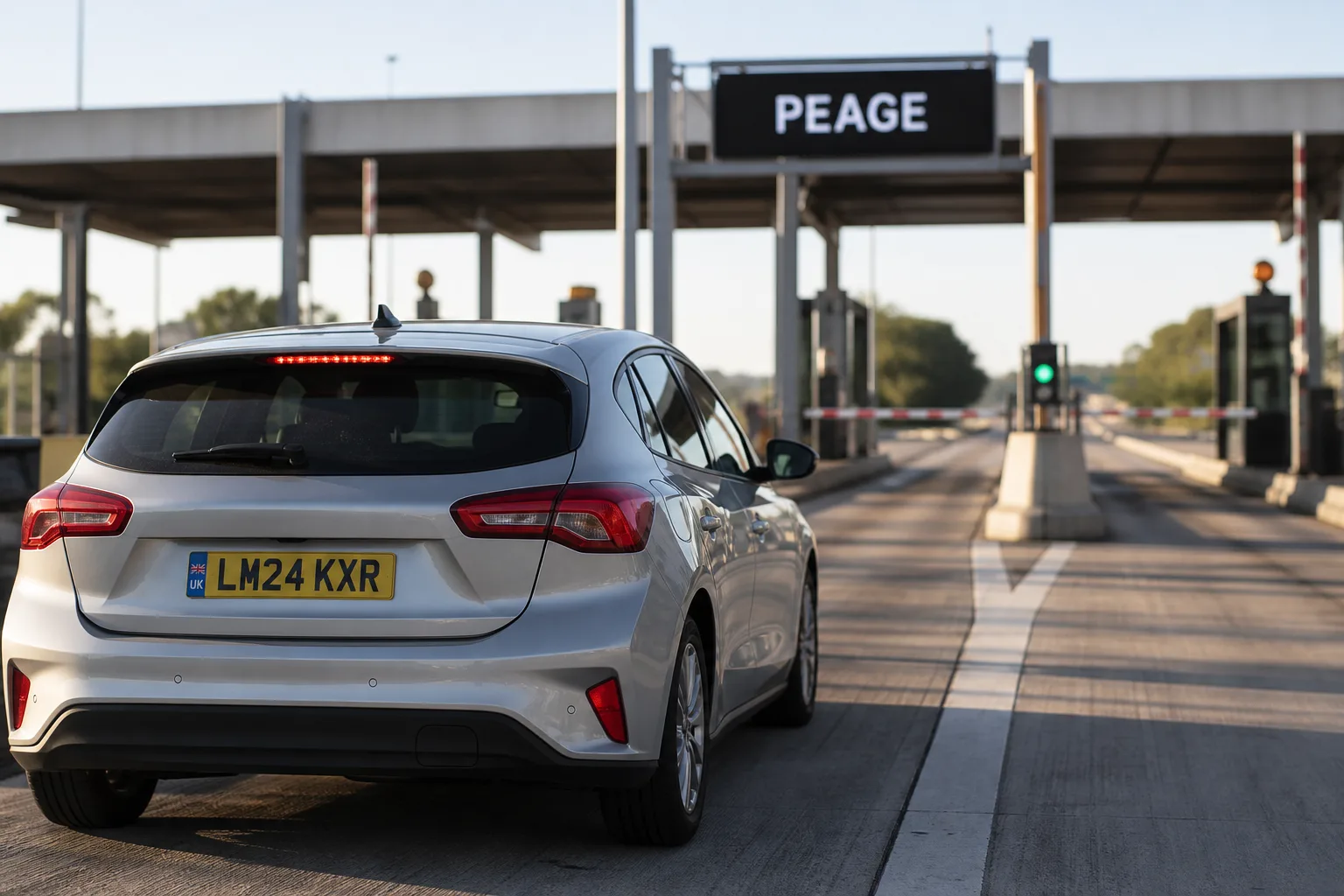
Most autoroutes run a closed system. You collect a ticket at the entry plaza, and you hand it in at the exit barrier, where the charge is worked out from the distance covered and your vehicle class. Shorter stretches sometimes use an open system with a flat charge at a single barrier and no ticket at all.
The part that surprises returning visitors is free-flow tolling. On the A79, on the A13 and A14 between Paris and Normandy, and at the Boulay-Moselle interchange on the A4, there are no barriers. Gantries read the plate and you pay afterwards. Without an electronic badge you have 72 hours to pay online or at a partner shop, and missing that window turns a small toll into a 90 euro surcharge, reduced to 10 euros if you settle within fifteen days of the notice.
Class matters more than most drivers expect. A car is class 1 up to two metres tall. Cross that height, which a roof box or a motorhome does easily, and you move into class 2 and a higher rate for the whole journey.
What Actually Catches Foreign Drivers
Rules that differ from British habits, rather than rules that are hard:
- Priorité à droite. On unmarked junctions, traffic joining from your right has priority. It survives mostly in towns and villages, and it is the single most counter-intuitive rule on French roads for a British driver.
- Headlight beam pattern. A right-hand-drive car dips its beam into the eyes of oncoming traffic. Deflectors or a headlight setting are needed, and modern cars often have a switch for it in the menu.
- UK identifier. Since 2021 the identifier is UK, not GB. If your plate does not carry a UK identifier on it, you need a UK sticker on the back of the car. Old GB stickers are no longer valid.
- Solid white lines. Crossing one is an offence in France in circumstances where UK drivers would treat it as guidance.
- Fines follow you home. France participates in EU cross-border enforcement, so a camera penalty is served on the registered keeper rather than forgotten at the border.
Driving On Past France
Very few people drive to France and stop there. France is the corridor to the Alps, to Spain, to Italy, and the moment you leave it the charging model changes completely.
Switzerland does not do distance tolls. It sells an annual vignette, it is checked at the border, and there is no per-kilometre alternative, so anyone heading for the Alpine tunnels needs the Swiss vignette before the crossing rather than after it. Austria, Slovenia, Czechia, Hungary and several others work the same way, on time rather than distance.
If your route crosses more than one of them, our vignette and toll hub shows which countries charge by time and which by distance, so the whole trip can be sorted in one sitting instead of country by country at the roadside.
Planning a wider European trip rather than a French one? The driving in Europe requirements checklist covers the documents and equipment that travel with you across every border.
The Short Version
Pack the licence, the V5C and the insurance evidence, and keep them in the cabin. Carry a warning triangle, and keep a hi-vis vest where you can reach it from the driver’s seat. Skip the breathalyser, which stopped being a requirement in May 2020. Order a Crit’Air sticker well before you leave if a city is anywhere on the route, because the low-emission zones survived the 2026 repeal attempt and there is no way to buy one on arrival.
Then remember that the limits drop when it rains, that the person on your right may have priority, and that the toll barrier is going to size up your roof box.
Frequently Asked Questions
What do I need to drive in France from the UK?
Your full driving licence, the V5C registration document, proof of insurance, a warning triangle and a high-visibility vest. Add a Crit’Air sticker if you plan to enter a low-emission zone, and headlight deflectors if the car is right-hand drive. No International Driving Permit is required for a visit.
Do I need a breathalyser to drive in France?
No. The requirement was removed from the code de la route by décret n° 2020-605 of 18 May 2020, in force from 22 May 2020. Any guide still listing a breathalyser kit as mandatory is out of date.
Do I need a Crit’Air sticker for France?
Only to enter a low-emission zone, but those zones cover most of the larger cities including Paris and Lyon. The sticker is ordered from the French government and posted out, so it has to be arranged before you travel rather than on arrival.
Were French low-emission zones abolished in 2026?
No. Parliament voted to remove them, but the Conseil constitutionnel struck that article down on 21 May 2026 as an unrelated legislative rider. The zones and the Crit’Air requirement remain in force.
What is the speed limit on French motorways?
130 km/h in dry conditions and 110 km/h in the rain. Drivers in their first three years hold the 110 figure in all weather. The reduced wet-weather limits are not signposted.
Is a UK licence valid in France?
Yes, for visits. A full UK licence is accepted and no International Driving Permit is needed. Residence is a different matter and involves exchanging the licence.
Do I still need a GB sticker for France?
No. The identifier changed to UK in 2021. If your number plate does not already show a UK identifier, you need a UK sticker on the rear of the vehicle. GB stickers are no longer valid.
How do French motorway tolls work?
By distance. You take a ticket when you join most autoroutes and pay at the exit barrier according to distance and vehicle class. Some newer roads have no barriers at all and read your plate instead, and those must be paid within 72 hours.
Will a French speeding fine reach me in the UK?
France uses camera enforcement heavily and participates in cross-border enforcement arrangements, so penalties are served on the registered keeper rather than dropped at the border.
Sources
- Code de la route, article R234-7 (version in force since 22 May 2020, amended by décret n° 2020-605)
- Code de la route, article R416-19 (warning triangle and high-visibility vest)
- Sécurité Routière: speed regulations
- ONISR: traffic speeds and reduced limits
- Conseil constitutionnel, décision n° 2026-903 DC of 21 May 2026
- Certificat qualité de l’air (Crit’Air), official ordering site
- gov.uk: displaying number plates and the UK identifier
- Your Europe: road rules and safety in France
Ramis Kalkan
Ramis Kalkan leads growth at Vignetim. He writes about everything that makes European road trips smoother, from digital vignettes to eSIMs. Based in Ankara, usually mid-way through planning his next drive.