Winter Tyres Finland: Rules, Fines and Foreign Cars
Finland’s winter tyre law is not a blanket ban on summer rubber. It is a five month window that switches on only when the weather asks for it, with a separate regime for vans, lorries and trailers, and no exemption for a foreign plate.
 Ramis Kalkan
Updated: 10 min read
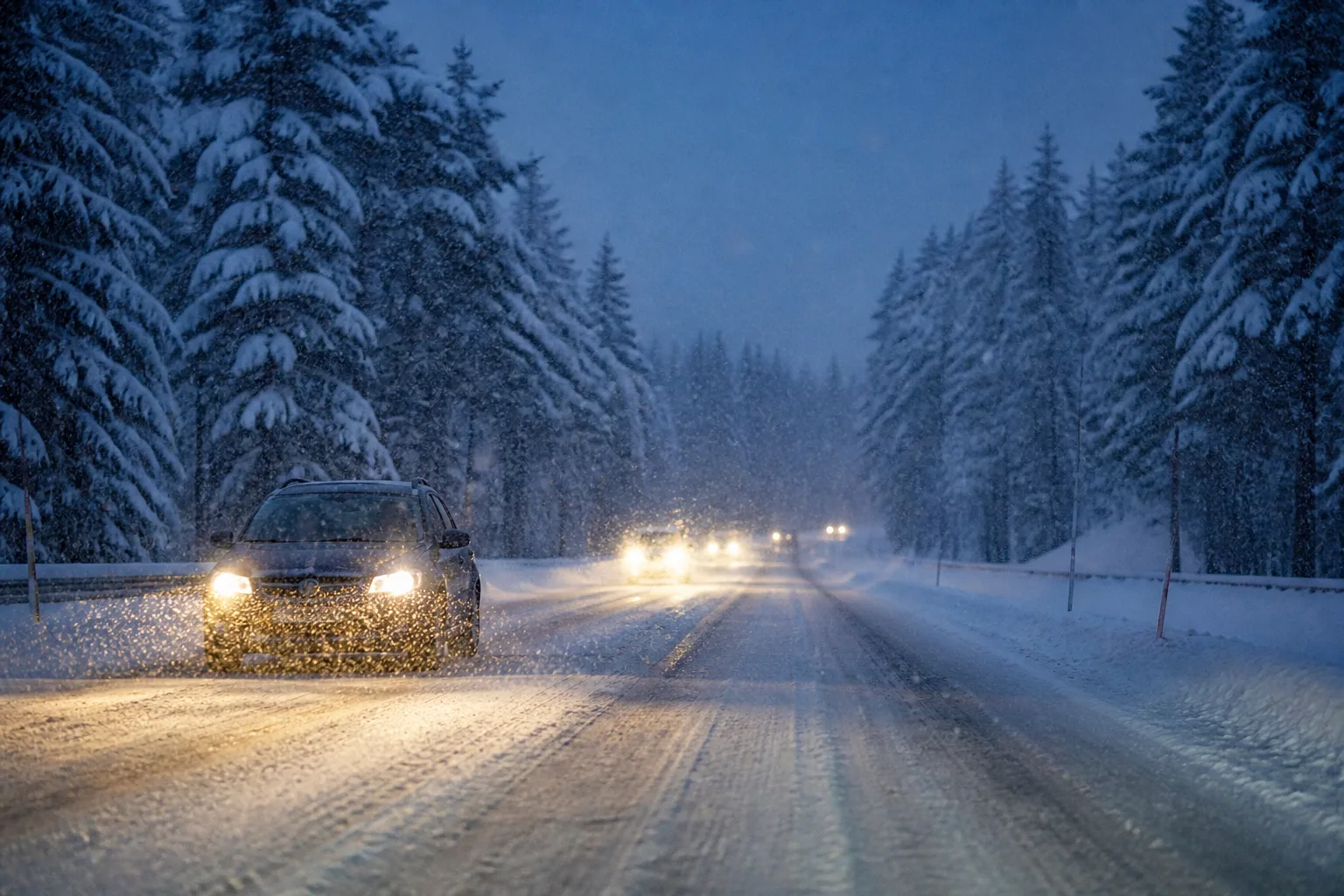
Yes, Finland requires winter tyres on cars and vans. The duty runs for five calendar months, from 1 November to 31 March, but it only switches on “if weather or road conditions require it.” There is no hard mid-winter block on summer tyres. Get caught without proper winter rubber when conditions demand it, and the fine is a fixed 100 EUR, whether the plate on your car is Finnish or foreign.
That trigger phrase changes how to read every other rule here. Finland does not ban summer tyres for five months straight. It requires you to be ready for winter, and leaves the judgement of “ready” to the actual road in front of you.
This guide covers the statute, how vans and lorries differ from cars, the tyre marking Finnish law actually names, snow chains, studded tyres, and the foreign-driver question in its own section. For how these rules compare across the continent, see our guide to winter tyre rules across Europe. If your route continues past Finland, most European trips also involve a toll or a vignette somewhere on the road, so check vignettes and tolls across Europe before you leave.
Do You Need Winter Tyres in Finland? The Law for Cars and Vans
The duty sits in Finland’s Road Traffic Act, Tieliikennelaki 729/2018, section 105 (“Talviaikana käytettävät renkaat”, tyres used during wintertime). It covers passenger cars up to 3.5 tonnes, vans, special-purpose cars up to 3.5 tonnes, motorcycles, mopeds, tricycles and quadricycles, and trailers over 0.75 tonnes and up to 3.5 tonnes when towed by any of these.
The window is the five named months: November, December, January, February and March. Inside it, the statute sets no unconditional mandate. It requires winter tyres only “jos sää tai keli sitä edellyttää” (if weather or road conditions require it). Drive a dry, salted, ice-free stretch in early November on summer tyres, and you are not automatically breaking the law. Drive the same stretch after the first snowfall, and you are.
Three narrow exemptions exist: transfers of 20 kilometres or less for manufacture, import, trade, repair, inspection or homologation; museum-vehicle events; and vehicles for which no winter tyre is available, which run a coarse-pattern winter-suitable tyre instead.
Vans, Lorries, Buses and Trailers: Where the Rules Differ
Heavy vehicles get their own paragraph, and missing it is a common mistake. Section 105, second paragraph, covers lorries, buses, cars and special-purpose cars over 3.5 tonnes, and tractors with a structural speed above 60 km/h. These need winter tyres of at least 5.0 mm on drive axles, excluding steering-drive axles, during the same window and the same weather trigger. Other axles, and every axle on a trailer it pulls, need only 3.0 mm. One exception: a tractor and trailer combination with a maximum permitted road speed of 60 km/h or lower falls outside this heavy-vehicle rule entirely.
Motorhomes are not named as their own category anywhere in the statute or the Traficom regulation. The reasonable reading is that a motorhome follows the van or lorry bracket matching its registered mass, but Finland’s published rules do not spell this out, so treat it as an inference, not a quoted rule.
Which Tyre Marking Counts, and the Tread Depth Numbers
Finnish law does not accept just any tyre labelled “winter.” Traficom regulation TRAFICOM/420043/03.04.03.00/2019 defines the legal winter tyre for cars, vans and special vehicles up to 3,500 kg, plus O2-class trailers, as one approved to demanding winter conditions under UNECE R117, R109 or R108 and marked with the 3PMSF alpine snowflake symbol, or an off-road-approved tyre marked POR (Professional Off Road), or a studded tyre. The same standard applies to cars and buses over 3,500 kg. An all-season tyre counts only if it physically carries the 3PMSF mark; the word “all-season” on the sidewall is not enough on its own.
Motorcycles and mopeds get a lighter definition: a “winter-suitable, coarse-pattern tyre,” with no 3PMSF or stud requirement.
A plain M+S mark, without 3PMSF, used to qualify under a transitional allowance that ended on 30 November 2024 for cars, vans, special vehicles, lorries and buses. Since 1 December 2024, a plain M+S tyre is no longer a legal winter tyre in Finland for those categories. O2-class trailers keep the M+S allowance until 30 November 2029.
On tread depth, keep two numbers apart. Section 104 sets a general, year-round minimum for every tyre: 1.6 mm, or 1.0 mm for motorcycles and moped trailers, not applying to vehicles with a maximum speed of 40 km/h or less. Section 105 sets a winter-specific minimum that applies only while the seasonal duty is live: 3.0 mm for cars, vans, special vehicles, motorcycles, mopeds, tricycles and quadricycles, rising to 5.0 mm on heavy-vehicle drive axles.
Snow Chains and Studded Tyres in Finland
Section 106 permits fitting studs, chains or an equivalent anti-skid device, provided they do not substantially damage the road surface, so chains are lawful in general terms. What chains cannot do is stand in for the legal definition of a winter tyre on an ordinary car or van; Traficom’s regulation defines that by the 3PMSF, POR or stud marking alone. Chains as a stand-alone qualifying device are confirmed only for fast tractors and for tricycles or quadricycles when a suitable tyre is not generally available, not for ordinary cars. Finland’s published rules describe no mandatory chain zone, carry-only duty, or dedicated chain road sign.
Studded tyres are permitted on cars, motorcycles, mopeds, tricycles, quadricycles, fast tractors and vehicles they tow, from 1 November to 31 March. Outside that window, they may still be used only in five defined situations: emergency vehicles, defence-forces off-road vehicles, road-maintenance vehicles, short transfers for trade or repair, and any listed vehicle when weather or road conditions genuinely require it. It is a closed list, not an open discretion.
If the towing car runs studded tyres, a towed trailer of 0.75 to 3.5 tonnes must itself run winter tyres. Studs go on all wheels, except one wheel of a dual pair, and stud counts across tyres must not differ enough to create a hazard. Finland’s statute and Traficom regulation publish no speed cap for studded-tyre driving, so do not repeat one if you read it elsewhere; the authorities have simply not set that figure. One local mechanism does exist: traffic sign C48 bans studded-tyre driving on a specific marked road, with a single exception for reaching a roadside property with no other access.
Foreign-Registered Vehicles: The Same Rule, No Exemption
This is the question most drivers actually search for, and Finland’s answer is short. Traficom states plainly that foreign-registered vehicles must follow the same winter tyre rules as domestic ones. The statute backs this up by contrast: sections 104 to 106 contain no foreign-plate carve-out, while the neighbouring section 103 expressly exempts a foreign-registered vehicle from a slow-vehicle plate duty. Finland’s lawmakers write an exemption where they intend one, and did not write one for tyres. The 100 EUR fee applies to a foreign plate on exactly the same basis as a Finnish one.
Driving into Finland from Sweden or Norway, do not assume the rules line up across the border. Check our guides to winter tyres in Sweden and winter tyres in Norway first, because the calendar windows and the studded-tyre conditions are not identical in all three countries.
The Fine for Driving on the Wrong Tyres
Section 171 sets a fixed liikennevirhemaksu, a traffic-violation fee, of 100 EUR for intentionally or negligently breaching the tyre rules in sections 104 to 106. A moped rider pays 40 EUR instead. If a fee covers two or more breaches at once, section 160 adds a further 40 EUR on top of the most severe breach’s fee, and a minor breach may draw a caution instead.
Unlike some neighbouring countries, Finland does not split this into an early-payment amount and a higher statutory ceiling. It is one fixed figure. Finland’s published sources do not cover a roadside power to immobilise a car on the wrong tyres, or how an insurer treats a crash on non-compliant tyres, so this guide will not guess at either.
Traps: What Other Guides Get Wrong About Finland
A few mistakes turn up often enough to name directly.
- Citing section 104 as the winter tyre law. That section covers general tread and tyre condition. The winter tyre duty itself is section 105.
- Claiming heavy vehicles have no winter tyre rule in Finland. Section 105, second paragraph, is a full regime with its own 5.0 mm figure for drive axles.
- Treating M+S as still valid for cars. That allowance for cars, vans, lorries and buses closed on 30 November 2024. Only 3PMSF, POR or studs qualify now, apart from O2 trailers, which keep M+S until 2029.
- Merging the two tread-depth numbers. 1.6 mm is the year-round minimum; 3.0 mm is the separate winter-specific minimum, live only during the seasonal duty.
- Assuming chains substitute for winter tyres on an ordinary car. They do not; the legal winter tyre is defined by its marking, not by chains in the boot.
- Inventing a stud speed limit or a municipal stud fee. Neither appears in Finland’s statute or its regulation. Say plainly that it is not published, rather than filling the gap with a plausible-sounding number.
The Short Version
Finland’s winter tyre law is a five-month window, 1 November to 31 March, that bites only when weather or road conditions call for it, not a fixed calendar ban on summer tyres. Cars and vans need 3.0 mm on a 3PMSF, POR or studded tyre; heavy vehicles need 5.0 mm on their drive axles. Chains are legal to fit but do not replace the marking requirement. Studded tyres run the same window with a closed list of outside-window exceptions. None of this changes for a foreign plate, and the 100 EUR fee applies equally to visitors and residents.
Frequently Asked Questions
Do I need winter tyres in Finland?
Yes, for cars and vans, from 1 November to 31 March, but only when weather or road conditions actually require it (Tieliikennelaki 729/2018, section 105).
What is the winter tires law in Finland for tread depth?
At least 3.0 mm while the seasonal duty is live, 5.0 mm on heavy-vehicle drive axles. A separate year-round minimum of 1.6 mm applies to every tyre under section 104.
Are studded tyres legal in Finland?
Yes, on cars, motorcycles, mopeds, tricycles, quadricycles and fast tractors, from 1 November to 31 March, with five defined exceptions outside that window. No speed cap is published.
Can I use snow chains instead of winter tyres in Finland?
Fitting chains is legal, but chains do not satisfy the legal definition of a winter tyre for an ordinary car. That definition rests on the 3PMSF, POR or stud marking.
Do foreign-registered cars need winter tyres in Finland?
Yes. Traficom states foreign-registered vehicles follow the same rules as Finnish ones, and the statute writes no foreign-plate exemption for tyres, unlike a neighbouring section that exempts foreign plates from a different duty.
What is the fine for not having winter tyres in Finland?
A fixed 100 EUR liikennevirhemaksu, or 40 EUR for a moped rider, under section 171, plus 40 EUR more if the fee covers two or more breaches at once.
Do trucks and buses need special winter tyres in Finland?
Yes. Lorries, buses, vehicles over 3.5 tonnes, and tractors with a structural speed above 60 km/h need winter tyres of at least 5.0 mm on their drive axles during the same window, if conditions require it.
Is a plain M+S tyre still legal in Finland?
Not for cars, vans, lorries or buses. That transitional allowance closed on 30 November 2024. Only a 3PMSF, POR or studded tyre now satisfies the winter tyre definition for those vehicles. O2-class trailers keep the M+S allowance until 30 November 2029.
Sources
Ramis Kalkan
Ramis Kalkan leads growth at Vignetim. He writes about everything that makes European road trips smoother, from digital vignettes to eSIMs. Based in Ankara, usually mid-way through planning his next drive.