eSIM Compatible Phones: Every Model That Supports eSIM
If your phone is newer than 2018, it almost certainly supports an eSIM. The model list by manufacturer, plus the 30-second dial-code check for your own device.
 Ramis Kalkan
Updated: 7 min read
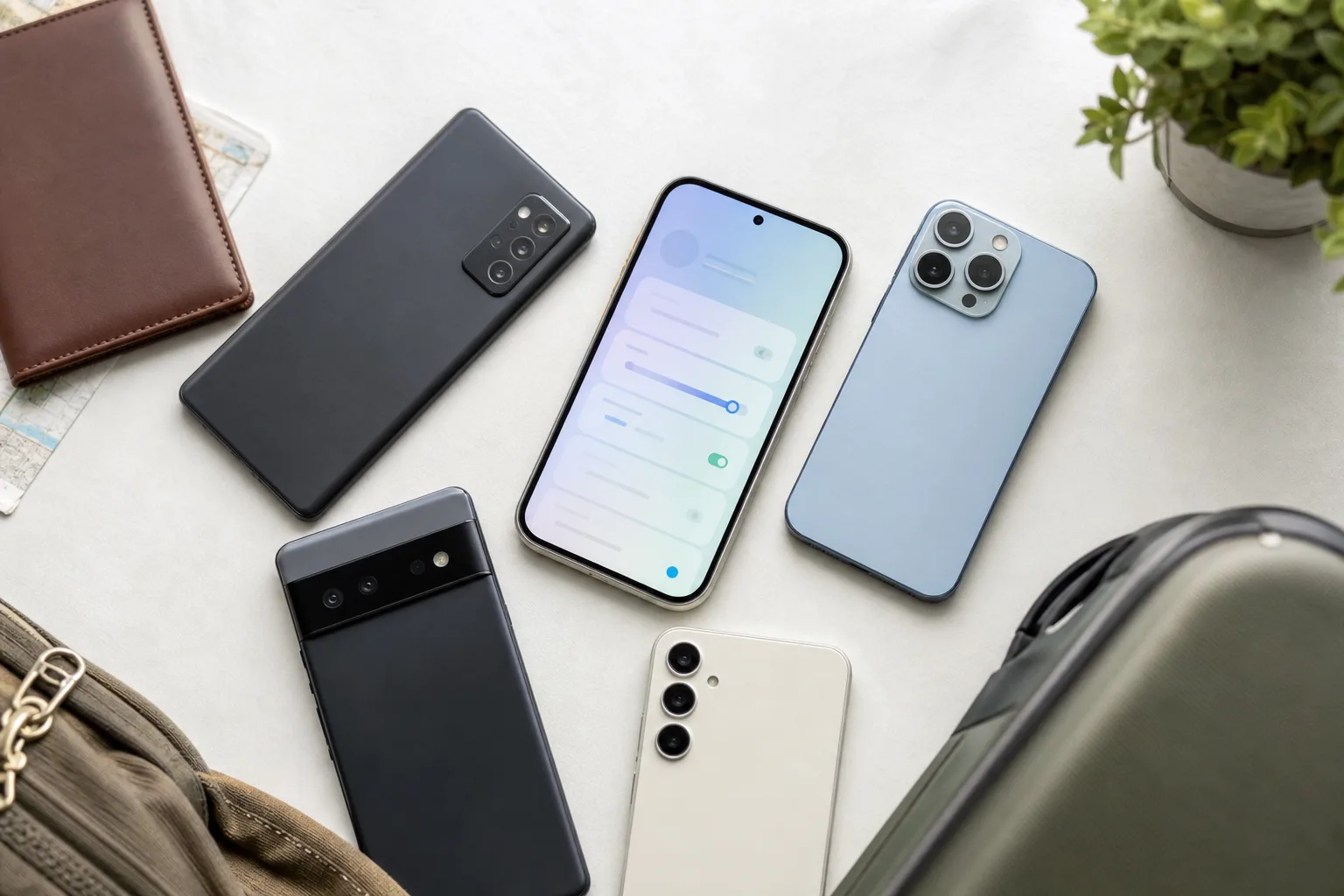
Almost every smartphone from the last few years supports an eSIM. The rule of thumb is simple. All iPhones since the iPhone XS and XR (2018) support eSIM. So do Samsung Galaxy models from the S20 series onwards. The same goes for every Google Pixel since the Pixel 3, plus 200-plus models from Xiaomi, Motorola, Sony, and other brands. The 30-second check for your own phone: dial *#06#, and if an EID appears alongside the IMEI, your phone supports eSIM.
Compatibility is the first question of every travel eSIM purchase. It is also the annoying one to get wrong. A plan bought for an incompatible or carrier-locked phone is money spent on nothing. This list settles it by manufacturer. It also shows the quick self-check and one extra condition, an unlocked phone, that trips travellers up.
Key Takeaways
- All iPhones from the XS and XR (2018) onward support eSIM; for Samsung it starts with the Galaxy S20 series, for Google with the Pixel 3.
- The fast test: dial
*#06#. If an EID (a 32-digit eSIM identifier) appears, your phone is eSIM compatible.- A travel eSIM from another provider also needs your phone to be carrier-unlocked, not just eSIM capable.
- European iPhones keep the physical SIM tray alongside eSIM (dual SIM); only US models went eSIM-only.
- When in doubt, the settings menu answers it: if “Add eSIM” appears, you’re ready.
How to Check if Your Phone Supports eSIM
The fastest route is the dial code. Open the phone app and dial *#06#. If an EID appears next to the IMEI numbers, a 32-digit eSIM identity code, the phone has an eSIM chip. No EID, no eSIM.
The settings route works too:
- iPhone: Settings › General › About, scroll to “EID”. Or Settings › Mobile Service › Add eSIM.
- Samsung and most Android phones: Settings › Connections › SIM manager › Add eSIM.
- Google Pixel: Settings › Network & internet › SIMs › Add SIM › Download a SIM instead.
If your phone offers to add an eSIM, it supports one. What happens when you install a profile is covered in our guide to how an eSIM works. The rest of our connectivity guides take it from there.
Where eSIM Support Starts, by Brand
| Manufacturer | eSIM compatible from |
|---|---|
| Apple iPhone | iPhone XS, XS Max, XR (2018) |
| Apple iPad | “Wi-Fi + Cellular” models from 2018 |
| Samsung Galaxy | Galaxy S20 series |
| Google Pixel | Pixel 3 |
| Xiaomi | Xiaomi 12T Pro |
| Motorola | Razr (2019) and the Edge series |
| Sony | Xperia 1 IV |
| OnePlus | OnePlus 11 |
(List verified July 2026; new releases from these brands ship eSIM-capable.)
eSIM Compatible iPhones and iPads
Apple introduced eSIM with the iPhone XS in 2018, and every iPhone since supports it. One detail matters for European buyers. iPhones sold in Europe keep the nano-SIM tray. They add eSIM as a second line (dual SIM). Only US-market iPhones dropped the physical tray entirely.
iPhones with eSIM:
- iPhone XS, XS Max, XR
- iPhone 11, 11 Pro, 11 Pro Max
- iPhone SE (2nd and 3rd generation)
- iPhone 12, 12 mini, 12 Pro, 12 Pro Max
- iPhone 13, 13 mini, 13 Pro, 13 Pro Max
- iPhone 14, 14 Plus, 14 Pro, 14 Pro Max
- iPhone 15, 15 Plus, 15 Pro, 15 Pro Max
- iPhone 16e, 16, 16 Plus, 16 Pro, 16 Pro Max
- iPhone Air, iPhone 17, 17 Pro, 17 Pro Max
iPads with eSIM (the cellular line of eSIM supported devices, only “Wi-Fi + Cellular” models): iPad 8th and 10th generation, iPad mini 5th and 6th generation, iPad Air 3rd to 5th generation plus the M2 models, and the current 11-inch and 13-inch iPad Pro.
eSIM Compatible Samsung Phones
Samsung’s eSIM support begins with the Galaxy S20 series. Every later flagship, the foldables, and part of the mid-range A series include it:
- Galaxy S: S20, S21, S22, S23, S24, S25, and S26, including the Plus, Ultra, FE, and Edge variants
- Galaxy Z (foldables): Z Flip through Z Flip7, and Z Fold2 through Z Fold7
- Galaxy Note: Note20 and Note20 Ultra
- Galaxy A (mid-range): A23 5G, A35, A36, A54, A55, A56
eSIM Compatible Google Pixel Phones
Google moved early: the Pixel 3 already supports eSIM, and every Pixel since is compatible, from the budget a-models to the folds:
- Pixel 3, 3 XL, 3a, 3a XL
- Pixel 4, 4 XL, 4a, 4a 5G
- Pixel 5, 5a, 6, 6 Pro, 6a
- Pixel 7, 7 Pro, 7a, 8, 8 Pro
- Pixel 9, 9 Pro, 9 Pro XL, 9a, 9 Pro Fold
- Pixel 10, 10 Pro, 10 Pro XL, 10 Pro Fold
- Pixel Fold
Other eSIM Compatible Phones: Xiaomi, Motorola, Sony, and More
Beyond the big three, most manufacturers now ship eSIM in their upper and mid ranges:
| Manufacturer | eSIM compatible models (selection) |
|---|---|
| Xiaomi / Redmi / Poco | Xiaomi 12T Pro, 13, 13T, 14, 14T, 15, 15T (incl. Pro and Ultra), Redmi Note 13/14 Pro series, Poco X7, Poco F8 Ultra |
| Motorola | Razr series (through Razr 60 Ultra), Edge 40 and Edge 60 (incl. Pro/Neo/Fusion), Moto G53, G54 |
| Sony | Xperia 1 IV, 1 V, 1 VII, 5 IV, 10 IV, 10 VI |
| OnePlus | OnePlus 11, 12, 13R, 13T, 15 |
| Nothing | Phone (3), Phone 3a Pro |
| Oppo | Find X3 Pro through Find X9 Pro, Find N2 Flip, Find N5, Reno14 and Reno15 series |
| Honor | Magic4 Pro through Magic8 Pro, Honor 90, Honor 400 |
| Huawei | P40, P40 Pro, Mate 40 Pro |
| Vivo | X90 Pro, X100 Pro, X200 series, X300 series, V29, V40, V50 |
| Nokia (HMD) | G60 5G, X30 5G, XR21 |
| Others | Fairphone 4, Gigaset GX4 Pro, TCL NxtPaper series, Realme 14 Pro+, Realme GT 7, ZTE nubia Flip2 |
One caution: Huawei models run without Google services, and eSIM setup can work differently there. Check the device’s own flow before buying a travel plan for one.
The Second Condition: An Unlocked Phone
An eSIM-capable phone isn’t automatically ready for a travel eSIM. To load a profile from another provider, the phone must be carrier-unlocked. A locked phone is usually one subsidised through a contract. It blocks other providers’ profiles until the carrier removes the lock. Carriers typically do on request once the contract terms allow.
Most phones bought outright are already unlocked. Is yours eSIM compatible and unlocked? Then the travel setup is simple. Your home number stays on the physical SIM, and destination data loads as an eSIM, the split explained in our eSIM vs physical SIM comparison. For a drive through several countries, a Europe-wide eSIM covers the transit countries on one profile, with nothing to swap at borders.
The Short Version
Is your phone newer than 2018? Then it is very likely eSIM compatible. That covers iPhone XS onward, Galaxy S20 onward, Pixel 3 onward, plus most recent models from every major Android brand. Confirm it in 30 seconds with *#06# and a look for the EID. Make sure the phone is unlocked. Then you can load a travel eSIM before the trip instead of hunting SIM cards after landing.
Frequently Asked Questions
How do I know if my phone supports eSIM?
Dial *#06# in the phone app. If an EID appears alongside the IMEI, your phone supports eSIM. You can also check the settings: an “Add eSIM” option under mobile or SIM settings means you’re compatible.
Can every phone use an eSIM?
No. The eSIM chip only appears in devices from roughly 2018 onward, and some budget models still ship without it. Older phones and a few entry-level handsets support only a physical SIM.
Do all iPhones have eSIM?
All iPhones from the XS and XR (2018) onward do, including the SE 2nd and 3rd generation. Earlier models, like the iPhone X and iPhone 8, don’t support eSIM.
Which Samsung phones support eSIM?
Samsung’s support starts with the Galaxy S20 series. All newer S, Z, and Note models are eSIM compatible. Part of the A series works too: A23 5G, A35, A36, A54, A55, and A56.
Does my phone need to be unlocked for a travel eSIM?
Yes. A carrier lock blocks profiles from other providers regardless of eSIM capability. Phones bought outright are usually unlocked; contract phones can be unlocked by the carrier on request.
Is there a downside to using eSIM?
The main one: moving to a new phone means transferring or re-issuing the profile through the provider rather than swapping a card. For travel, the advantages, instant delivery and dual-SIM data, outweigh it comfortably.
Do European iPhones still have a SIM tray?
Yes. iPhones sold in Europe keep the physical nano-SIM tray and add eSIM alongside it, so you can run both at once. Only US-market iPhones dropped the tray and went eSIM-only.
Can I use an eSIM on an iPad?
On cellular iPads, yes: “Wi-Fi + Cellular” models from 2018 onward support eSIM data plans. Wi-Fi-only iPads have no mobile hardware at all, so no SIM of either kind.
Sources
Ramis Kalkan
Ramis Kalkan leads growth at Vignetim. He writes about everything that makes European road trips smoother, from digital vignettes to eSIMs. Based in Ankara, usually mid-way through planning his next drive.