Turkey Truck Tolls: HGS for Foreign-Plate Lorries and Trailers
For a foreign-plated truck, the expensive part of Turkish tolls is not the toll. It is the exit block at customs, the penalty ladder that runs without warning, and the trailer plate that collects fines of its own. Here is the whole picture for international fleets.
 Ramis Kalkan
Updated: 11 min read
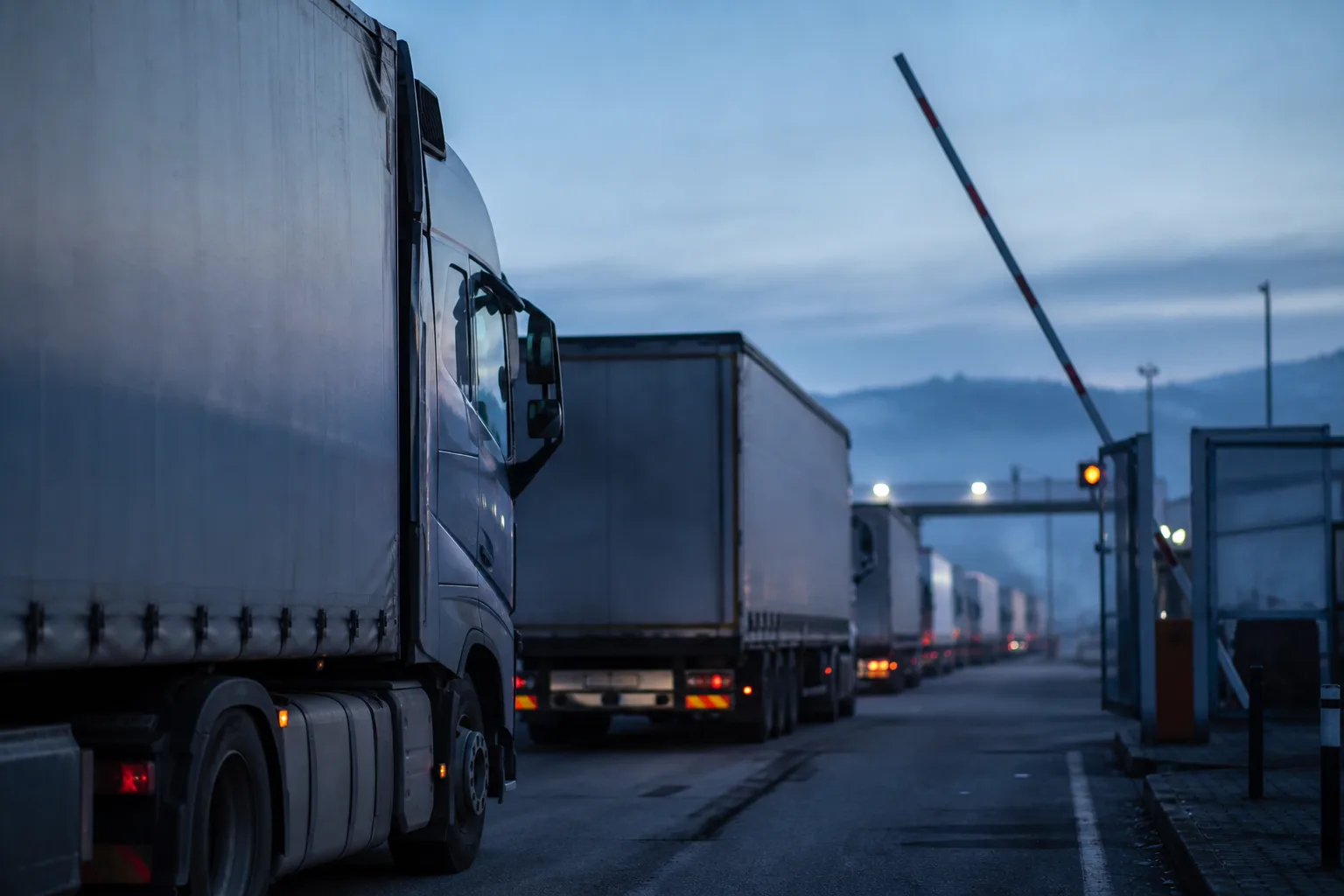
For a car, an unpaid Turkish toll is an annoyance. For a truck it is a stranded asset. Toll debt is held against the plate, it reaches the customs system, and the vehicle does not leave the country until the debt is cleared.
That single rule reorders everything else on this page. Tariffs matter less than timing, and timing matters less than making sure the account and the plates are set up before the first gantry.
Key Takeaways
- Unpaid toll debt is visible plate by plate at customs, and the vehicle is not permitted to exit Turkey until it is paid (Law 6001, art. 8).
- Foreign plates are excluded from the advance-notice guarantee before the fourfold penalty (art. 30).
- Class is set by the total axle count of tractor and trailer together, not by the tractor alone.
- The trailer carries its own plate and can collect violation records in its own name.
- A single class 5 crossing can cost more than 5,000 TL, so balance thresholds built for cars fail immediately.
Why an Unpaid Toll Keeps the Truck in Turkey
Turkish law routes unpaid toll debt through three institutions before it reaches the border:
- The General Directorate of Highways records the unpaid crossing.
- The debt passes to the Ministry of Treasury and Finance.
- It appears plate by plate in the Ministry of Trade system, which customs checks on exit.
Article 8 of Law 6001 is explicit about the consequence. Until the debt is collected, the customs administration does not permit the vehicle to leave the country. Collection is meant to happen through domestic payment channels first, which is the polite way of saying that the border is the last place you’d want to discover the problem.
If it does reach the border, payment at the gates is made by bank or credit card. Cash is accepted only at the cash desks of the customs administrations’ accounting units, which is a different counter in a different building.
Since March 2025 the block also covers build-operate-transfer debts, so a balance owed on the Osmangazi Bridge, the 1915 Çanakkale Bridge, the North Marmara Motorway, or the Eurasia Tunnel holds the truck exactly the same way a state motorway debt does.
For a fleet running scheduled loads, the cost of that delay isn’t the toll. It’s the driver’s hours, the demurrage, and the load that misses its slot.
How the Penalty Ladder Reads for a Foreign Plate
The ladder has three steps and the clock starts at the crossing, not at any notification.
| Timing | What you pay |
|---|---|
| Within 15 days | The toll only. No administrative fine. |
| Days 16 to 45 | The toll plus one times the toll. No further notice is served, and the 25% early-payment discount does not apply. |
| After day 45 | The toll plus four times the toll. |
Two details in that middle row catch foreign operators. There is no separate notification at that stage, and the discount that applies to most Turkish administrative fines is specifically excluded here.
The general mechanics of the 15-day window, including how to check and pay a crossing you have already made, are covered in our guide on driving without HGS in Turkey.
No Advance Warning Is Sent to Foreign Plates
Turkish law does contain a warning obligation before the fourfold penalty. The vehicle owner is informed at least 15 days in advance by text message, email, written notice, or the state e-government portal.
That obligation carries an exclusion, added in March 2025: it applies “with the exception of foreign-plated vehicles.”
So the warning that a domestic haulier receives does not reach you. There is a second consequence too. The administrative sanction decision is deemed served on the date it is issued, not on the date any post arrives, which means the window for challenging it starts running while the paperwork is still in Turkey and you are not.
So don’t rely on notification at all. Query the plates on a schedule instead.
Class 4 and Class 5: It’s the Axle Count, Not the Vehicle
Turkish toll classes for heavy vehicles are set by axles touching the road, counting the tractor unit and the trailer together.
- Four or five axles in total puts the combination in class 4.
- Six axles or more puts it in class 5.
Buy the product for the maximum axle count the combination can reach. When an axle is lifted during a crossing, the Smart Class mechanism charges the lower class for that pass, so registering at the top of your range does not mean overpaying on lighter runs.
Getting this wrong hurts in both directions. A class defined too low means every crossing underpays and the difference can be recorded as a violation. Defined too high, you pay for capacity you are not using on the crossings where no axle is lifted. The full six-class table is in our guide to HGS vehicle classes.
The Trailer Has Its Own Plate, and Its Own Fines
This is the part almost nobody outside Turkey knows, and it produces violation records that look inexplicable from the office.
Turkish gantries do not always read the tractor plate. On some crossings the pass is identified from the trailer plate instead. Because the trailer’s plate differs from the tractor’s, and because the system sees no defined relationship between them, the crossing is recorded against the trailer as an unregistered vehicle.
Your tractor’s balance being healthy doesn’t prevent this. The system isn’t looking at the tractor.
The fix is not to buy a second HGS product for the trailer. No separate or virtual product is issued to a trailer plate at all. Instead the trailer plate is bound to the tractor’s existing product. After binding, a crossing read from the trailer plate resolves to the tractor’s account, the toll is charged there, and no violation is created.
What Binding a Trailer Plate Requires
The scheme covers corporate and foreign customer types, so an international fleet is inside its scope rather than outside it.
Conditions that have to hold together:
- The tractor plate must carry an active class 4 or class 5 HGS product.
- The trailer’s registration document must show the vehicle type as a trailer, semi-trailer, or light trailer. Other vehicle types are not accepted.
- The trailer plate must not already hold an active HGS product of its own.
- The trailer plate must not already be bound to a different tractor.
Those last two are one rule seen from both sides. A plate is either carrying its own product or bound to a tractor, never both. If the plate already has a product, cancel it or move it to another plate first. If the plate is bound elsewhere, release that binding first. This is the single most common reason a binding request is refused.
One trap deserves its own line. Cancelling the tractor’s HGS product automatically drops every trailer bound to it. After you buy a new product for that tractor, the trailers have to be bound again. Skip that step and the trailer plates start collecting violation records from the very next crossing.
A single tractor can carry more than one bound trailer plate, so a fleet that swaps trailers does not need a separate account per unit.
Sizing the Balance for a Class 5 Crossing
Balance thresholds written for passenger vehicles fail on the first heavy crossing. Under the tariffs effective 1 July 2026, a class 5 vehicle pays 5,560 TL on the 1915 Çanakkale Bridge and 3,720 TL on the Osmangazi Bridge. Class 4 pays 2,925 TL and 2,950 TL on the same two crossings.
State-operated crossings are far cheaper. The older Bosphorus bridges charge 440 TL in class 5 under the 1 January 2026 tariff, and the Yavuz Sultan Selim Bridge charges 860 TL.
Set the threshold against the most expensive crossing on the route, not the average one. A truck that runs the Çanakkale corridor needs a different floor from one that stays on the Istanbul to Ankara motorway. Tariffs are published by the General Directorate of Highways and by each concession operator, and they change on 1 January and 1 July.
Where Trucks Can’t Go: The Eurasia Tunnel and the Bosphorus
Routing in Istanbul is a class question before it is a distance question.
The Eurasia Tunnel is closed to trucks entirely. The operator’s prohibited list covers buses, lorries, articulated trucks, tractor units, and any vehicle with more than two axles, alongside a 5,000 kg weight limit and a 2.8 m height limit. Payment there is by HGS only in any case, with no cash or card alternative at the roadside. The details are in our guide to the Eurasia Tunnel.
For the Bosphorus itself, classes 2 through 5 that do not appear on the permitted-vehicle list cross on the Yavuz Sultan Selim Bridge. Plan the route through it from the start rather than discovering the restriction at the approach.
Setting It Up Before the Border
The official Turkish channels assume a Turkish national ID, a Turkish bank account, or access to the state e-government portal. A foreign operator usually has none of the three.
You do not need them. A foreign plate can be registered and funded remotely, and activation works through plate recognition rather than through a physical sticker arriving in the post. The channel comparison for single vehicles is in our guide to HGS for foreign-plated vehicles.
Register before the border crossing where you can. Registering afterwards is still possible inside the 15-day window, but it turns a routine setup into a deadline.
Before the first gantry, confirm all five:
- The tractor plate is registered and the class matches the maximum axle count.
- Every trailer plate that runs behind it is bound to that product.
- The balance covers the most expensive crossing on the route.
- The route avoids the Eurasia Tunnel and uses the Yavuz Sultan Selim Bridge for the Bosphorus.
- Someone owns the weekly plate query, for the tractor and the trailers.
Running a fleet rather than one truck Vignetim’s fleet panel manages vehicles, balances, and top-ups from a single dashboard, with a separate role for drivers. It is not limited to Turkish tolls: vignettes and tolls across twelve European countries, driver eSIM data, Green Card and travel health insurance, and Europe-wide traffic fine tracking sit in the same place. Setup takes three steps, adding each vehicle by plate and category. See the fleet management page for the scope, or open an account directly at fleet.vignetim.com. For a single foreign-plated vehicle, the HGS for Turkey page covers the app route instead. No Turkish ID, bank account, or e-government access is required.
The Short Version
The financial risk in Turkish tolls for an international fleet is not the tariff. It is the exit block. Unpaid debt sits against the plate in the customs system and the vehicle stays in the country until it clears, and since March 2025 that covers concession roads as well as state motorways.
Three operational details decide whether you ever meet that rule. Class is set by the combined axle count and the product should be bought at the top of your range. The trailer carries its own plate and needs binding to the tractor’s product, or it collects violations in its own name. Balance thresholds have to be sized against the most expensive crossing on the route, which can exceed 5,000 TL for a class 5 vehicle.
And do not wait to be told. Foreign plates are excluded from the advance-warning obligation, and the sanction decision counts as served the day it is issued. Query the plates on a schedule and the ladder never starts.
Frequently Asked Questions
Can my truck be stopped from leaving Turkey over an unpaid toll?
Yes. Unpaid toll debt is recorded plate by plate in the Ministry of Trade system, and under article 8 of Law 6001 the customs administration does not permit the vehicle to exit until it is paid. Since March 2025 this covers concession-road debts too.
How do I pay a toll debt at the border?
At customs gates, payment is by bank or credit card. Cash is accepted only at the cash desks of the customs administrations’ accounting units, which is a separate counter.
Will I be warned before the fourfold penalty?
No. The advance-notice obligation applies with the exception of foreign-plated vehicles, an exclusion added in March 2025. Nothing is sent to you.
Is my truck class 4 or class 5?
Count the axles of the tractor and trailer together. Four or five axles is class 4, six or more is class 5. Buy the product for the maximum axle count your combination reaches.
Do I need a separate HGS for the trailer?
No, and one is not issued. The trailer plate is bound to the tractor’s existing product, and the toll is always charged to the tractor’s account.
Why did my trailer get a violation when the tractor’s balance was fine?
Because the crossing was read from the trailer plate and no binding existed between the two plates. The system treated the trailer as an unregistered vehicle.
What stops a trailer plate from being bound?
An active HGS product already on that plate, or an existing binding to another tractor. A plate can be in one state or the other, never both.
What happens to bound trailers if I cancel the tractor’s product?
All of them are dropped automatically. After buying a new product for the tractor, every trailer plate has to be bound again.
Can a truck use the Eurasia Tunnel?
No. Lorries, articulated trucks, tractor units, buses, and any vehicle over two axles are prohibited, and weight and height limits of 5,000 kg and 2.8 m apply.
Can I register a foreign-plated truck without a Turkish ID?
Yes. Registration and funding work remotely and activation runs on plate recognition, so no Turkish ID number, Turkish bank account, or e-government access is needed.
Sources
Ramis Kalkan
Ramis Kalkan leads growth at Vignetim. He writes about everything that makes European road trips smoother, from digital vignettes to eSIMs. Based in Ankara, usually mid-way through planning his next drive.